
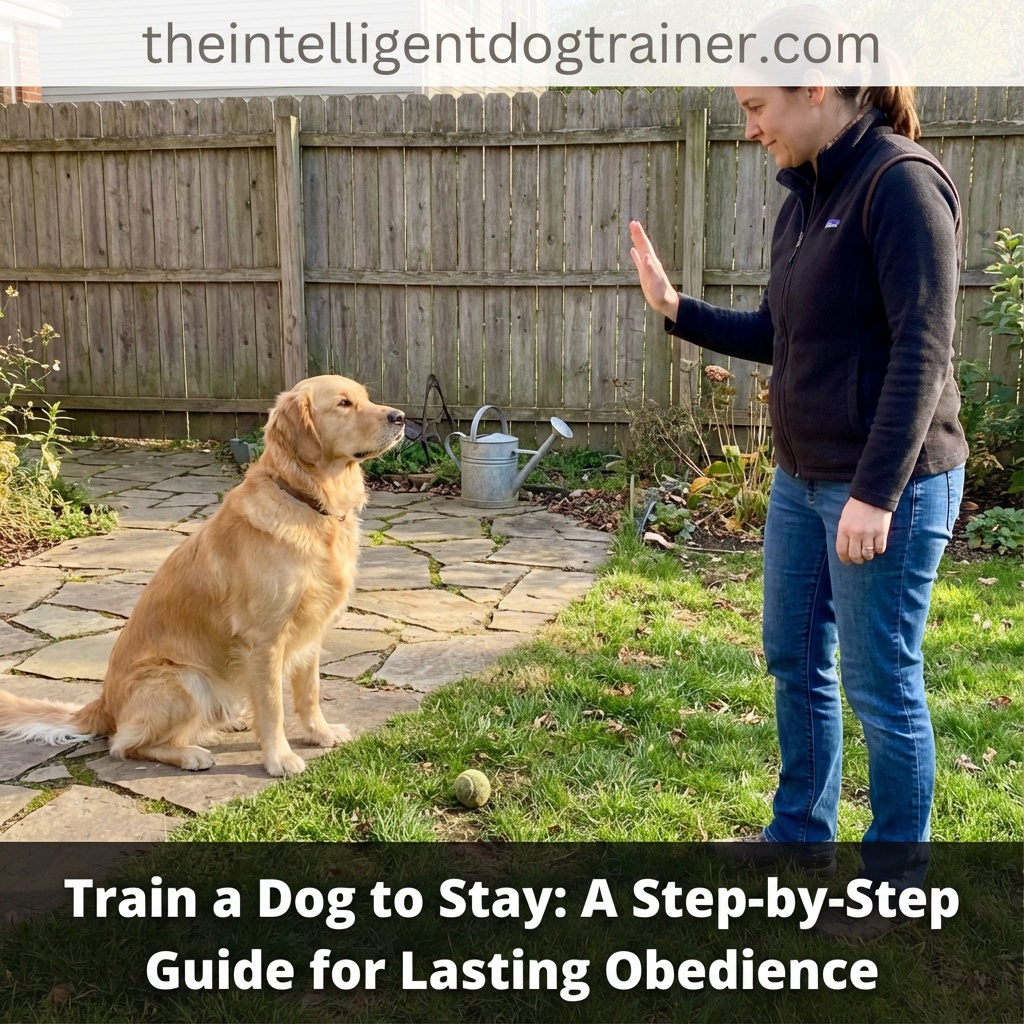
Cultivating a solid “stay” is among the most impactful gifts you can give your canine companion, acting as a fundamental pillar for both their personal safety and general manners. Far from being a mere parlor trick, a dependable stay ensures your dog remains composed and stationary in high-stakes moments, such as when navigating traffic or welcoming guests into your home.
Whether you are managing an energetic puppy or guiding a mature dog, achieving mastery over this behavior demands a blend of patience, steady consistency, and a nuance grasp of canine learning patterns. Throughout this article, we will delve into the finer points of teaching a dog the stay command, providing you with the tools to foster a level of trust and obedience that endures for years.
Introduction to teaching a dog the stay command
Entering the world of how to train a dog to stay requires an understanding that this specific cue is a profound exercise in impulse control. While actions like sitting or lying down are active physical postures, the stay is defined by the absence of movement—a mental challenge that can be particularly taxing for high-energy breeds.
Many pet parents find themselves asking, “Is it better to teach ‘stay’ from a sit or a down position?” Generally speaking, a down position offers more physical stability for longer stretches, yet the sit remains an excellent choice for quick, everyday transitions.
At the start, your goal is essentially to reward your dog for the art of doing nothing at all. This perspective is vital to how to train a dog with real success, as it pivots the focus from physical movement to sustained mental concentration.
It is best to keep your sessions brief and always conclude on a high note. If you are wondering, “How many times a day should we practice the stay command?”, aim for two or three short bursts of training, lasting about five to ten minutes each. This cadence prevents mental burnout and keeps the experience engaging for your pet.
How to teach a puppy to stay from the very first day
Bringing a new puppy home often sparks the question, “At what age can I start teaching my dog to stay?” Surprisingly, you can begin laying the groundwork as early as seven or eight weeks of age.
Although puppies are famous for their fleeting attention spans, their minds are incredibly receptive to new cues during this window. “How long should a puppy hold a stay in the beginning?” In these initial steps, even a brief two-second hold should be celebrated as a significant milestone.
Guiding a young dog is deeply intertwined with properly socializing a puppy alongside their formal education. A puppy that feels secure and confident in its surroundings will naturally find it easier to remain still and calm.
Start your practice in a quiet, familiar room to minimize distractions and set them up for a win. Use high-value rewards to capture the precise moment they hold their position. As noted on Wikipedia, positive reinforcement stands as the most reliable method for cementing these habits during a dog’s formative months.
Essential dog training stay command steps for beginners
To see real progress, it helps to follow a logical series of dog training stay command steps. Begin by asking your dog to sit comfortably. Present an open palm toward their nose and give the verbal cue “stay.”
Wait just a single second, then offer a reward. New handlers frequently ask, “What is the best hand signal for the stay command?” Professional trainers usually favor an open, flat palm facing the dog—much like a “stop” sign. This clear visual signal provides an extra layer of communication.
As your dog becomes more proficient, you can slowly introduce the “Three Ds”: Distance, Duration, and Distraction. This methodical layering is a core component of the advanced dog training techniques utilized by experts.
If you find yourself frustrated and asking, “Why does my dog keep breaking the stay command?”, it is often a sign that one of those Three Ds was increased a bit too quickly. Regarding rewards, “Should I use treats every time my dog stays successfully?” In the beginning, yes. However, once the behavior is reliable, you can transition to an intermittent schedule to keep them motivated without relying on food every single time.
Understanding the difference between the stay and wait commands
A frequent source of confusion in the training world is the stay vs wait command dogs distinction. Many owners ask, “What is the difference between the ‘stay’ and ‘wait’ commands?”
Look at a “stay” as an absolute commitment; the dog must remain in place until you return to their side and provide a specific release word. Conversely, a “wait” is a more casual, temporary pause—often used at a doorway or before crossing a street—where the dog expects to move forward or follow you shortly after.
Clarifying these two concepts is essential for safety, particularly when transitioning to how to train a dog to come later in your journey. While a “wait” serves as a boundary marker, a “stay” is a rock-solid promise to remain in one spot.
A common follow-up question is, “How do I teach my dog to stay while I walk away?” You achieve this by taking just one small step backward and immediately returning to reward them, reinforcing the idea that your movement is not an invitation for them to move.
Using a clear release word for dog training success
The release word for dog training acts as the definitive “finish line” for your dog’s task. Without a distinct word such as “Okay,” “Free,” or “Release,” your dog is left to guess when the job is done, which inevitably leads to inconsistent performance.
“What should I do if my dog gets up before the release word?” Avoid the urge to scold. Simply reset them calmly into their starting position and try again, perhaps making the duration slightly easier to ensure they succeed.
Implementing a consistent release word is also remarkably effective when addressing other habits, such as learning how to stop a dog from jumping on visitors. By only offering the release word when your dog is composed, you reinforce the lesson that rewards are the result of patience.
Clear communication ensures your dog never feels anxious about their expectations, making the entire training process more transparent and rewarding for you both.
Proofing the stay behavior against common distractions
Once your dog has the basics down in a quiet setting, the focus shifts to proofing the stay behavior. This involves practicing in more dynamic environments, like a local park, near other animals, or while a ball is being bounced nearby.
As discussed in entries regarding Wikipedia, dogs do not always generalize behaviors easily; a “stay” in your quiet kitchen doesn’t instantly translate to a “stay” at a busy park.
Proofing is the secret ingredient for maintaining composure during outdoor adventures, such as when you train a dog to walk on a leash without them lunging at every passing squirrel. Start with mild distractions—perhaps a squeaky toy in the corner—and gradually work up to more intense environments.
By consistently reinforcing the command across various scenarios, you ensure that your dog’s obedience is functional in the messy reality of the world, not just within the safety of your living room.
To summarize, teaching your dog to stay is a process of steady, incremental growth. By utilizing clear steps, distinguishing between “stay” and “wait,” and committing to a consistent release word, you create a foundation of reliability.
Keep in mind that proofing the behavior across different settings is what truly makes the command functional and keeps your dog safe. With a little patience and plenty of positive reinforcement, the stay command will eventually become a second-nature part of your dog’s daily life.