
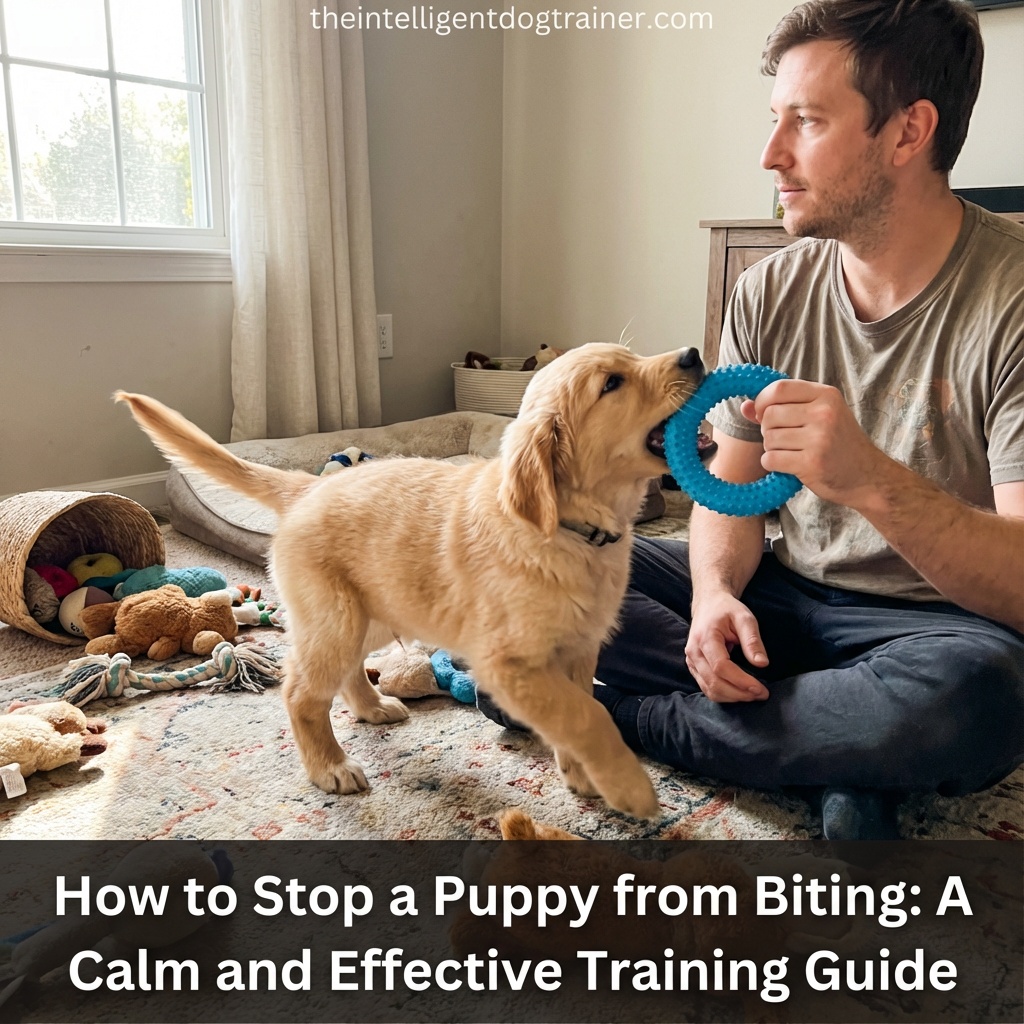
Bringing a new puppy into your life is a heartwarming milestone, though those razor-sharp milk teeth can quickly turn a gentle snuggle into a stinging surprise.
Mastering how to stop a puppy from biting is about much more than just saving your skin; it is a foundational pillar of early education that ensures your dog matures into a balanced and socialized adult.
While nipping is an entirely natural instinct for young canines, it takes a steady, patient hand to mold these impulses into appropriate behavior.
By decoding the why behind those tiny nibbles and refining your communication, you can navigate this land shark era with poise and strengthen the connection you share with your new best friend.
Understanding the puppy biting timeline and development
The journey of a puppy’s oral exploration follows a very specific path that every pet parent helps to guide.
A common question for those in the thick of it is, “At what age do puppies typically stop the biting phase?”
For most, you will notice the intensity of the nipping begin to fade around six or seven months, coinciding with the arrival of their permanent adult teeth.
In their earliest weeks, puppies learn the basics of jaw control from their siblings.
If a pup clamps down too hard during a wrestling match, a littermate’s sharp yelp and subsequent withdrawal from the game provide the first lesson in social boundaries.
Once they transition to your home, following a clear puppy training schedule is vital to reinforcing these lessons during their most impressionable developmental windows.
It is also quite common for owners to notice a spike in mouthiness once the sun goes down.
“Why does my puppy go crazy and start biting more in the evening?” This behavior is frequently a symptom of overstimulation or the infamous puppy zoomies.
Just like a tired toddler, a puppy that has reached its limit loses its ability to regulate impulses, leading to bites that are both more frantic and more painful.
In these instances, rather than continuing to engage, your puppy likely needs a quiet break in a crate or pen to decompress.
Keeping the broader puppy biting timeline in perspective helps you maintain a level head; you aren’t just correcting a nuisance, you are teaching a nuanced physical skill as the canine brain matures and learns to manage high-energy states.
Evaluating aggressive puppy biting vs play behavior
A major concern for many new owners is distinguishing between normal development and a deepening behavioral issue.
“What is the difference between playful nipping and aggressive biting?” In the vast majority of scenarios, puppy biting is purely exploratory and driven by a desire to play.
You can usually identify playful nipping by a loose, wiggly body, a rhythmic tail wag, and the classic play bow.
Conversely, aggression in dogs typically involves a rigid body posture, baring teeth outside of a game, and deep, guttural growling that lacks the bouncy quality of play vocalizations.
If you are ever unsure, watching how they introduce a puppy to an older dog can be enlightening, as mature dogs are masters at signaling the difference between a clumsy pup and a genuine threat.
“Is it normal for my puppy to growl while nipping?” It absolutely is; many puppies are extremely vocal when they are fully immersed in a game of tug or wrestling.
This play growl is rarely a sign of hidden malice.
However, if the nipping is accompanied by intense lunging or a fixation that doesn’t stop when you move away, professional guidance might be necessary.
“When should I seek professional help for my puppy’s biting?” It is a good idea to contact a certified behaviorist if the biting appears to be rooted in fear or if they are leaving deep punctures.
Correctly identifying aggressive puppy biting vs play early on allows you to apply the right training methods before these habits solidify.
Specific techniques for puppy nipping at hands and feet
Puppies are naturally wired to chase movement, which makes your walking feet and gesturing hands the ultimate prey.
“How do I teach my puppy to stop biting my hands and feet?” One of the most powerful tools at your disposal is the art of being boring.
As soon as those teeth touch your skin, stop all movement and withdraw your attention immediately.
By becoming stone-faced or simply turning your back, you teach the puppy that biting is the ultimate off switch for the fun they were having.
If your ankles are under constant attack, you can teach a dog to leave it, which provides a mental cue to override their instinct to hunt your shoes.
The secret to success here is ensuring that every person in the household sticks to the same rules.
“Does yelping when bitten help stop a puppy from biting?” While the idea is to mimic a littermate, this technique can be a bit of a double-edged sword.
For high-drive or reaktive breeds like Terriers or certain Herding dogs, a high-pitched Ow! can sound like a squeaky toy, which might actually heighten their excitement.
If you find that yelping only makes your puppy more relentless, a silent transition to a time-out behind a gate is a much more effective strategy.
When working on puppy nipping at hands, the goal is to show that only gentle contact results in continued engagement.
As a rule of thumb, it’s best to avoid using your hands as toys altogether; if you use your bare fingers to wrestle, you are essentially telling the puppy that your skin is a chew toy.
How to handle puppy teething and common discomfort
Between three and six months of age, a puppy’s mouth undergoes a massive transformation as 28 baby teeth fall out to make room for 42 permanent ones.
This is a genuinely uncomfortable process, and many puppies use biting as a way to massage their inflamed gums.
When considering how to handle puppy teething, cold relief is often the best medicine.
Providing frozen carrots, twisted wet washcloths that have been chilled, or hollow rubber toys can offer soothing pressure.
If you don’t provide these outlets, the puppy will find their own, making it essential to stop a dog from chewing furniture or household items by proactively offering enticing dental alternatives.
Variety is key during this period.
Some puppies are looking for the crunch of a hard nylon bone, while others find relief in a softer, squishable rubber ring.
By rotating through different textures, you keep the puppy engaged with their own gear rather than your belongings.
Remember that during this window, mouthiness is often a physical need rather than defiance.
If you notice your puppy is particularly restless or drooling excessively, they are likely experiencing a teething flare-up.
Being proactive during this phase not only saves your shoes but also helps you learn how to handle puppy teething with empathy, making the transition much easier for your pet.
Practical methods for redirecting puppy bites to toys
The beauty of redirection lies in swapping a bad behavior for a good one before the pup even realizes they’ve made a choice.
The moment you see that wild look in your puppy’s eyes or they start targeting your sleeve, calmly place a toy in their path.
Using positive reinforcement dog training ensures the puppy learns that biting the toy is the behavior that earns them rewards and keeps the game going.
“How can I use toys to redirect my puppy’s biting behavior?” A clever trick is to keep a variety of toys within easy reach in every room.
If they try to mouth you, present a long toy like a rope or a flirt pole to put some safe distance between their teeth and your skin.
“Should I punish my puppy for biting during play?” It is far more effective—and safer for your relationship—to avoid physical corrections like scruffing or holding the muzzle shut.
These actions usually either ramp up the puppy’s arousal or cause them to become fearful of your hands.
Instead, lean into the replacement method.
If the puppy bypasses the toy and goes for your arm again, the play session ends.
By consistently redirecting puppy bites toward appropriate objects, you are building their decision-making skills.
Eventually, the puppy will realize that when they get the urge to chew, the rope toy is the best way to get what they want.
This proactive approach prevents nipping from becoming a habitual way to get your attention.
Essential bite inhibition exercises for long-term safety
Bite inhibition is perhaps the single most important safety skill a dog can learn.
It describes a dog’s ability to regulate the strength of their jaw. The aim isn’t just to stop biting, but to teach the dog that human skin is incredibly delicate.
To work on bite inhibition exercises, let your puppy mouth your hand during a calm moment.
If they press a bit too hard, use a soft verbal cue like “too hard” and stop the interaction for about twenty seconds.
Eventually, you can slowly decrease what you consider acceptable pressure until the puppy learns to never put actual weight into a bite.
You can also teach a dog to drop it to ensure you have total control over what they have in their mouth at any given time.
“What are effective bite inhibition techniques for stubborn puppies?” For puppies that seem to have a harder time with self-control, keep your play sessions brief and structured.
Play for two minutes, luego ask for a sit to help them reset their brain.
This prevents them from hitting that point of no return where they become over-aroused and frantic.
By focusing on bite inhibition exercises in a controlled way, you are creating a safety buffer.
If that dog is ever accidentally hurt or startled in adulthood, their reflex will be to inhibit their bite force, which can prevent a minor incident from becoming a serious injury.
This focus on long-term safety is much more reliable than trying to suppress behavior through intimidation.
In the end, helping a puppy outgrow the biting phase is a journey that requires consistency and an understanding of their natural development.
By blending smart redirection with proper teething outlets and bite inhibition training, you provide the tools your puppy needs to thrive in a human world.
Your patience will be your greatest asset throughout this process; while the nipping can certainly be a test of endurance, it is a fleeting chapter of puppyhood.
Focus on rewarding the calm moments and communicating clearly, and you will eventually be rewarded with a gentle, focused, and well-mannered adult dog.