
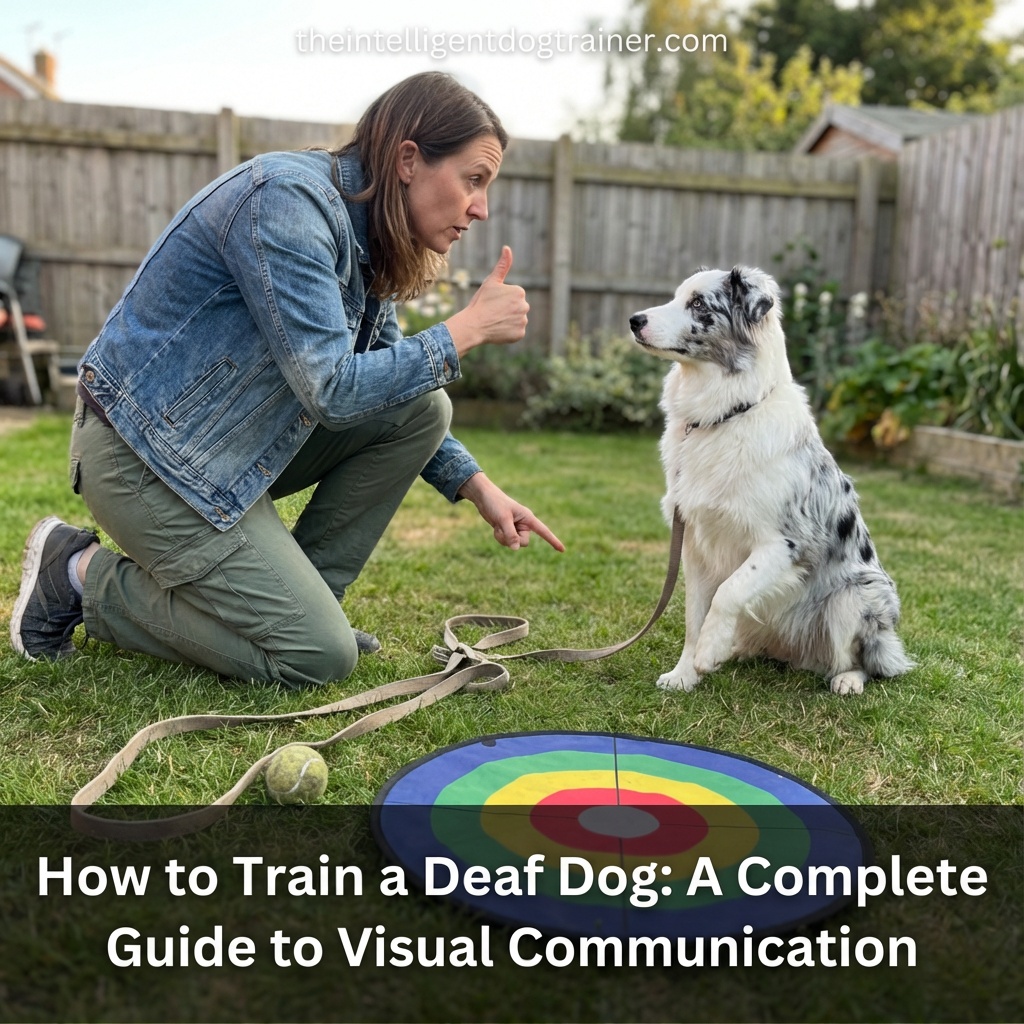
Welcoming a canine companion into your life who cannot hear might initially feel like a daunting prospect, yet it is a journey that frequently leads to an incredibly deep and intuitive bond.
Many owners find themselves asking, are deaf dogs more difficult to train than hearing dogs? The reality is that these dogs aren’t inherently more stubborn or slower to grasp concepts; they simply navigate a “language” centered on sight and touch rather than sound.
By shifting your approach from vocal commands to clear, visual communication, you empower your dog to move through their world with absolute confidence. This guide explores the essential techniques and modern best practices to ensure your deaf pup truly thrives in a world designed for the hearing.
Understanding the Foundations of Training a Deaf Dog
The primary secret to success when you train a deaf dog lies in establishing a clear, unmistakable “yes” marker. In a traditional setting, a clicker or a spoken word like “good” signals to a dog that they have earned a reward.
For a non-hearing dog, you must substitute this with a visual marker, such as a thumbs-up or even a quick flash from a small handheld light, to indicate they’ve performed correctly.
You might find yourself wondering, can you use positive reinforcement with deaf dogs? The answer is a resounding yes. Training should always be anchored by a foundation of rewards, utilizing high-value treats and play to create joyful associations with your specific cues.
Before any instruction can take place, you fundamentally need your dog’s eyes on you. How do you get a deaf dog’s attention without sound?
Effective methods include a gentle wave of the hand within their peripheral vision, a firm stomp on the floor so they feel the rhythmic vibration, or utilizing a flashlight during evening strolls.
The goal is to cultivate a “check-in” habit where your dog naturally looks to you for guidance every few moments. Adopting these positive reinforcement dog training principles ensures that your dog stays eager to work and trusts your leadership implicitly.
Using Hand Signals and Visual Cues effectively
Once you have captured your dog’s focus, the next step involves replacing spoken language with a silent, meaningful vocabulary. Hand signals for dogs are remarkably effective because canines are naturally hardwired to interpret body language and physical movement.
Standard visual cues for dog training often involve a flat palm to signify “stay,” a pointing finger for “down,” or a closed fist for “sit.”
What are the essential hand signals for training a deaf dog? At a minimum, you should develop distinct signs for “sit,” “stay,” “come,” “no,” and a clear “good” signal to mark the exact moment of success.
To make this wordless dialogue work, your dog must be looking at you. This is why it is absolutely vital to teach a dog the watch me command as their very first functional skill.
When they realize that focusing on your face leads to consistent rewards, the rest of your visual cues for dog training become much easier to layer in. Keep your gestures consistent and just slightly exaggerated so they remain identifiable from a distance.
Whether you choose American Sign Language (ASL) or unique personal gestures, ensure that every person in the household uses identical motions to avoid confusing your pup.
The Role of Touch Signals for Reliable Communication
While sight is the primary driver, touch serves as a powerful secondary communication tool, particularly when your dog isn’t looking directly at you. Touch signals for dogs involve gentle, purposeful taps on specific parts of the body to convey directions or needs.
For instance, two light taps on the shoulder might be your way of saying “look at me,” while a soft touch on the haunches could signify “sit.” This tactile vocabulary is also a pillar of safety.
How do I prevent my deaf dog from becoming startled easily? By conditioning your dog to enjoy unexpected touches through positive reinforcement, you can drastically reduce their startle reflex and prevent fear-based reactions.
Learning how to teach a dog to touch helps bridge the communication gap in crowded settings or dim environments where visibility might be poor.
This concept is equally important for resting animals. What is the best way to wake up a sleeping deaf dog without startling them?
Try placing your hand near their nose to let them catch your scent first, or gently tap the floor or bedding near them to create a subtle, waking vibration. By making touch a predictable and rewarding experience, you foster a safer environment for a dog that cannot rely on the sound of approaching footsteps.
Socializing a Deaf Puppy for Real-World Success
When it comes to socializing a deaf puppy, the goal is to carefully expose them to a wide array of sights, smells, and textures to build a resilient sense of confidence.
Because they aren’t processing auditory data, they often lean more heavily on their olfactory system to make sense of new environments.
It is crucial to introduce them to calm, well-behaved dogs and people of all ages. During these interactions, observe their body language with a keen eye.
A deaf dog needs to feel certain they can look to you for a “safety signal” if a situation begins to feel overwhelming. Proper socialization also means coaching a puppy on how to interact politely despite their lack of hearing.
Your focus should be on socialize a puppy in a way that prevents them from becoming panicked by fast-moving children or energetic pets.
Since they can’t hear a warning growl or a sharp bark from another dog, you essentially have to serve as their “ears,” monitoring social dynamics and intervening before a misunderstanding escalates.
Varied exposure—from the bustle of a park to the quiet of a hiking trail—will help them mature into a well-adjusted, stable adult.
Mastering Deaf Dog Recall Training and Safety
One of the most common anxieties for owners is the challenge of deaf dog recall training. Without the ability to hear their name called across a field, how do you make sure they return?
How do you teach a deaf dog to come when called? Begin in a securely fenced area using a long training lead. Instead of a shout, use a wide, sweeping arm motion as your “come” signal.
The moment your dog turns toward you, give your “good” visual marker and offer a high-value reward. You want to make the act of returning to you the absolute highlight of their day.
Safety is the priority, so it’s wise to consider how can I keep my deaf dog safe while walking in public? Using a vest or leash sleeve labeled “Deaf Dog” helps strangers understand that they shouldn’t try to get your dog’s attention from behind.
Consistently practice how to train dog to come when called using your chosen visual markers or vibrations.
As a general rule, never let a deaf dog off-leash in an unsecured area until they demonstrate a 100% reliable response to your long-distance cues. A long line is a great middle ground, offering them a sense of freedom while ensuring they are always within your control.
Advanced Communication Using Vibration Collar Training
For those looking to achieve long-distance communication or off-leash work in safe zones, vibration collar training can be a total game-changer.
Let’s clear up a common concern: is a vibration collar safe and effective for deaf dogs? Absolutely, provided it is a high-quality, vibration-only collar and not a “shock” or “e-collar” intended for punishment.
Think of the vibration as a remote “tap on the shoulder”—a neutral signal designed specifically to get the dog’s attention so they look back at you for further instruction.
By teaching the dog to instinctively look towards you whenever they feel that subtle vibration, you grant them much more autonomy. This tool is often the key when you intend to train a dog to walk off-leash in secure areas or on a trailing line.
Looking ahead, many experts consider the vibration collar an “invisible leash” that allows deaf dogs to enjoy the same freedom as any other pet.
Always pair the vibration with a treat during the initial learning phases so the dog views the sensation as an invitation to something wonderful.
Training a deaf dog is a deeply rewarding experience that hinges on clarity, patience, and a nuanced understanding of visual and tactile cues.
By embracing hand signals, building a rock-solid “watch me” foundation, and perhaps utilizing technology like vibration collars for distance, you can effortlessly navigate the hurdles of hearing loss.
While the specific tactics differ from those used with hearing dogs, the end result—a confident, happy, and well-behaved companion—is exactly the same. Your commitment to these specialized techniques ensures your dog can live a vibrant, safe, and full life right by your side.