
thought
Training your dog to engage with the world through a simple nose-to-hand contact is one of the most versatile tools in a modern trainer’s toolkit. Known commonly as “targeting,” this behavior is far more than just a cute trick.
It serves as a foundational building block for complex behaviors, focus-building, and even managing behavioral issues like anxiety or reactivity. In this guide, we will explore exactly how to teach a dog to touch your hand with precision and enthusiasm.
This transforms a simple “nose boop” into a reliable communication channel between you and your canine companion. Whether you are working with a high-energy puppy or an older dog, mastering this skill will significantly enhance your training journey.
Understanding the Benefits of Hand Targeting for Dogs
The benefits of hand targeting for dogs extend far beyond simple obedience. At its core, this exercise is a gateway to positive reinforcement dog training which encourages your dog to become an active participant in their learning process.
What is the ‘touch’ command and why is it useful for dog training? Essentially, it is a behavior where your dog purposefully touches their nose to a specific target—usually your palm. This is incredibly useful for directing your dog’s movement without physical force.
Furthermore, can hand targeting help improve my dog’s recall? Absolutely. If your dog understands that “touch” means coming to your hand for a reward, it creates a powerful “magnet” effect that can be used to call them back to you.
It is also an excellent tool for confidence building. For shy dogs, interacting with a human hand on their own terms can reduce fear, while for high-arousal dogs, it provides a “job” that redirects their energy into a calm, focused task.
Essential Preparation for Successful Target Training
Before you start, you need to set the stage for a distraction-free learning environment. Target training for dogs works best when the animal is motivated but not overly frustrated.
You will need high-value treats and a clear “marker” to tell the dog exactly when they’ve done the right thing. Using a clicker is highly recommended because it provides an instant sound that marks the exact microsecond the nose hits the skin.
Many owners find it helpful to clicker train a dog prior to starting “Touch” to ensure the dog understands the “click equals treat” relationship.
Is it better to use a clicker for hand targeting training? While a verbal marker works, a clicker’s distinct sound often speeds up the learning process for nose-to-palm contact. You should also decide on your hand signal.
Should I use the same hand every time during initial training? In the very beginning, yes. Using a consistent “target hand” helps the dog identify the goal quickly. Once successful, you can begin alternating hands to generalize the behavior.
Ensure you are in a quiet room Wikipedia: Operant conditioning to minimize outside interruptions during these first few critical minutes.
Step-by-Step Instructions to Teach Your Dog to Touch Your Hand
Ready to begin? The process of hand targeting for dogs relies on the dog’s natural curiosity to sniff new things.
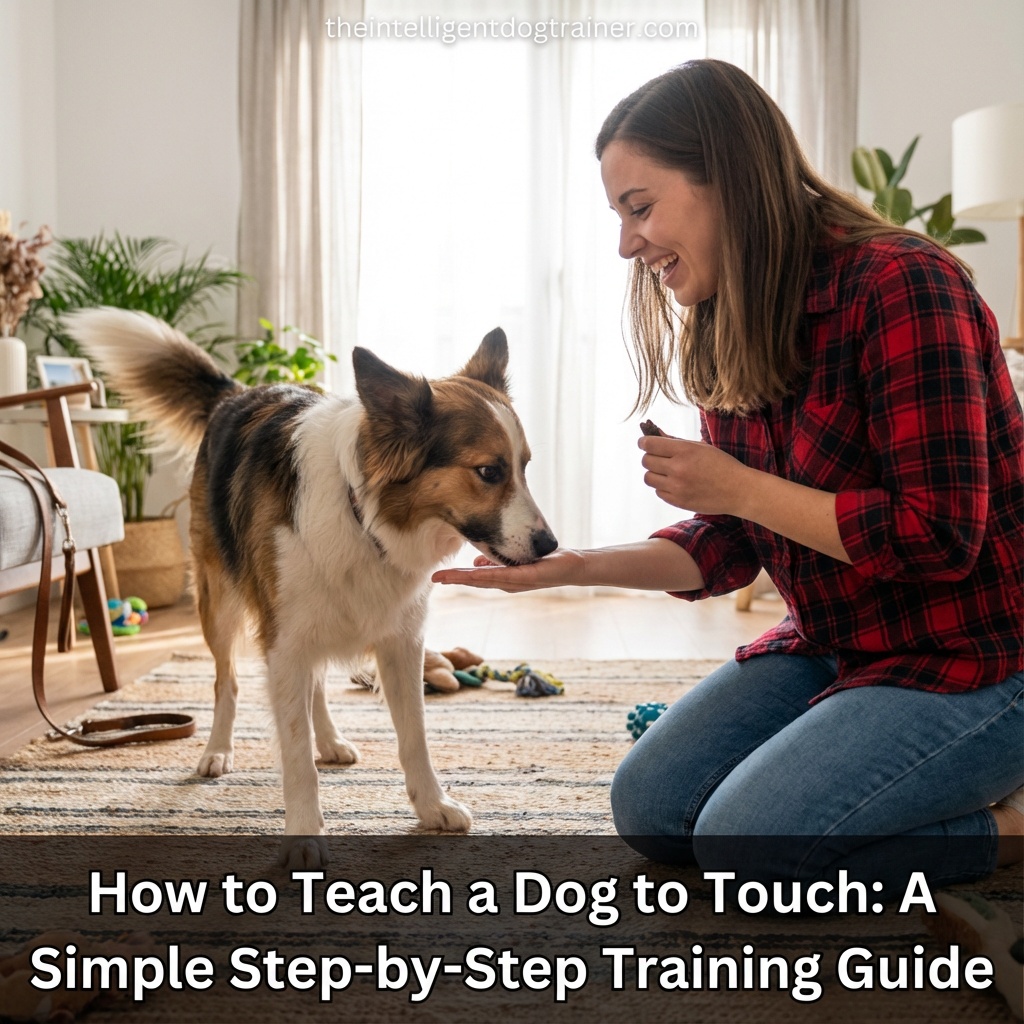
What are the step-by-step instructions to teach a dog to touch? First, present your flat palm about 2–3 inches away from your dog’s nose. Most dogs will naturally move forward to sniff it.
The moment their nose makes contact with your skin, click and deliver a treat from your other hand. Repeat this several times until the dog is lunging to boop your hand as soon as it appears.
Once the movement is fluid, you can begin to add the verbal cue “Touch.” Say the word just as the dog is moving toward your hand. By applying diverse dog training techniques like “capturing” and “shaping,” you can gradually move your hand to different positions.
How long does it usually take for a dog to learn the touch command? Most dogs grasp the internal logic within 5 to 10 minutes. However, it takes several days of short sessions to make the response truly “automatic” in various environments.
Common Challenges in Nose Boop Training and How to Fix Them
Even the smartest dogs can hit a plateau. A frequent question from pet parents is: Why is my dog biting my hand instead of touching it with his nose?
If your dog is “mouthy,” it usually means they are over-excited or confusing the target hand with the reward hand. To fix this, keep your target hand very flat and still, and ensure your treats are hidden.
If the biting persists, you may need to learn how to stop puppy biting by redirecting that oral fixation. What should I do if my dog loses interest in target training?
This often happens if the criteria are too hard or the rewards aren’t valuable enough. If your dog stops trying, move your hand closer—even right in front of their nose—to make it “un-fail-able.”
Remember that nose boop training should be a game. Keep your energy light, praise frequently, and use “jackpot” rewards for particularly fast or enthusiastic touches.
Advancing the Command: Moving from Hands to Specific Objects
Once your dog is a pro at hitting your palm, you can expand their horizons. How do I transition the touch command from my hand to a specific object?
This is the bridge to advanced skills like closing doors or learning to teach a dog the place command by targeting a mat. To do this, hold a small object in your target hand.
When the dog touches the object to get to your hand, click and treat. Slowly move the object further away until the dog understands that the object is now the target.
This phase is where the “Touch” command becomes a powerful tool for Wikipedia: Animal training. This shaping process allows you to communicate complex physical tasks by breaking them down into simple nose-touches.
It’s a great way to provide mental enrichment in 2025. Always ensure the objects you use are safe, non-toxic, and large enough that the dog won’t accidentally swallow them.
Practical Ways to Use the Touch Command in Daily Life
The true magic of knowing how to teach dog hand target lies in its real-world application. How can I use hand targeting to help a reactive dog?
If your dog is nervous around strangers, “Touch” can be used as a “u-turn” maneuver. By asking for a touch, you give the dog a focal point that is you, shifting their brain from a state of threat detection to task performance.
This is a staple in leash reactivity training because it moves the dog physically away from the trigger while rewarding them for remaining engaged with the handler.
Use “Touch” to lead your dog onto a scale, into a car, or to keep them in a “heel” position. It is often more effective than a “Come” command because it provides a specific physical destination (your hand).
By integrating this simple behavior into your daily routine, you reinforce your role as a fun and reliable leader, ensuring your dog remains attentive and eager to work with you in any situation.