
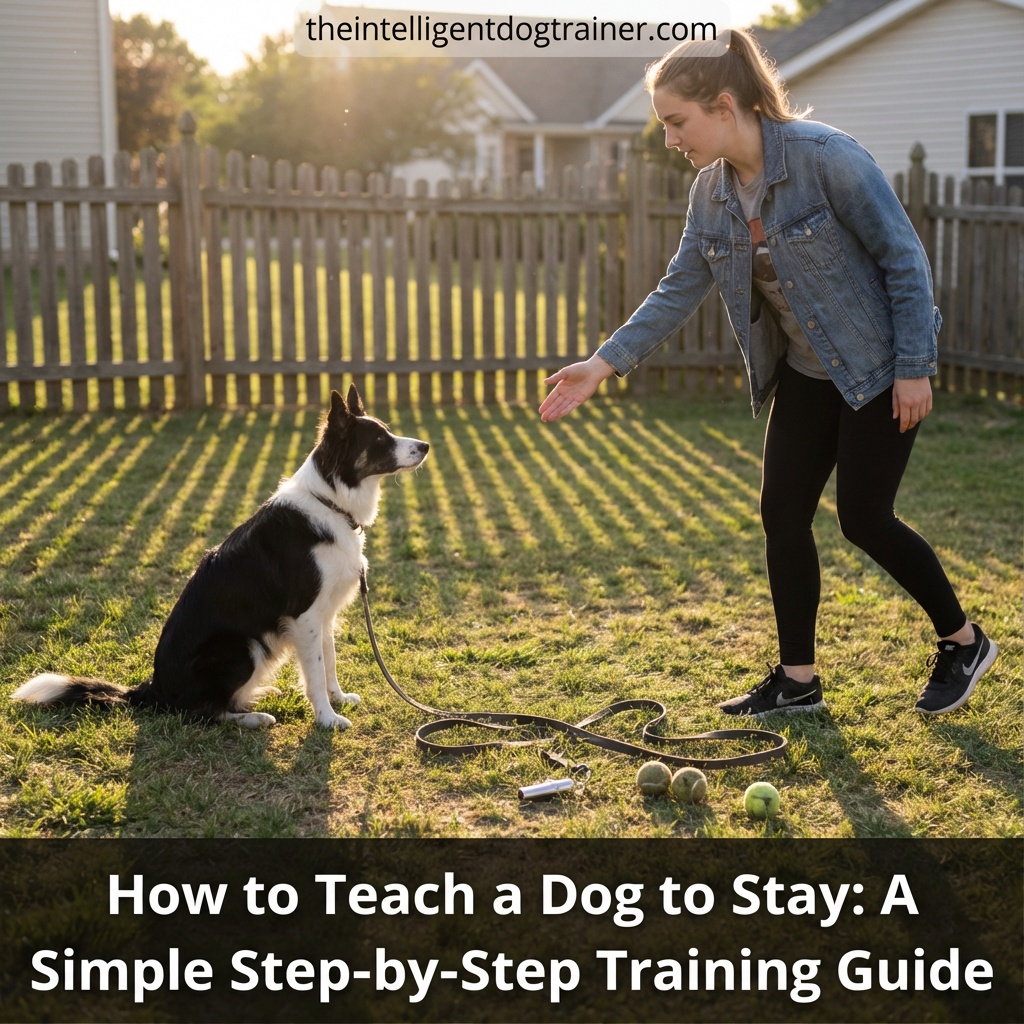
Cultivating a rock-solid “stay” in your dog is about much more than just displaying polished obedience during a weekend park visit. At its center, this behavior serves as a fundamental safety net, preventing your companion from darting into traffic or overwhelming a guest at your front door.
While the idea of keeping a high-energy canine anchored to one spot might seem like a daunting challenge, the process itself is deeply rewarding—particularly when you approach it with patience and science-backed methods.
This guide focuses on the fine-tuned mechanics of the “stay” behavior, providing a roadmap to building a foundation so resilient it holds firm even during the busiest moments of life. By following this journey, you will gain the practical skills necessary to ensure your dog remains calm and stationary until you personally provide the green light to move.
Understanding the difference between stay and wait in dog training
To ensure your dog truly succeeds, you must first develop a clear grasp of the difference between stay and wait dog training so you avoid sending confusing signals.
Think of a “stay” as an absolute, non-negotiable command: it requires the dog to remain frozen in their current posture—whether sitting, lying down, or standing—until you return directly to their side and offer a release word.
In contrast, a “wait” functions as a more casual, temporary pause. This is ideal for transitions at the front door or the car trunk where your dog expects to move forward after a brief moment.
Many owners find that learning how to wait is an excellent way to establish basic boundaries, but for a formal stay, the dog shouldn’t move an inch until the exercise is officially concluded.
What is the difference between the stay and wait commands in dog training? Put simply, “stay” requires duration in a specific spot until the handler returns to the dog, whereas “wait” acts as a momentary speed bump before an action resumes.
Essential steps to teach a puppy to stay for the first time
When you begin to teach a puppy to stay, it is vital to account for their naturally fleeting attention spans, which means your training sessions should be brief, upbeat, and positive.
If you are curious about at what age can I start teaching my puppy the stay command, you can actually begin as early as 7 or 8 weeks, provided you are utilizing positive puppy training techniques.
Start the process with your puppy already in a stable sit or down. Extend your palm toward them—much like a stop sign—and clearly state the word “stay.”
It is important to keep the initial goals modest: how long should a beginner stay command last? At first, you are looking for only a second or two of stillness before delivering a high-value treat while they are still in position.
If they happen to wiggle out of it too early, there is no need for concern; just calmly lead them back to the start without showing frustration. Using hand signals to help teach a dog to stay offers a visual anchor that reinforces your verbal cue, making the logic much easier for a developing brain to process.
Selecting and using effective dog training release words
The stay command is really only one half of a two-way conversation; the “release” is the vital second half that informs your dog their job is done.
Using consistent dog training release words like “OK,” “Free,” or “Release” eliminates any ambiguity for your pet. What is a release word and why is it critical for the stay command?
It acts as the precise marker that the criteria for the behavior have been fully satisfied, preventing the dog from deciding on their own when they’ve had enough. How do I choose the right release word for my dog?
It is usually best to pick a sharp, single-syllable word that doesn’t frequently appear in your everyday household conversations to avoid accidental releases.
Much like you might teach a dog to drop it to signal the end of a physical hold, the release word functions as a clear “on/off” switch that maintains high levels of clarity in your communication.
Mastering the three Ds of dog training: duration, distance, and distraction
Moving your training from the quiet environment of your living room into the real world requires mastering the three Ds of dog training duration distance distraction.
As noted in Wikipedia, behaviors become more resilient through the systematic reinforcement of increasingly challenging criteria.
Your primary objective should be duration: reward your dog for staying for 10 seconds, then gradually work up to 30. Once they are steady, you can begin to introduce distance.
how do I teach my dog to stay while I walk away? Start by taking just one small step backward and immediately returning to reinforce the stillness.
Finally, you can introduce distractions, such as a rolling ball or a neighboring dog. This layered approach is a core pillar of positive reinforcement dog training, ensuring we set the dog up for a win by only changing one “D” at a time.
If the behavior falls apart, simply return to the last level where your dog felt confident and successful.
How to proof the stay command against real-world challenges
Once the basic mechanics are established, the next phase is learning how to proof the stay command so it remains dependable even at a crowded beach or a busy park.
Proofing is essentially the “generalization” phase where your dog learns that the rules remain the same regardless of the location or the surrounding activity.
This logic mirrors the principles of effective boundary training, helping your dog understand that the command takes priority over the “pull” of their environment.
How do I practice the stay command with high distractions? Start in a familiar, quiet backyard before progressing to a sidewalk with occasional foot traffic.
If you find yourself struggling with how can I stop my dog from breaking their stay before I release them, the secret is often to increase your reward frequency when the environment becomes more stimulating.
If they do break character, what should I do if my dog gets up before I give the release word? Remain calm and lead them back to the exact starting position without a treat, wait a brief moment, and then try again for an easier, shorter duration.
Advanced long down stay training tips for reliable obedience
To reach elite levels of reliability, applying specific long down stay training tips can help your dog settle comfortably for several minutes, even in public settings.
In the field of canine ethology, the “down” position is understood to be significantly more stable and physically relaxing for a dog than a “sit,” making it the ideal posture for extended stays.
You can effectively teach a dog to lie down as the primary “home base” for these longer exercises.
You might even set a milestone for 2026 to achieve a five-minute stay while you briefly step out of sight. A vital rule here is to always return to your dog to deliver the reward, rather than calling them to your side.
This reinforces the idea that staying put is exactly what earns the prize. Developing this level of mastery is a true testament to the trust and clear dialogue between you and your dog.
Ultimately, teaching a reliable stay is a systematic process that rewards clear communication and steady, incremental progress. By distinguishing between “stay” and “wait,” establishing a definitive release cue, and carefully balancing duration, distance, and distraction, you build a behavior that lasts.
Whether you are starting fresh with a young puppy or polishing the skills of an adult dog, consistent positive reinforcement turns the stay from a forced chore into a rewarding task.
Through diligent proofing and the practice of advanced long stays, you provide your dog with the impulse control they need for a safe, dependable, and enriched life in the real world.