
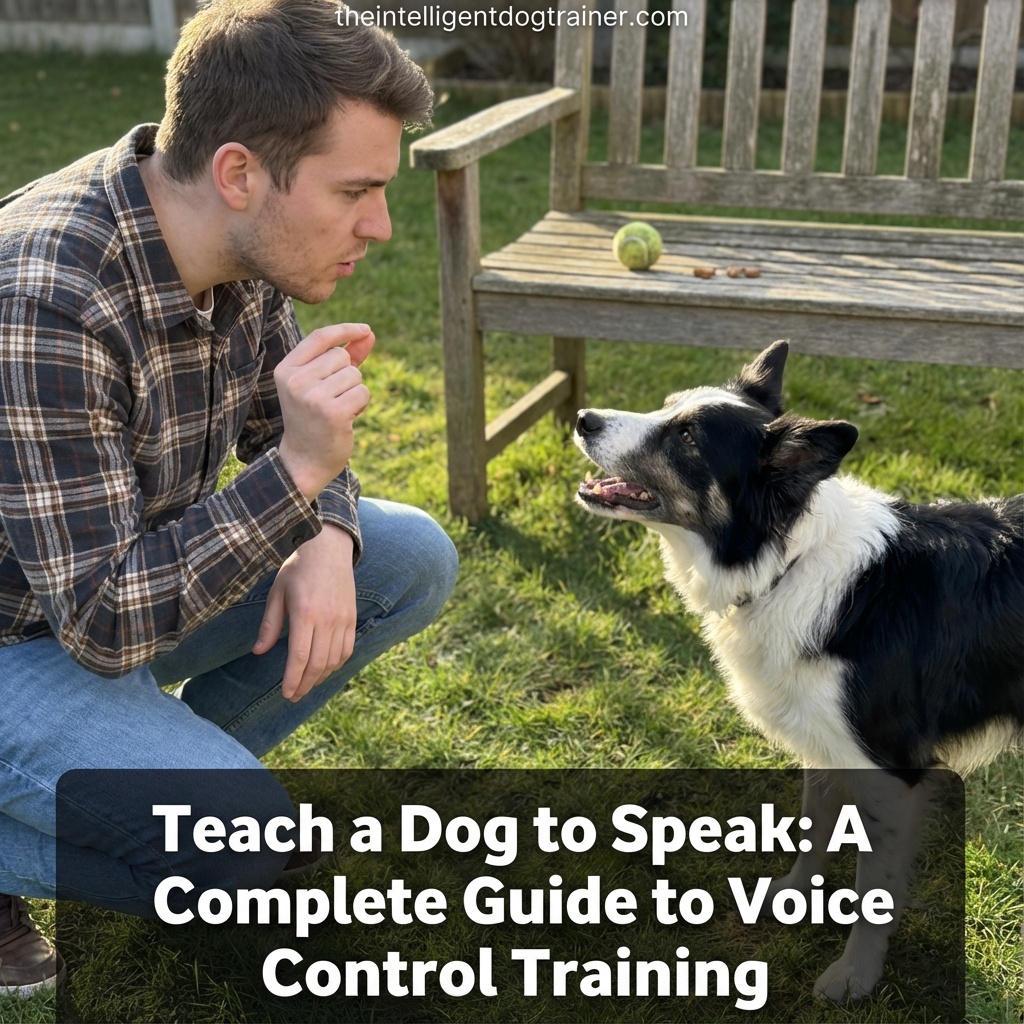
Helping your canine companion learn to vocalize on cue is one of the most remarkable and practical skills you can add to their repertoire. When you teach a dog to speak, you are moving far beyond a simple party trick; you are creating a sophisticated bridge of communication that allows your pet to express specific needs within the boundaries of a well-ordered home.
Entering 2026, the world of modern training has shifted its focus toward genuine dialogue and emotional well-being, stepping away from the rigid obedience of the past. This guide explores the subtleties of voice control, taking you from that first curious yip to a polished “quiet” command, ensuring your sessions are productive, science-based, and—above all—fun.
Understanding the Basics of Barking on Command
Before we get into the literal mechanics of how to make dog bark on command, we need to look at the psychology behind the noise. Barking serves as a vital communication tool for dogs, acting as a versatile signal for everything from pure joy to a perceived threat.
A frequent concern for many owners is: Will teaching the ‘speak’ command make my dog’s barking worse? It might seem counterintuitive, but the answer is a resounding no. By bringing the behavior under the control of a specific cue, you actually gain the power to decide when it starts and when it stops.
Is it possible to train any breed to speak officially? While it is true that certain groups, such as Terriers or Herding breeds, are naturally more “talkative,” almost any dog can learn the “speak” command with the right approach.
The secret lies in a technique called “capturing”—waiting for a natural vocalization and marking it the instant it happens. This method leans heavily on positive reinforcement dog training to make sure your dog views their voice as a way to earn something wonderful.
You’ll need to be a bit of a detective here; being ready to reward the very second your dog makes a sound is the foundation of the entire process.
How to Make Your Dog Bark Using Positive Motivation
To kick things off, you need to find the specific “spark” that triggers a natural bark from your pet. You might be sitting there wondering, how do I get my dog to bark on command if they are the silent, stoic type?
There are several ethical ways to create a little excitement, such as showing them a favorite squeaky toy, knocking gently on a hard surface, or perhaps rattling their dinner bowl. As soon as your dog offers even a tiny “woof,” mark that moment.
Should I use a clicker when teaching voice commands? Doing so is highly recommended. A clicker offers a distinct, consistent sound that tells the dog exactly which behavior hit the jackpot.
This strategy works so well because it taps into the dog’s own internal drive. If you are planning to clicker train a dog for vocal tasks, remember that consistency is your greatest ally.
Create the trigger, wait for the noise, click, and provide a treat. How long does it take for a dog to learn the speak command? Most pups will start to make the connection within just two or three sessions.
It usually takes a few weeks of practice in different settings to achieve 100% reliability. Just be careful not to let them get too frustrated or frantic; you want clear, intentional barks rather than chaotic noise.
Using Hand Signals for Clearer Voice Communication
It is a well-known fact that dogs are visual creatures, often picking up on non-verbal cues much faster than spoken words. By integrating a dog speak command hand signal, you give your pet a clear visual anchor to look for.
Many trainers prefer a “talking hand” gesture—holding your hand up and opening and closing your fingers like a puppet’s mouth. What hand signal works best for the speak command? While any unique gesture will do, this specific motion is very intuitive for humans to give and easy for a dog to spot from across a room.
These visual signals are a lifesaver in noisy environments where your voice might get lost. Interestingly, many of the same principles used to train a deaf dog apply here; a clear physical signal removes any ambiguity.
Once the dog recognizes the gesture, they should respond with the vocalization immediately. To get there, you’ll gradually “fade” the original trigger while introducing the hand signal, until the movement alone is all they need to see.
Training the Whisper for a Controlled Volume
After your dog has mastered the “big” bark, you can add a layer of sophistication and train dog to whisper. This is a fantastic exercise in impulse control and vocal awareness.
To begin, keep a close ear out for those softer “inside” barks or mumbles, and reward those specifically with high-value treats. This teaches your dog that they can actually adjust their own volume dial.
What should I do if my dog gets too excited and won’t stop barking? If the energy gets a bit too high, it’s best to take a break and offer some mental stimulation for dogs to help them reset and find their calm again.
Can I teach a naturally shy or quiet dog to speak? Absolutely, though you may need a bit more patience. For more reserved dogs, the “whisper” is often a much more comfortable starting point than a loud bark.
You should reward any sound they give you—a huff, a grunt, or a tiny “boof.” Over time, you can shape these small efforts into a confident, controlled “speak.”
The end goal is a dog that can communicate across a full spectrum, from a gentle mumble to a clear announcement, giving you total control in any social situation.
Teaching Speak and Quiet Commands for Total Control
A “speak” cue is only truly useful when paired with its counterpart; you must also teach dog to be quiet to maintain a peaceful household. What is the best way to teach the ‘quiet’ command alongside speak?
A great way to do this is through the “contrast” method. Ask your dog to speak, then immediately present a very tasty treat right at their nose. Because they have to stop barking to sniff and eat the treat, you create a window of silence.
The moment they go quiet, say “Quiet” and give them the reward. This way, you teach speak and quiet commands as two halves of a single conversation.
Teaching a dog to stop doing something is often much harder than teaching them to start. This is exactly why it helps to teach a dog to wait or practice staying calm before they get what they want.
How do I stop my dog from barking for treats during training? If your dog starts “guessing” and barking without being asked, simply cross your arms or turn away until they are silent. Only reward the barks that you specifically requested.
This reinforces the idea that you are the one who starts the dialogue, ensuring they don’t turn into a “demand barker.”
Managing Nuisance Barking and Training Discipline
The big-picture goal of this training is to stop nuisance barking by giving your dog a productive way to use their voice. When a dog views barking as a specific job they do for a reward, they are far less likely to use it randomly for attention or out of boredom.
Discipline in this context is all about clear boundaries: the dog only vocalizes when they see the cue or hear the command. If your dog starts barking at a passing neighbor, you can use the “quiet” command you’ve built to instantly grab their attention and redirect them to something else.
If you find yourself dealing with more intense territorial or reactive behavior, you might need to dive deeper into how to stop a dog from barking through a process called desensitization.
The “speak” and “quiet” cues are invaluable tools here, serving as a “reset” for your dog’s emotional state. By turning barking into a regulated skill, you take a potential source of stress and turn it into a moment of focus.
Mastering these vocal cues is a deeply rewarding journey that builds a stronger, more intuitive bond between you and your dog. By combining positive motivation, clear visual signals, and volume modulation, you give your pet the ability to “talk” in a way that respects your lifestyle.
This structured approach ensures that barking becomes a purposeful, controlled action, leading to a much more peaceful and communicative life together.