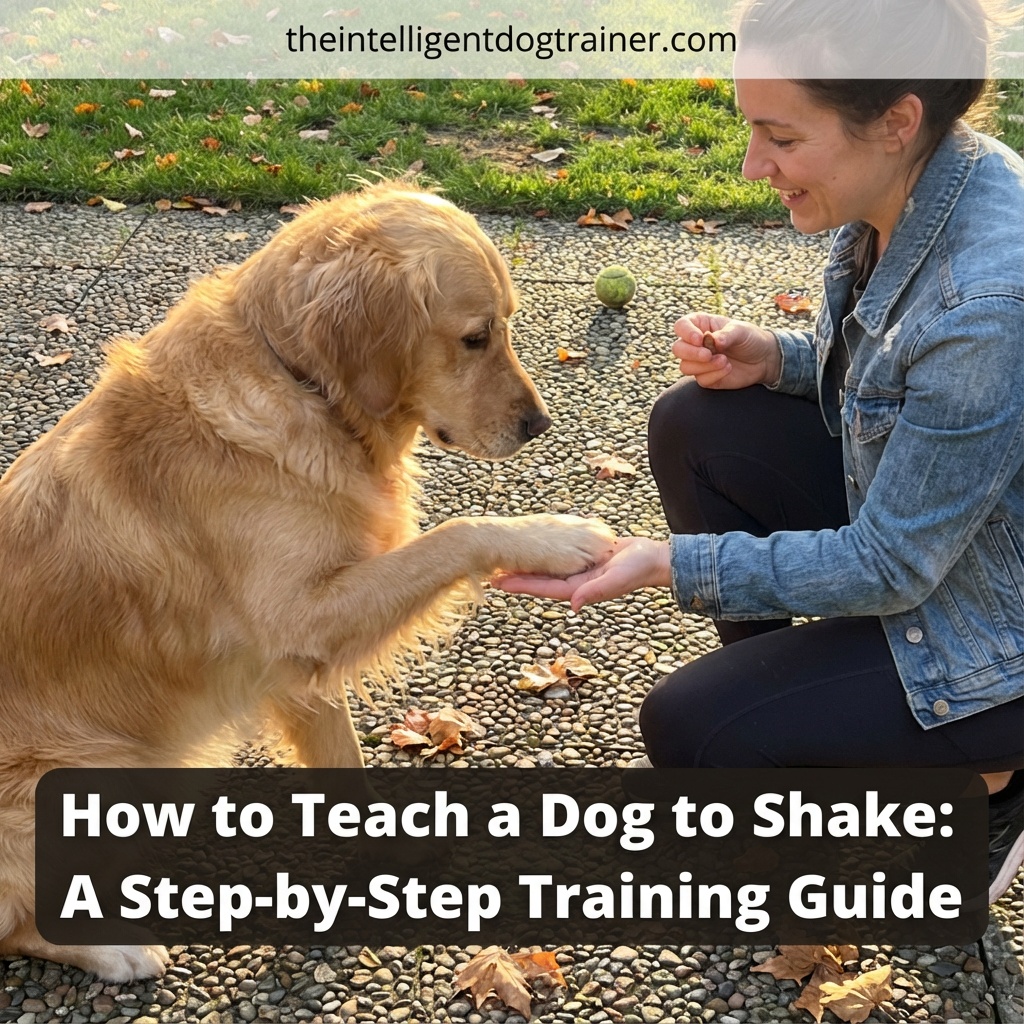
Helping your canine companion master the “shake” command is far more than a simple party trick; it is a core exercise that builds physical confidence and mutual cooperation.
Whether you are looking to impress friends or just want to make routine nail trimming a bit more manageable, learning how to teach a dog to shake is a deeply satisfying process for both ends of the leash.
This guide breaks down the mechanics of paw-based skills, starting with that initial tentative lift and moving toward the sophisticated ability to distinguish between left and right limbs.
By focusing on science-backed positive reinforcement, you can transform a natural canine instinct into a reliable behavior that strengthens the bond you share with your pet.
Foundational Steps to Train Your Dog to Shake Hands
For a successful session when you train dog to shake hands, your pup needs to feel physically stable and secure.
Professional trainers often suggest starting from a resting position so the dog can focus without worrying about their balance.
You may find yourself wondering, can I teach my dog to shake before they know how to sit? While it is technically possible, asking a dog to balance on three legs from a standing start is quite a challenge.
For the best results, it is wise to first teach a dog to sit so they are attentive and grounded.
Once seated, they are in the perfect “power position” to lift a paw without the risk of wobbling or toppling over.
Preparation is key, so choose a quiet spot and gather some high-value rewards. A common question for many owners is, what are the best treats for teaching a dog to shake?
Small, soft, and fragrant morsels—like tiny pieces of plain chicken or freeze-dried liver—work best because they can be swallowed quickly, keeping the momentum of the lesson going.
In contemporary training, “low-calorie, high-motivation” snacks remain the preferred choice to keep a dog’s interest sharp.
As detailed by Wikipedia, the strategic application of positive reinforcement builds a clear mental bridge between a specific movement and a pleasant outcome.
A Simple Method to Teach Your Dog to Give Its Paw
The most natural approach to how to teach a dog to give paw involves a method known as “shaping” or “capturing” a behavior.
Start by hiding a treat inside your closed fist and holding it near your dog’s knee level.
Most dogs will naturally try to figure out how to get the snack by sniffing, nudging, or—eventually—pawing at your hand.
The moment their paw makes contact with your skin, open your hand and let them enjoy the reward.
This instant feedback is the essence of positive reinforcement dog training, which emphasizes rewarding correct choices rather than correcting mistakes.
If you hit a roadblock and wonder, how do I teach my dog to shake if they won’t lift their paw? try shifting your weight slightly toward them or gently tickling the back of their leg just above the paw.
This usually triggers a natural reflex to lift the foot. Once they are consistently reaching out to touch your hand, you can introduce the verbal cue.
Say “Shake” right as the paw begins its upward movement. It is best to keep these sessions short—around 5 to 10 minutes—to prevent your dog from getting bored or tired.
You might ask, how long does it usually take for a dog to learn the shake command? While many dogs understand the basics in just a few sessions, reaching true consistency requires patient repetition over several days.
Clear Dog Trick Shake Instructions for Quicker Results
To refine the behavior and ensure your dog isn’t just pawing at you for attention, follow these dog trick shake instructions carefully.
Once your dog reliably offers their paw to a closed fist, transition to offering an open, flat palm. This change signals that the “handshake” is now an intentional, formal interaction.
To speed up the process, many trainers recommend using a marker to pinpoint the exact moment of success.
Should I use a clicker when teaching the shake command? It is highly recommended.
A clicker provides a distinct, consistent sound that allows you to clicker train a dog with much more precision than the human voice can offer.
Consistency is the secret ingredient to any successful training program. In the beginning, always use the same hand to request the same paw to avoid confusing your pet.
If your dog gets a little too eager, you might encounter a common issue: why does my dog paw at me aggressively after learning the shake trick?
This usually happens when a dog realizes that pawing leads to treats and tries to “demand” them. The solution is straightforward: only provide the reward when you have specifically asked for the behavior.
If you are concerned about what should I do if my dog starts giving paw without being asked? the best tactic is to simply ignore the unrequested action.
By only reinforcing the cues you give, you remain the leader of the training dialogue.
Advancing the Trick: How to Teach Your Dog to Wave
When the standard handshake becomes second nature, you can move on to more expressive gestures, such as learning how to teach your dog to wave.
To do this, simply hold your hand just out of your dog’s reach when you give the command.
When they reach out to “shake” but find no hand to rest on, their paw will naturally move through the air. This “air shake” is exactly what you want to capture.
By rewarding this effort to reach without contact, you provide excellent mental stimulation for dogs, which is just as important for their well-being as a daily walk.
According to researchers cited on Wikipedia, dogs are incredibly adept at interpreting subtle hand signals.
To transform that air shake into a clear wave, begin using a back-and-forth hand motion as your visual signal.
Remember that every dog learns at their own pace, and don’t be swayed by common myths: can older dogs learn how to shake hands as easily as puppies?
While puppies are quick to soak up new information, senior dogs often have better focus and can learn these tricks with ease, provided they are physically comfortable.
Always check that your dog isn’t experiencing joint stiffness before practicing repetitive movements.
Level Up Training by Teaching Dogs Left and Right Paw
If you want to take your training to the next level, you can teach dog left and right paw as two separate commands.
This adds a layer of cognitive challenge that keeps your dog’s mind sharp. Start by dedicating a specific hand to each paw—for example, use your right hand to ask for their left paw and your left hand for their right.
Incorporating a “touch” command can be a useful bridge here. If you teach a dog to touch your hand with their nose first, they become more aware of how to target your palm with different parts of their body, including specific feet.
You might wonder, how can I teach my dog to distinguish between left and right paw? The trick lies in pairing the unique verbal cue with the specific physical target.
Say “Right” only when you are presenting your hand to their right side, and “Left” for the opposite.
If they offer the wrong paw, avoid a negative correction; simply retract your hand, wait a second, and try again.
This kind of bilateral training is fantastic for improving a dog’s coordination and body awareness.
Many owners find it particularly rewarding to teach dog to wave with a specific paw, showing a high degree of communication and focus between pet and owner.
Transitioning the Shake: How to Teach Your Dog to High Five
The natural final step in this series is learning how to teach dog to high five.
This is essentially an evolution of the “shake,” but with your palm rotated vertically and held at a higher level.
A frequent question is, what is the difference between teaching shake and high five? It mostly comes down to the position and height of your hand.
While a shake involves the dog resting their paw in your hand, a high five is more of an active push against your upright palm.
By using proven dog training techniques like luring, you can make this transition very smoothly.
To achieve that perfect high five, start with a basic shake and gradually raise the height of your hand over several successful repetitions.
As your hand moves higher, the dog will naturally change the angle of their leg to reach it—at this point, you can introduce the “High Five!” command.
As noted on Wikipedia, dogs often prioritize visual cues over verbal ones, so make sure your upright palm looks distinct from your “shake” gesture.
This progression keeps your training sessions fun and ensures your dog remains an enthusiastic partner in the learning process.
In summary, teaching your dog to give their paw is a joyful journey that begins with a simple sit and can evolve into a full repertoire of impressive tricks.
By using clear signals, rewarding treats, and marker training, you can turn a physical action into a sophisticated conversation.
Keep things positive, move at a pace that suits your individual dog, and you’ll find that every “shake” brings you closer together.