
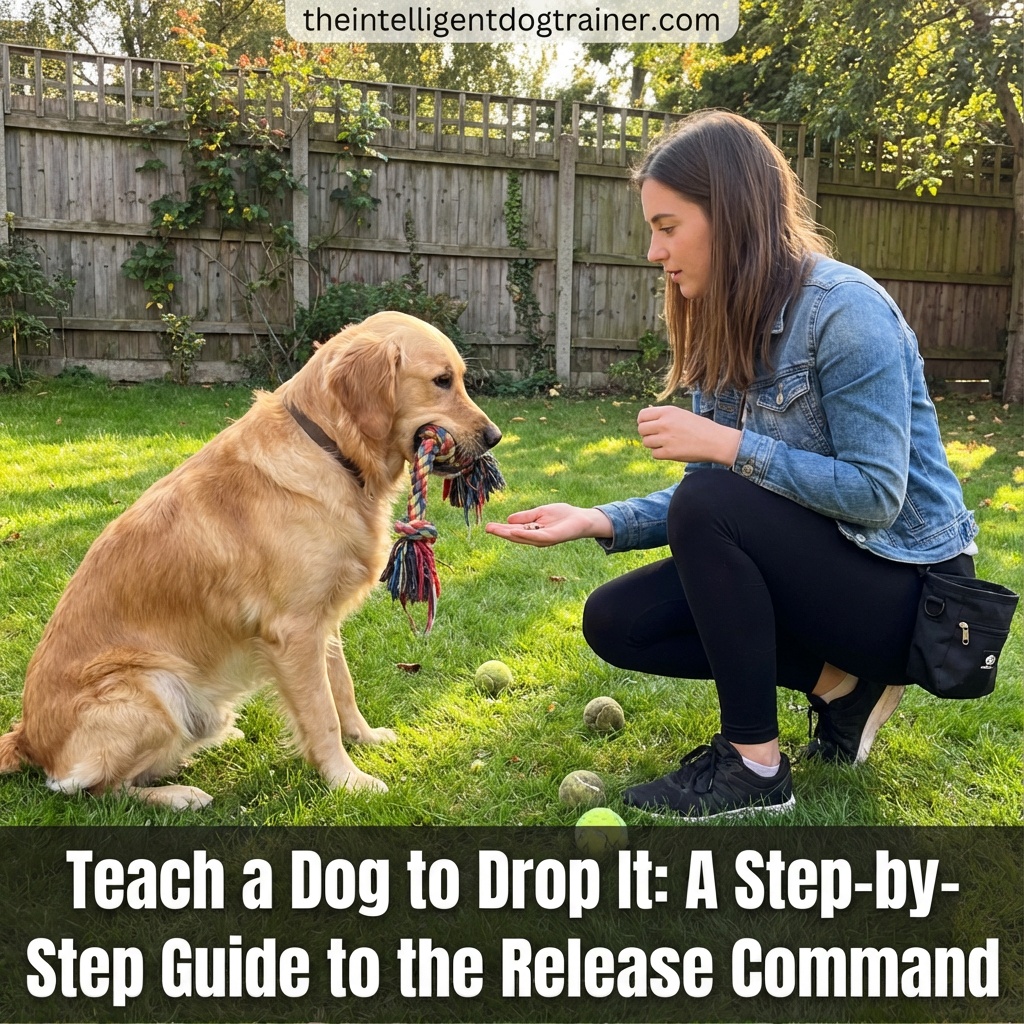
Guiding your four-legged companion to release an object on cue is far more than a simple parlor trick; it is a vital safety skill that every responsible owner should cultivate.
Whether your pup has scavenged a questionable snack from the pavement or is gripping a favorite toy with a bit too much intensity, knowing how to teach a dog to drop it can prevent the ingestion of dangerous items and foster a much more balanced relationship.
Throughout this guide, we will delve into the subtleties of the release command, focusing on positive reinforcement techniques that transform a potentially stressful lesson into an engaging game.
By the time you finish reading, you will possess a practical strategy to ensure your dog responds with consistency, even when they have found something truly irresistible.
The Importance of the Drop It Command for Canine Safety
In the world of pet ownership, the “drop it” command serves as a genuine life-saving tool. Because dogs are inherently curious, they navigate their environment primarily with their mouths, which frequently leads them to pick up hazardous materials like chocolate, stray plastic fragments, or even toxic garden plants.
When you teach dog drop it command protocols effectively, you gain the power to intervene before a moment of curiosity spirals into an emergency trip to the veterinarian.
This isn’t merely about exercising authority; it is about establishing a bridge of trust where your pet learns that letting go of a “treasure” consistently results in a favorable outcome.
Safety isn’t limited to physical wellbeing; it also dictates how smoothly your dog navigates social spaces and behavioral boundaries. A dog that is comfortable releasing objects is significantly less likely to engage in frustrating games of “keep-away” that often test an owner’s patience.
By integrating various effective dog training techniques, you can maintain your dog’s focus and responsiveness in high-pressure settings, such as a crowded local park or a home filled with guests.
New trainers often wonder about the timeline for success in these sessions. While a particularly bright pup might pick up the basics in a few days, you might find yourself asking: How long does it typically take for a dog to master the drop it command?
Generally speaking, if you commit to consistent daily practice, most dogs will reach a point of proficiency within two to four weeks, although performing the task in highly distracting outdoor environments may require a bit more time to perfect.
Understanding the Difference Between Drop It and Leave It
A frequent source of frustration for many owners lies in the confusion of drop it vs leave it dog training. Although they may seem interchangeable at first glance, they occupy very different roles in a dog’s vocabulary.
Think of “leave it” as a preventative measure; it instructs the dog to ignore an object before they ever make physical contact with it. In contrast, “drop it” is a reactive measure used strictly when the dog already has something held between their teeth.
What is the main difference between the ‘leave it’ and ‘drop it’ commands? Put simply, “leave it” focuses on the act of ignoring a temptation, while “drop it” centers on the act of surrendering a possession.
Drawing this clear distinction is crucial because it eliminates the mixed signals that often stall progress. For example, if your dog is merely sniffing a piece of fallen food, the “leave it” cue is appropriate. However, if they have already managed to snatch it, you must immediately pivot to the release command.
This level of precision in your communication is incredibly helpful for managing daily household challenges, such as when you need to stop a dog from counter surfing or reclaiming a TV remote stolen from the table.
By applying the correct cue at the precise moment it is needed, you reinforce your role as a reliable and clear-headed leader in your dog’s eyes.
How to Teach Your Dog the Release Command Using Positive Rewards
To teach dog drop it command fundamentals correctly, it is essential to lean into positive rewards rather than resorting to physical intervention.
The psychological goal is to convince the dog that letting go is actually in their best interest. Start the process with a low-value item, like a plain rubber toy. Once they are holding it, present a high-value treat close to their nose.
The very second they open their jaw to accept the treat, provide the verbal cue “drop it.” Many trainers find that using a specific marking sound can accelerate this realization.
Should I use a clicker when teaching my dog to release an object? Absolutely; a clicker allows you to pinpoint the exact millisecond the item hits the floor, which helps the dog connect their action with the coming reward.
You can explore further details on how to clicker train a dog to refine your timing and make your training sessions more efficient.
The nature of the reward can also be tailored to what your pet loves most. You might ask: Is it okay to use a toy instead of a treat as a reward for dropping an item? It certainly is.
For dogs with a high play drive, “trading” a boring object for a spirited game of fetch can be just as motivating as a piece of cheese. The underlying principle is simple: the “payment” you offer must be more enticing than the object they are currently guarding.
The Power of the Trade: Getting Your Dog to Spit Something Out
Often referred to as the “Trade Game,” this method is perhaps the most effective way to frame the act of surrendering an item as a profitable exchange.
Rather than feeling like they are losing a prize, the dog learns that the act of dropping something actually “unlocks” a better opportunity. This is consistently the most reliable path for those wondering how to get dog to spit something out without triggering a defensive power struggle.
As you begin practicing these exchanges, you might wonder: What high-value treats work best for the trade game training method?
Professional trainers usually suggest using “high-value” snacks that are soft and pungent—think small pieces of boiled chicken, bits of string cheese, or specialized liver treats that aren’t part of their standard diet.
This level of incentive makes the trade almost impossible for a dog to refuse. This strategy is also a fantastic way to stop a dog from chewing on your furniture, as it provides them with an immediate and positive alternative to destructive habits.
If you have ever worried about how do I teach my dog to drop an item without forcing their mouth open?, the answer always comes back to the trade.
Physically prying a dog’s jaws apart can inadvertently teach them to fear your hands or even spark aggression. Instead, hold the treat to their nose and let patience do the work. Eventually, the sensory appeal of the snack will naturally override their desire to keep hold of the object.
Advanced Strategies to Stop Your Dog Guarding High-Value Toys
Resource guarding is a deeply rooted natural instinct, but it can quickly become a “problematic” behavior in a home setting. To effectively stop dog resource guarding toys, you must nurture a relationship built on the concept of “giving” rather than “taking.”
If you frequently snatch items away, your dog may view your approach as a threat to their resources. This often leads to the question: Why does my dog run away with objects when I try to take them? Essentially, they have learned that your proximity signifies the end of their fun.
By applying the “drop it” command with consistent rewards, you flip this script, proving that giving items to you results in a win-win scenario.
However, if your dog exhibits signs of tension, such as a stiff body or low growling, it is vital to proceed with caution. What should I do if my dog shows aggression when asked to drop a toy?
If safety becomes a concern, seeking the help of a professional is the best course of action. Look into specialized training for aggressive dogs to modify these behaviors in a secure and structured way.
You can also use active playtime to reinforce these lessons. Can playing tug-of-war help teach the drop it command? It is actually one of the most effective ways to train the cue in a “high-arousal” state.
During the game, simply stop pulling—let your arms go limp—and ask for the drop. When they let go, the reward is an immediate resumption of the game. This teaches the dog that dropping the toy isn’t a loss; it is the “key” that restarts the fun.
Common Challenges When Training the Drop It Verbal Cue
Even with the most dedicated approach, you might hit a few bumps when learning how to teach dog release command mechanics.
A frequent pitfall is the “bribe” trap, where a dog decides they will only listen if they see the treat in your hand first. To overcome this, start hiding the reward behind your back or in a pocket, only revealing it once the dog has successfully responded to your verbal instruction.
Consistency remains the cornerstone of how to train a dog with lasting results.
If one person in the house treats a stolen sock like a game of chase while another demands a “drop it,” the dog will inevitably become confused. It is essential that every family member uses the same cue and follow-through.
What is the best way to practice the drop it command during walks? Bring a variety of high-quality treats and occasionally ask your dog to release a mundane item like a twig or a leaf.
Rewarding them heavily for these easy wins builds a strong reflex for when the stakes are higher. In 2025, the focus of modern canine education has shifted firmly toward behavioral psychology, moving away from outdated “alpha” or dominance-based theories.
By prioritizing clear communication and the “power of the trade,” you transform a moment of potential conflict into a meaningful bonding opportunity. Every successful release is a building block toward a safer, more cooperative, and happier life with your pet.
Mastering the “drop it” command is a collaborative journey that relies on patience, steady practice, and a steady supply of high-value incentives.
By grasping the differences between similar commands and leaning into the “trade” philosophy, you can teach your dog to surrender any object reliably.
This doesn’t just keep them safe in the face of danger; it also proactively prevents issues like resource guarding. Through positive reinforcement and regular engagement, you will create a foundation of mutual trust that benefits the entire household.