
Have you ever felt like your canine companion is tuned into every frequency except your own? From a scampering squirrel across the street to a simple leaf dancing in the wind, capturing a pup’s attention amidst the world’s distractions is the true cornerstone of successful obedience.
In this guide, we will explore exactly how to teach a dog the watch me command, a fundamental skill that shifts a distracted pet into a focused and willing partner. By mastering this deceptively simple behavior, you are doing more than just teaching a neat trick.
You are establishing a clear channel of communication that ensures both safety and cooperation, no matter where you are.
The Importance of Building Engagement with Your Dog
Cultivating a deep-seated sense of engagement is often regarded as the “secret sauce” used by professional trainers. But why is the watch me command essential for obedience training?
The logic is straightforward: if your dog isn’t looking at you, they aren’t truly listening to you. Engagement acts as a mental tether between you and your dog, making it significantly easier to provide further directions.
When you prioritize effective dog training techniques, you place the relationship above the mechanical behavior, ensuring your dog chooses to work with you rather than feeling coerced.
This psychological connection is especially invaluable for dogs that become easily overstimulated, a topic often explored in the broader context of Wikipedia entries on animal behavior.
Many owners find themselves asking: Can the watch me command help with leash reactivity? The answer is an emphatic yes.
By training your dog to “check in” with you, you can pivot their focus away from stressful triggers and back toward your face, effectively diffusing a reactive outburst before it even starts.
To succeed, you must essentially become more captivating than the surrounding environment. True engagement isn’t just a byproduct of treats; it’s fueled by your energy, your body language, and the bond you nurture every day.
By building engagement with your dog from their earliest puppy days—or even after bringing home a senior rescue—you lay the groundwork for a lifetime of reliable responses.
At the end of the day, a dog that keeps an eye on their owner is a dog that remains safe, focused, and ready for any challenge.
How to Get a Dog’s Attention Using Positive Reinforcement
Learning how to get a dog’s attention requires us to think about what actually drives them. Positive reinforcement stands out as the most powerful tool for encouraging a dog to offer their focus of their own fruition.
Many experts find that utilizing a “bridge,” like a clicker, helps to pinpoint the precise moment a dog offers eye contact. If you decide to clicker train a dog, you can clearly signal to your pet that meeting your gaze is the absolute best way to earn a reward.
One of the first hurdles many owners face is selecting the right motivation. What are the best high-value treats to use for attention training?
Generally, you want rewards that are pungent and soft—think tiny morsels of boiled chicken, cheese, or high-quality training treats—rather than standard dry kibble.
You might also contemplate, is it better to use a clicker for teaching eye contact? While it isn’t mandatory, a clicker offers a distinct, consistent sound that cuts through the noise of the real world.
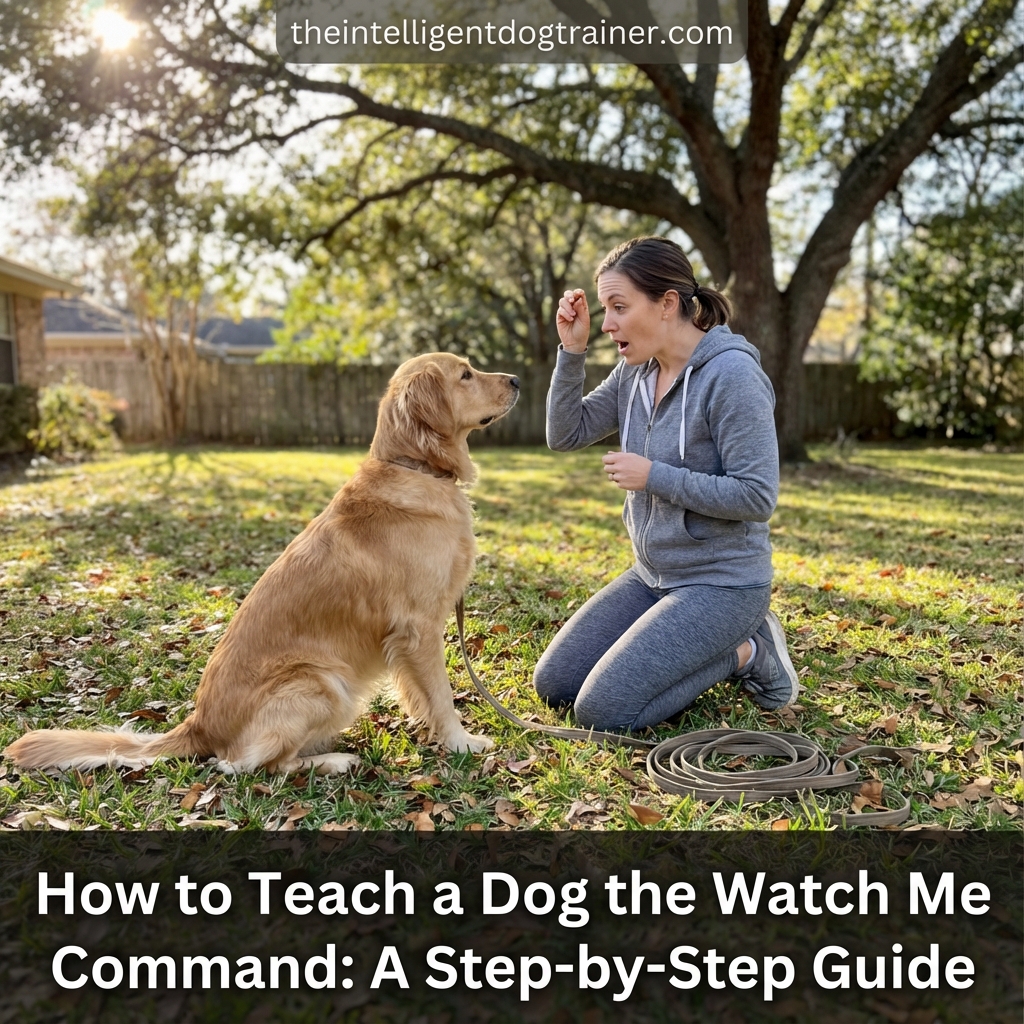
Kick things off in a tranquil setting with minimal interruptions. Hold a treat in your closed hand and simply wait for the dog to shift their gaze from the food to your face.
The second your eyes meet, click (or use a verbal marker like “Yes!”) and provide the reward. This teaches the dog that looking at their human is the primary way to get what they want.
By consistently building engagement with your dog through these positive repetitions, you transform “watching you” from a forced chore into a rewarding natural habit.
Phase One: Train a Dog to Make Eye Contact
Before you ever introduce a formal verbal cue, you need to train a dog to make eye contact voluntarily. This technique is often referred to as “capturing” the behavior.
To start, hold a treat between your fingers, let your dog catch the scent, and then move your hand in an invisible line from their nose up to the bridge of yours.
As soon as your dog locks eyes with you, offer warm praise. You might naturally wonder, how long should I expect my dog to hold eye contact initially?
At the beginning, even a fleeting second of focus is an achievement worthy of a reward. As their proficiency grows, you can start asking for a little more duration.
If your dog seems to be struggling with the concept, it can be helpful to warm up with some simpler foundation exercises, such as when you teach a dog to sit, just to get them into a focused “learning mode.”
A common worry for many is: What should I do if my dog refuses to look at my face? Some pups might find direct eye contact a little intimidating or may simply be too fixated on the treat in your hand.
In these instances, try holding the reward slightly to the side of your eye rather than directly in front, or reward them the moment they look anywhere near your face to help build their confidence.
The overarching goal is to keep dog focus training exercises lighthearted and stress-free. Once they realize eye contact is a fun game, they will start offering it more frequently.
During this phase, your consistency is vital—keep your sessions brief and full of positive energy.
Adding the Look at Me Dog Command to Your Routine
Once your pet is consistently following the lure to your eyes, you are ready to introduce the formal look at me dog command.
This step involves linking a verbal label to the physical action they’ve already mastered. Simply state “Watch” or “Look” the moment their eyes meet yours.
It is crucial to wait for the action to happen before saying the word so the association remains crystal clear. This is a primary step in learning how to train a dog to listen to your voice.
Owners often ask, what is the difference between the look and watch commands? In reality, there is no technical difference; it is purely a matter of which word feels more natural to you.
The key is to pick one and stick with it consistently. You might also ask, how many times a day should we practice the attention command?
It is always better to have short, frequent sessions. Try for two or three mini-sessions a day, lasting only about five minutes, to keep the dog engaged without causing boredom or frustration.
As we move toward modern training standards for 2025, incorporating “passive” training is also highly effective. This involves rewarding your dog whenever they spontaneously choose to look at you throughout the day.
This reinforces the concept that building engagement with your dog is a constant way of life, not just something reserved for a training mat.
Eventually, you’ll be able to phase out the lure and the constant treats, relying more on your voice and a quick pat for reinforcement.
Advanced Dog Focus Training Exercises for Real-World Success
Once the basics are solid, it’s time to take your dog focus training exercises out for a spin in the real world.
A dog that is a star in the living room might find it much harder to focus when faced with neighborhood birds, cyclists, or other pups.
To bridge this gap successfully, start practicing the command while you train a dog to walk on leash in relatively quiet outdoor spots.
A frequent question that arises during this transition is: When can I stop using treats for the watch me command? While you shouldn’t stop rewarding entirely, you can transition to an “intermittent schedule.”
Once the behavior is about 90% reliable, try rewarding with a treat every second or third time, using enthusiastic praise for the remaining reps to keep your dog motivated.
Another excellent advanced drill is the “Distraction Yo-Yo.” Have a friend stand a few yards away waving a favorite toy while you ask for a “Watch.”
The very moment your dog chooses you over the toy, give them a “jackpot” of several treats at once! This teaches them that you are consistently the most rewarding element in any environment.
When you teach a dog to focus on owner interactions regardless of the surrounding chaos, you gain the confidence to take your dog anywhere.
How to Teach a Dog to Focus on the Owner Around Distractions
The final hurdle in focus training is maintaining that attention when the stakes are high. You might find yourself wondering, how do I teach my dog to look at me when high distractions are present?
According to the principles of Wikipedia on operant conditioning, the secret lies in managing “distance and duration.”
If your dog cannot focus with a squirrel five feet away, try moving back to ten or fifteen feet. This approach is specifically helpful to stop dog pulling on leash when they are locked onto something.
When you teach a dog to focus on the owner in the middle of a busy environment, you are essentially learning to compete with the world. Always bring your “A-grade” treats for these scenarios.
If your dog is struggling to respond, don’t be afraid to take a step back; training progress often involves small retreats before making big leaps forward.
By 2025, the heart of modern training is the understanding that focus is a two-way street. It isn’t just about the dog watching you; it’s about you being finely tuned to your dog’s emotional state.
Mastering the “Watch Me” command provides a reliable “reset button” for your dog’s mind. Whether you are navigating a bustling cafe or a crowded waiting room, these dog focus training exercises allow you to bring your dog back to a calm state.
Teaching the “Watch Me” command is truly one of the most rewarding steps you can take in your journey together.
By transitioning from basic eye contact to unwavering attention amidst distractions, you build a language based on mutual respect and clarity.
Stay patient, keep your training sessions upbeat, and always prioritize the bond you share with your dog. With steady consistency, your dog will soon be looking to you for guidance in every situation.