
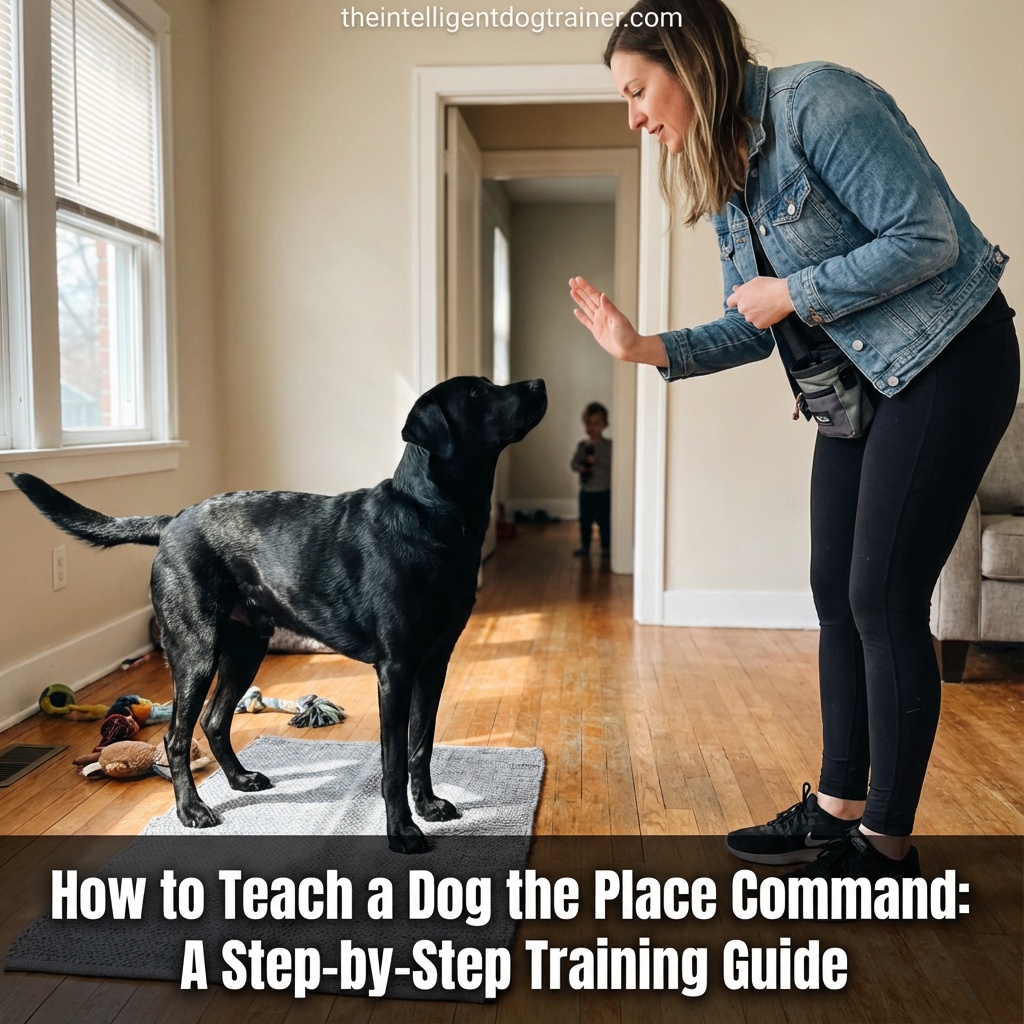
Developing a deep, reliable connection through training is one of the most fulfilling aspects of sharing your life with a pet, yet few skills are quite as impactful as the “place” command. It helps to think of this cue as a physical and mental “reset button” for your canine companion.
By using it, you provide them with a dedicated sanctuary—a clear safe zone where the only requirement is to relax and stay put until they hear their official release word. Whether you are tired of your dog hovering expectantly at the dinner table or need a way to settle their frantic energy when the doorbell rings, learning how to teach a dog the place command is a fundamental pillar of modern, well-mannered dog ownership.
In this guide, we will explore why this behavior is so incredibly practical and walk through the specific steps to help your dog find their “off switch” regardless of what is happening around them.
Understanding the place command and why your dog needs it
At its most fundamental level, the place command is an instruction for your dog to seek out a defined boundary—such as a bed, a specialized mat, or a raised cot—and remain there until you give them the “all-clear.” Unlike a standard “sit,” which is often just a momentary posture, “place” is specifically intended to foster a genuine state of mental tranquility.
It serves as a total lifesaver for managing household chaos, particularly during those hectic stretches in the kitchen or when a delivery driver pulls into the driveway. Many frustrated owners often ask, can the place command stop my dog from rushing the front door? The answer is an emphatic yes.
By giving your dog a specific “job”—simply staying on their mat—you help them redirect that impulsive urge to bolt into a structured, stationary, and rewarding task. The true magic of this cue lies in the underlying psychology.
Research into animal behavior suggests that having a “safe home base” can significantly lower a dog’s overall stress levels. It effectively removes the heavy burden of decision-making during high-trigger moments.
Whether you are starting fresh with a bouncy puppy or working with an older dog who has a few ingrained habits, mastering how to train a dog effectively requires clear boundaries and a healthy dose of patience. This isn’t merely a clever party trick; it is a vital life skill that cultivates impulse control and teaches your dog that they can be a calm, integrated part of the family without always being physically under your feet.
Essential dog training place command steps for beginners
Getting started with the dog training place command steps is primarily about preparation and having the right motivation ready to go. You’ll need a highly visible boundary, such as a dedicated rug or a training cot, along with some high-value treats that your dog finds truly irresistible.
Start the process by “luring” your dog toward the mat with a treat held right at their nose. The very moment all four paws land on the target surface, mark that success with an enthusiastic “Yes!” or a click, and deliver the reward immediately.
You might wonder, should I use a clicker to teach my dog the place command? While you can certainly train successfully without one, a clicker acts as a highly precise “bridge” that tells your dog exactly which millisecond of behavior earned the prize, which often significantly accelerates the learning curve.
As your dog begins to step onto the mat with more confidence, you can start layering in the verbal cue “Place.” To really solidify the association, it helps to clicker train a dog by timing your signal the exact second they make contact with the target area.
How long does it typically take to teach a dog to go to their place? Most dogs will grasp the basic concept within just a few short, 15-minute sessions. However, achieving that 2025-level mastery—where they stay put even amidst heavy distractions—usually requires a few weeks of steady, consistent practice.
A vital tip for long-term success is to always use a release word like “Okay” or “Free” before they step off, ensuring they understand the boundary remains active until you personally dismiss them.
How to train a dog to settle on a mat with positive reinforcement
The next phase of the process is moving beyond simply “standing” on the mat and transitioning into a state of total relaxation. This is the stage where owners often ask, what type of bed or mat is best for teaching the place command?
For dogs just starting their journey, a raised orthopedic bed or a rug with a very distinct texture is perfect because it provides a physical “border” they can easily feel beneath their paws. Once your dog is settled on the mat, wait for them to eventually offer a “down” position on their own accord, then reward that choice generously.
This helps them realize that the mat is a dedicated zone for calm, showing you exactly how to train a dog to settle on a mat through their own choice rather than through force or pressure. Positive reinforcement is all about creating a happy, voluntary association with their specific spot.
You can utilize various dog training techniques like “capturing,” which involves rewarding your dog whenever you catch them making the independent choice to rest on the mat.
If you are curious, how can the place command help manage a hyperactive dog?, the secret lies in how it lowers physiological arousal. By rewarding a settled, lying-down posture instead of a high-energy stance, you are essentially teaching their brain to shift into a lower gear.
This comes in incredibly handy during family dinners or when guests arrive, giving your dog a productive and peaceful way to channel their energy.
Comparison guide: The place command vs stay in daily obedience
It is very common for pet parents to blur the lines between “place” and a standard “stay,” but they actually serve very different roles in your daily training toolkit. When people ask, what is the difference between the ‘place’ command and ‘stay’?, the distinction is usually centered on freedom and duration.
A “stay” is typically a more rigid command where the dog is expected to remain in one specific posture (like a formal sit) without moving an inch. Conversely, the place command vs stay dynamic allows for a bit more autonomy; as long as those four paws stay within the designated boundary of the mat, the dog is free to sit, stand, circle, or lie down comfortably.
This added flexibility is what makes the place command far superior for long-term relaxation. While you might train a dog to stay for a brief moment at a busy street corner, asking for a rigid “stay” during a thirty-minute family meal is a very big ask for any dog.
How do I increase the duration my dog stays in their place? You achieve this by gradually stretching the time between rewards while they are resting on the mat.
By focusing on the duration of the stay rather than a frozen physical pose, you create a dog that is happy to “park” themselves for longer periods, making your daily household routine much more organized and peaceful.
Increasing distraction and teaching duration for place command success
Once the boundary is clearly understood, the real-world challenge lies in teaching duration for place command success when life gets busy. You can’t realistically expect a dog to stay glued to their mat if a squirrel runs by the window or a guest walks through the door without practicing those specific scenarios first.
Start small by introducing minor distractions—perhaps take a single step away or wave your arms slightly—and reward your dog for staying put. If you find yourself wondering, what if my dog keeps getting off their mat before I release them?, it is usually a sign that the current challenge is a bit too high.
Just calmly lead them back without a reward and try a slightly easier version of the task to rebuild their confidence. Building this kind of impulse control is the “secret sauce” for resolving many common behavioral hurdles.
For instance, it is a remarkably effective way to stop a dog from jumping on visitors. If your dog is fully committed to holding their “place” when someone enters the home, they aren’t physically able to be at the door lunging at your guests.
Is the place command effective for stopping dogs from jumping on guests? It truly is, because it gives them an incompatible, highly rewarding task to focus on instead. Always remember to praise them for their social “grit”—staying focused through the distraction—as this is what builds the mental muscle required for real-world reliability.
Using the place command for reactive dogs to build focus and calm
The place command for reactive dogs is an essential tool for emotional self-regulation. For dogs that often feel overwhelmed by fear or over-excitement, the mat becomes a predictable sanctuary where the environment is controlled and the rewards are steady.
By concentrating on their spot, the dog learns how to effectively tune out triggers, like a neighbor walking past the front window. Many owners ask, can I use the place command to help with separation anxiety or barking?
While it isn’t a magic silver bullet for every complex issue, it provides a structured routine that lowers general anxiety levels, making it much easier for a dog to cope with solitude or external noises. In more sensitive training cases, such as when you need to train an aggressive dog, the place command allows for much safer and more effective environmental management.
The principles of operant conditioning show us that by consistently reinforcing a peaceful state on the mat, you are effectively competing with the dog’s reactive urges.
Over time, your dog will naturally start to view the mat as the place where they can finally “switch off” and let you handle the complexities of the world. This transition from being reactive to being focused is a major milestone in advanced training, ultimately leading to a much more harmonious and stress-free life for everyone involved.
At the end of the day, the place command is arguably one of the most practical and life-changing behaviors you can ever teach your dog. By following these structured steps—moving from simple luring to managing complex real-world distractions—you provide your companion with the mental framework they need to thrive in a busy human environment.
Recognizing that “place” is fundamentally about relaxation rather than a rigid, frozen “stay” ensures your dog remains a calm, welcome participant in your daily activities. With a little bit of patience and a lot of positive reinforcement, that simple mat will likely become your dog’s favorite place to be.