
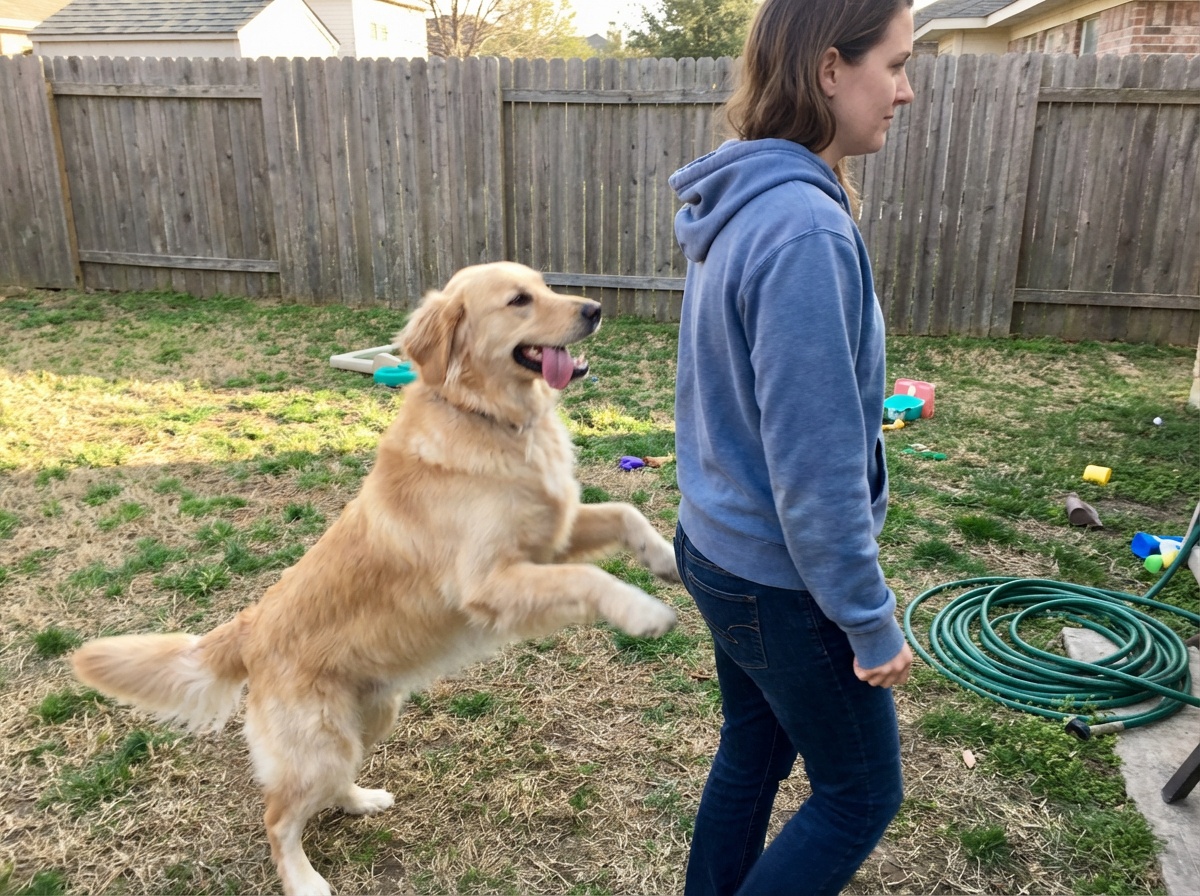
We have all navigated that familiar, chaotic entry: you wrestle the front door open, arms laden with grocery bags or perhaps dressed for a serious meeting, only to be immediately besieged by a whirlwind of fur and unbridled enthusiasm.
While the affection we share with our canine companions is undeniably heartwarming, living with a dog that launches themselves at you or your guests is not merely a nuisance—it presents genuine safety risks, particularly when frail relatives or small children are involved.
If you are currently struggling to figure out how to stop a dog from jumping, take comfort in the fact that you aren’t alone; this specific issue ranks among the most frequent behavioral challenges dog owners encounter.
Fortunately, this is a solvable puzzle. Jumping is a natural instinct, yet it is one that can be modified through consistency and an appropriate methodology.
Our goal isn’t to crush their spirit or dampen their joy; rather, it is about channeling that boundless energy into a form of greeting that doesn’t involve bruised shins or muddy clothes.
Whether you are managing a boisterous puppy or an older dog with years of practice, the journey toward polite greetings begins with understanding the motivation and committing to a plan that rewards keeping four paws firmly on the floor.
Understanding Why Your Dog Jumps on People
To truly change a behavior, we must first comprehend what drives it. When frustrated owners ask, “Why does my dog jump on me constantly?”, the answer takes us back to early canine development.
In the litter, puppies jump up to lick their mother’s face, a greeting ritual that naturally stimulates regurgitation for food. As they mature, this instinct evolves into a way to simply say “hello” and get as close as possible to your face, which remains the primary source of your communication and attention.
It is vital to recognize that your dog isn’t attempting to dominate you; they are simply overflowing with excitement. You might observe this pattern and wonder, “Why does my dog jump when excited but not when calm?”
When a dog’s arousal levels spike—such as the moment you walk through the door—their impulse control plummets, and they default to instinctual actions.
Jumping is inherently self-rewarding because it usually yields attention, even if that attention involves you pushing them away or shouting “No!” In the canine mind, any interaction is often preferable to being ignored.
Transforming this dynamic requires shifting our perspective from merely correcting the dog to teaching them a new language of interaction. Establishing a robust foundation in learning how to train a dog relies on the principle that dogs repeat behaviors that are successful for them.
If jumping ceases to generate attention, but keeping feet on the floor begins to pay off, the behavior will naturally reshape itself over time.
How to Stop Dog Jumping on People Using the Ignore Method
One of the most powerful strategies at our disposal is “negative punishment,” a technical term that simply means withholding the very thing the dog desires—your attention—whenever they engage in the unwanted action.
This philosophy forms the core of the ignore dog jumping training method. The concept is deceptively simple but demands rigorous timing: the instant those paws leave the ground, you must essentially become a statue or remove yourself from the immediate vicinity.
You may wonder, does turning your back stop a dog from jumping? Yes, and it is highly effective because it instantly severs the face-to-face connection the dog is seeking.
When your dog jumps, cross your arms, gaze at the ceiling, and turn your back completely. Remain silent, avoid eye contact, and do not push them away. Wait for that precious split second when all four paws return to the floor before you offer any engagement.
While some outdated advice recommends physical aversives, finding yourself asking, “Is using a knee to block a jumping dog effective?” should lead to a firm “no.”
Modern behavioral science strongly advises against kneeing a dog in the chest. Beyond the risk of physical injury, this tactic can erode the bond of trust between you and your pet, or paradoxically increase excitement in high-drive dogs who might interpret the roughness as a wrestling game.
Instead, lean on proven positive dog training techniques that focus on withholding rewards rather than inflicting physical discomfort.
How to Teach Your Dog to Greet Politely Instead
Simply ignoring the bad behavior is only half the equation; you must also provide a clear directive on what they should be doing. To teach dog to greet politely, we utilize the concept of an “incompatible behavior.”
Quite simply, a dog cannot jump on you if they are sitting or lying down. This allows us to bridge the gap between “stop doing that” and “do this instead.”
Owners often search for a magic word, asking, “What is the command to stop a dog from jumping?” While many default to “Off”—which generally means “get off of me or the furniture”—the superior command is “Sit.”
Try to anticipate the jump before it occurs and ask for a sit. When they comply, reward them heavily with high-value treats and calm praise.
If you are curious “How long does it take to train a dog not to jump?”, the timeline depends entirely on consistency. It usually takes a few weeks of daily repetition for the new habit to solidify.
Cultivating this level of focus requires the same discipline used for other core commands. Just as you build engagement when you train a dog to come when called, you must build immense value in the “Sit” position during greetings.
If the payout for sitting exceeds the reward for jumping, the choice becomes obvious to your dog.
Effective Ways to Stop a Puppy from Jumping Up
When working with young dogs, you have the distinct advantage of a relatively clean slate, though you must also contend with boundless puppy energy. To stop puppy jumping up, it is imperative that every member of the household adheres to the same rules.
If you diligently ignore the jumping but your children allow the puppy to scramble all over them, the puppy will become confused and continue testing boundaries.
A frequent question arises: How should I react when my puppy jumps on me? The answer is to strictly withdraw attention immediately.
If they persist in jumping and nipping, you may need to step behind a baby gate or retreat to another room for a brief “time-out” until they settle.
As for the question, “Can older dogs learn to stop jumping like puppies?”, the answer is absolutely. While puppies might learn the concept faster, older dogs often possess better impulse control once they grasp the rules.
The process remains identical; it may simply require a bit more patience to override the established habit.
Puppies often compound jumping with mouthing or nipping, making it important to address these issues holistically. The techniques used to calm a jumping puppy are often synonymous with strategies on how to stop puppy biting, as both behaviors stem from over-arousal and a lack of body inhibition.
Managing the environment to prevent the puppy from practicing the mistake is key to success.
Correcting Dog Jumping When Excited and Greeting Guests
The ultimate test for any owner is the arrival of visitors. You might have a dog that behaves perfectly with you, yet typically the doorbell rings and chaos ensues.
Effective dog jumping when excited correction relies more on management than immediate training during these high-stress moments. You cannot expect a highly aroused dog to heed a “Sit” command if they haven’t first mastered it in a quiet, calm environment.
So, How do I get my dog to stop jumping on guests? The smartest approach is to prevent the jump from happening physically.
Can leashing my dog inside help with jumping? Yes, keeping your dog on a leash when guests arrive allows you to control the distance.
You can step on the leash—leaving enough slack to stand comfortably but not enough to jump—to physically prevent the behavior while rewarding them for keeping four paws on the floor.
Another excellent strategy involves giving the dog a specific task when the doorbell rings, such as retreating to their bed or utilizing skills from learning how to crate train.
This ensures they have a safe, confined space to calm down before interacting with visitors, removing the immediate pressure of the greeting and keeping your guests safe from scratchy paws.
Managing Dog Jumping on Strangers During a Walk
The world outside your front door presents a different set of variables. Dog jumping on strangers walk situations can be both embarrassing and stressful.
Well-meaning strangers often inadvertently sabotage training by exclaiming, “It’s okay, I love dogs!” while encouraging the jump. You must act as your dog’s advocate, firmly telling people, “Please wait, we are in training,” before allowing any approach.
Regarding socialization, meeting people on walks is beneficial, but only if the interaction remains calm.
If your dog begins pulling and attempting to launch toward a passerby, retreat to a distance where the dog can refocus on you. Ask for a sit, and reward the dog for looking at you rather than the stranger.
Control is vital in these scenarios. A loose leash indicates a relaxed mental state, whereas a tight leash often telegraphs tension down to the dog.
Mastering valid techniques on how to train a dog to walk on leash will give you the mechanical control necessary to prevent the dog from lunging.
By controlling the distance and the nature of the greeting, you ensure that every interaction reinforces polite behavior rather than excited jumping.
Conclusion
Learning how to stop a dog from jumping is a journey that requires patience, consistency, and a clear understanding of operant conditioning.
By steadfastly ignoring attention-seeking behaviors, heavily rewarding the incompatible action of keeping four feet on the floor, and managing high-excitement environments, you can transform your bouncy hound into a polite greeter.
Remember that your dog ultimately wants to please you; they simply need you to demonstrate that calmness, not chaos, is the key to unlocking the love and attention they crave.