
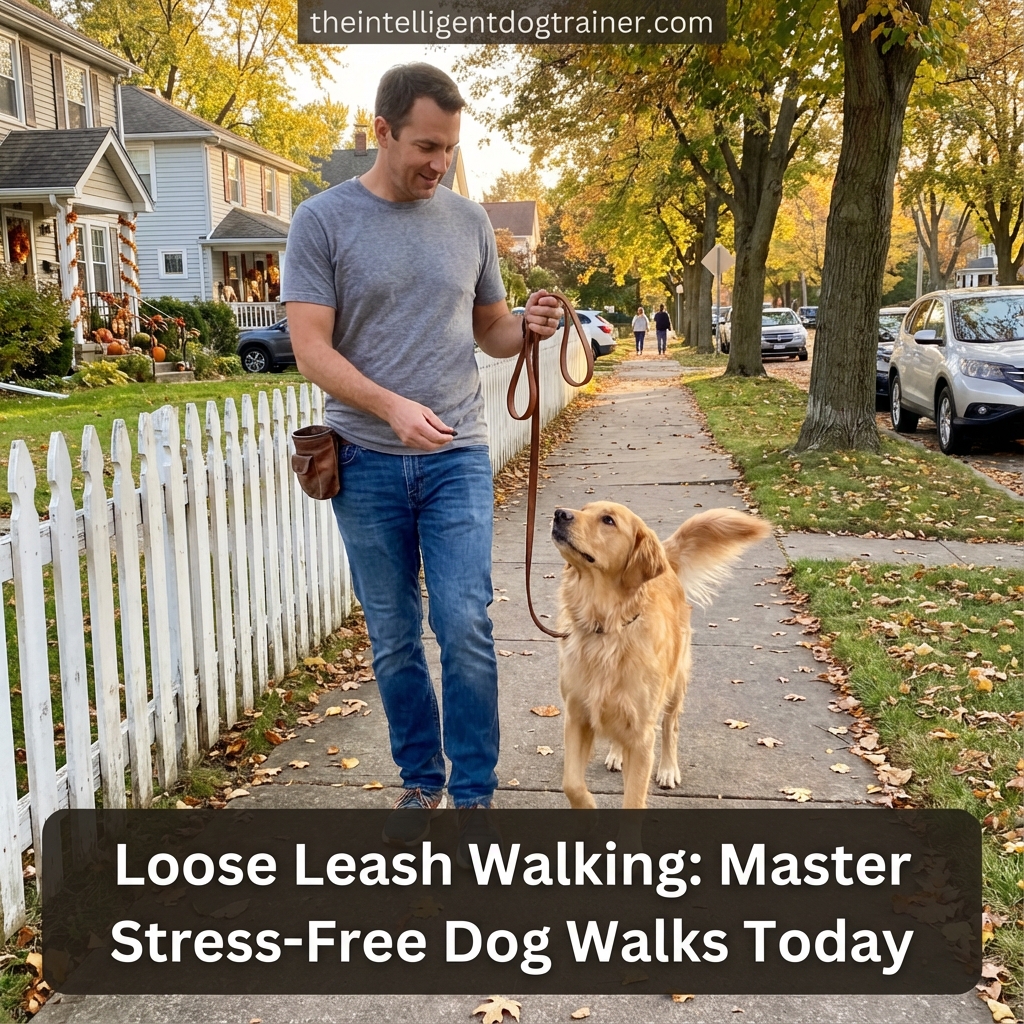
A stroll with your dog should ideally be a highlight of your day—a peaceful interval for both of you to stretch your legs and breathe in the fresh air.
Instead, many pet owners find themselves in a grueling tug-of-war that leaves their shoulders aching and their patience thin. Learning the art of loose leash walking is the definitive answer to this struggle.
This turns chaotic scrambles into fluid, synchronized movements. When you grasp the psychology of why dogs pull and implement science-based training, you can reach that “J-shaped” leash goal.
Your dog stays close simply because it is the most rewarding place to be. This guide offers the insights and practical tools you need to move through the world in total harmony.
The Fundamentals of Stress-Free Loose Leash Walking
The journey toward a relaxed walk begins with a simple realization: dogs naturally move at a much faster clip than humans.
To a dog, the outdoors is an intoxicating buffet of smells and sights; that tension on the line is usually just a byproduct of their sheer zest for life.
The bedrock of loose leash walking is teaching your dog that forward progress only happens when the leash is slack.
This approach hinges on patience and a dedicated use of positive reinforcement dog training to foster a relationship built on trust.
Rather than treating the walk as a physical grind, try viewing it as a mental exercise where you consistently reward your dog for “checking in” with you.
How do I keep my dog’s attention during walks? The trick is to make yourself more captivating than the environment.
By keeping high-value rewards on hand and frequently changing your tempo, you keep your dog engaged and curious about your next move.
It’s a frequent mistake to view leash manners as a matter of physical strength; they are, in fact, a form of dialogue.
As noted by Wikipedia, operant conditioning gives us the framework to reinforce calm, desirable behaviors.
When you reward the absence of tension, your dog eventually realizes that a loose leash is the “key” that opens up the world.
Start these lessons in quiet spots like a hallway or your backyard to ensure the basics are tucked away before you tackle the distractions of the neighborhood.
Effective Leash Training Techniques for Every Dog
Since every dog possesses a unique temperament and history, the path to a perfect walk might look a bit different for everyone.
One of the most effective leash training techniques is often called the “Penalty Box” or “Red Light, Green Light.”
The rules are simple: the moment the leash goes tight, you stop dead in your tracks—you become a tree.
You only start moving again once the dog returns to your side or settles back to create slack. For dogs that find the world particularly overwhelming, the silky leash method works wonders.
It teaches the dog to move with the pressure rather than fighting it, which naturally lowers their desire to strain against the restraint.
What should I do if my dog lunges at other dogs? This behavior is usually a hallmark of leash reactivity training requirements.
This is often triggered because the dog feels restricted by the leash and overreacts to social pressure. In these moments, creating distance from the “trigger” is your best strategy.
Can older dogs learn loose leash walking? They certainly can; dogs never stop learning, though it is always wise to check if pulling is a response to physical discomfort.
How long should leash training sessions last? Keep things brief and successful—around 5 to 10 minutes is the sweet spot to prevent mental burnout.
Frequent, short practices will always outperform an hour-long struggle where the dog spends most of its time hauling you toward every passing squirrel.
How to Stop Your Dog from Pulling on the Leash
A question every trainer hears is: “How do I stop my dog from pulling on the leash?” Often, the solution is found in focus.
If a dog is constantly scanning the horizon for the next distraction, they are bound to hit the end of the rope.
To truly stop dog pulling on leash, you need to be proactive about rewarding eye contact.
Weaving the watch me command into your routine allows you to catch their attention before the pull even begins.
If you notice your dog fixating on something, redirecting them and offering a reward turns a potential lunging match into a focused game of “look at me.”
Why is my dog pulling on the leash all of a sudden? A sudden shift in behavior could be anything from a spike in energy to an interesting new scent.
If the pulling becomes a theme of the walk, try the “About Face” maneuver. The second you feel the line tighten, walk in the opposite direction.
This teaches the dog that pulling actually carries them away from whatever they were trying to reach.
What is the fastest way to teach loose leash walking? While there are no shortcuts, high-frequency reinforcement is the most efficient way to build muscle memory.
Choosing the Best Training Leash for Your Needs
The tools you use can make your training either a breeze or a chore. Most professionals point toward a standard 6-foot lead made of nylon or leather.
This length offers a nice balance, giving the dog room to explore without letting them build up enough speed for a dangerous jolt.
Is a retractable leash good for training? Typically, no; these tools actually teach dogs that pulling is how they get more line.
Plus, those thin cords can be quite risky for both the handler and the pet.
Should I use a harness or collar for leash training? For powerful pullers, a front-attachment harness is a game-changer.
Occasionally, an owner might look into how to muzzle train a dog to keep outings calm for everyone involved.
The Wikipedia entry on canine gear explains how various designs distribute pressure across the body.
It is vital to avoid “corrective” collars that rely on discomfort, as these often cause negative associations with the environment.
Differentiating Loose Leash Walking vs Heeling
It helps to realize the difference between loose leash walking vs heeling, as they serve two very different functions.
Loose leash walking is a “casual” skill where your dog has the freedom to sniff and wander within the radius of the leash.
Heeling is a formal, precise position where the dog stays right at your hip with their eyes on you.
Heeling is fantastic for navigating a crowded sidewalk, but it is mentally exhausting for a dog to maintain for an entire outing.
You can teach a dog to heel as a specific tool to use in short, focused bursts.
Is loose leash walking the same as heeling? Not exactly. Think of a loose leash walk as a “casual chat” while heeling is like “marching in formation.”
It is also important to let your dog enjoy “sniffaris”—walks where their nose leads the way—for their mental well-being.
By distinguishing between these methods, you set clear expectations, making the experience much more predictable and fun for both of you.
How to Train a Puppy to Walk on a Leash Naturally
When you train puppy to walk on leash, you are working with a clean slate.
Since puppies can find the weight of gear strange at first, let them wear it around the house to get used to the feeling.
Use treats to lure them into following you without the leash attached initially. Once you clip on the lead, keep things light and avoid any jerky movements.
Puppies have the attention span of a lightning bolt, so fitting lessons into a structured puppy training schedule will help them stick.
A classic puppy hurdle is “anchoring,” where they simply sit down and refuse to budge.
Instead of tugging, use an enthusiastic voice and a treat to coax them forward. As mentioned on Wikipedia, early socialization is key to avoiding future problems.
Remember, for a puppy, every blowing leaf is a potential new best friend. By being the most exciting thing in their world, you lay the groundwork for a lifetime of easy walks.
Keep your goals realistic, focusing more on the quality of their focus than how many blocks you actually cover.
Perfecting a relaxed walk is a process of steady consistency and clear signals. By valuing the relationship over the destination, you can transform a stressful chore into the favorite part of your day.
Whether you are guiding a headstrong adult or a tiny puppy, the keys remain the same: patience, rewarding right choices, and using the right equipment.
As your bond grows, the leash will eventually feel less like a restraint and more like a safety net for a partnership built on mutual respect.