
Bringing a new puppy into your life is a heartwarming milestone, yet for the senior dog already living there, it can feel like a sudden invasion of their peaceful sanctuary.
Learning how to introduce a puppy to an older dog requires a nuanced approach that balances patience, biological insights, and proactive management of your home environment.
By prioritizing safety and respecting the existing social dynamics, you can guide a potentially stressful encounter toward a genuine, lifelong friendship.
This guide explores proven strategies to ensure your 2025 multi-dog household begins its journey on a stable and confident footing.
Preparing Your Home for Introducing a Second Dog
The groundwork for a successful relationship is laid well before the puppy ever crosses your threshold. When introducing a second dog, your main goal is to eliminate any reason for resource competition.
Since dogs are naturally territorial, the relentless “puppy energy” can easily overwhelm an older pet who has grown accustomed to a quiet routine.
Start by carving out distinct zones where each animal feels completely secure. This means setting up separate feeding areas and temporarily putting away high-value toys or chews to prevent “guarding” instincts from flaring up.
Scent familiarization is a subtle but powerful tool during this phase. Before the physical meeting, bring home a blanket or towel used by the puppy so your older dog can investigate the newcomer’s scent in a low-pressure environment.
It’s equally important to ensure your resident dog has a dedicated sanctuary—a “puppy-free zone”—where the youngster is strictly forbidden.
Utilizing effective crate training techniques allows your senior to retreat to a quiet haven when the puppy’s enthusiasm becomes a bit too much to handle.
Can adult dogs hurt puppies during introductions? Unfortunately, the answer is yes; even a gentle dog might snap if they feel cornered or overstimulated, which is why physical boundaries are so vital during the first few days.
Initial Meetings and the Parallel Walking Method for Dogs
That first face-to-face interaction should never happen inside the house, where the “home turf” advantage might trigger defensive behaviors.
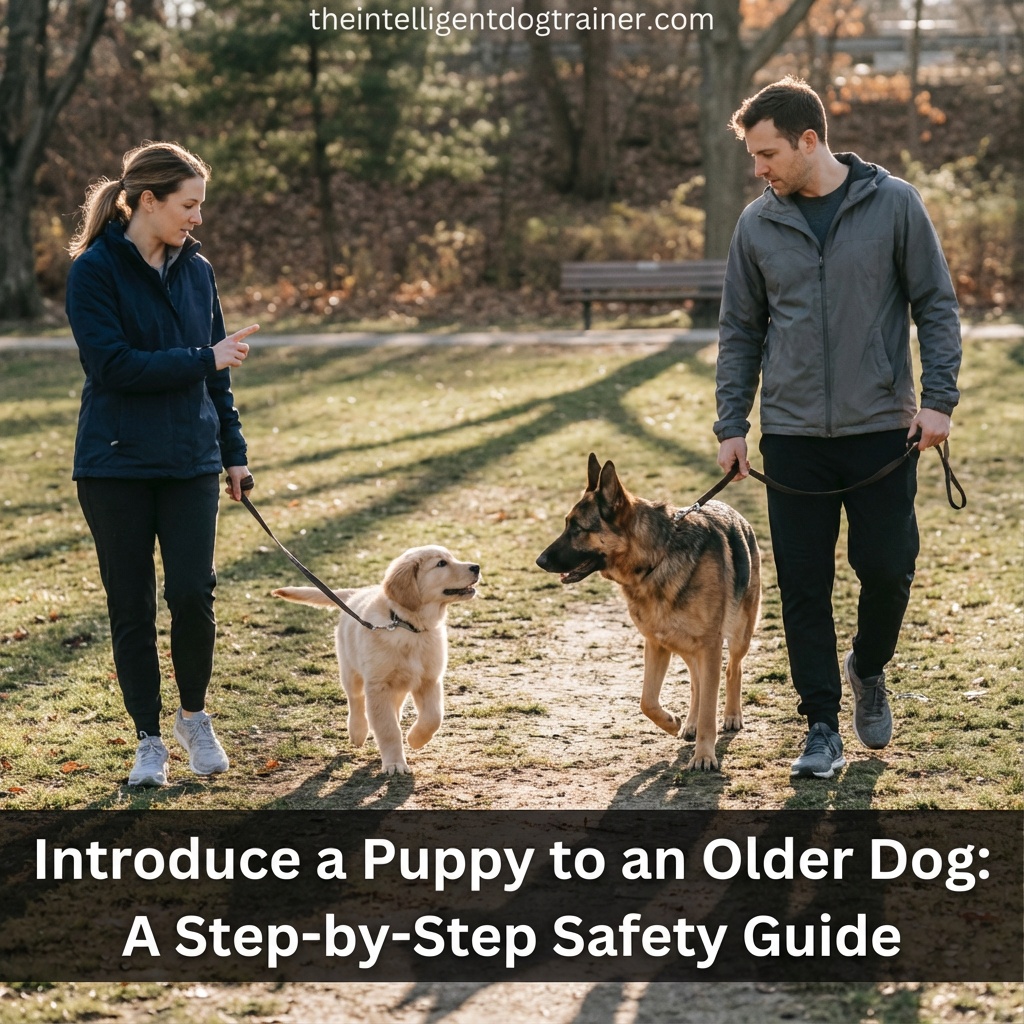
Instead, choose a neutral outdoor location, like a quiet park or a neighbor’s fenced yard. One of the most effective strategies for this is the parallel walking method for dogs.
This involves two handlers walking the dogs in the same direction, keeping enough distance so they aren’t forced into a direct stare or a lunging match.
As you see both dogs start to relax their posture, you can gradually decrease the space between them. This movement-based approach lets both dogs read one another’s body language naturally, without the mounting pressure of a static greeting.
As noted on Wikipedia, forward motion helps dissipate social tension and mimics the way canine groups move together in the wild.
If the puppy keeps pulling or the older dog starts showing signs of reactivity, it might be helpful to review leash walking fundamentals to maintain a calm atmosphere.
Only allow a supervised “sniff” once both dogs remain visibly composed and relaxed. How do I safely introduce a new puppy to my resident dog? Keep the initial greeting brief, keep it positive, and stay strictly on-leash so you can intervene the moment the energy shifts.
Effective Tips for Integrating a Puppy into a Multi-Dog Household
Once the outdoor meeting goes well, the focus of integrating a puppy into a multi-dog household moves to the daily indoor routine.
Puppies often lack “social etiquette” and might pester a senior who just wants to nap. Managing these early days through a structured schedule is essential.
Using baby gates or “tethering” the puppy to you ensures they won’t trap your older dog in a corner or interrupt their rest.
Consistency is the ultimate foundation for a quiet home. Try to keep your older dog’s schedule—their walks, nap times, and meals—as normal as possible to prevent them from feeling displaced.
Adopting a predictable puppy training schedule helps the new arrival understand when it’s time to play and when it’s time to settle down.
This structure also gives your senior dog much-needed “puppy-free” breaks to recharge. How do I feed two dogs in the same room safely? During the transition, it is much safer to feed them in different rooms or on opposite sides of a physical barrier to prevent any friction over food.
Is Your Older Dog Growling at the New Puppy? Understanding Limits
It’s natural for owners to feel a bit anxious when they hear their older dog growling at the new puppy, but this is often a healthy and necessary form of communication.
In the canine world, a growl is a clear boundary, essentially saying, “I’m not comfortable with this, please stop.” Generally, you should allow the older dog to provide these minor social corrections.
Should I let my older dog correct the puppy’s behavior? Yes, as long as the correction is balanced—like a low growl or a quick lip curl—because it teaches the puppy essential lessons in social respect.
Your role as the human is to watch how the puppy responds. If the youngster ignores the warning and continues to jump on the senior, you need to step in and redirect the puppy to something else.
Understanding the nuances of training an older dog to accept a new sibling means realizing that seniors may have less patience, perhaps due to age-related discomfort like arthritis.
Why does my older dog hide from the new puppy? It is common for seniors to feel overwhelmed by the constant movement; for them, hiding is a practical way to cope.
Respect their need for privacy and never force an interaction if they are asking for space.
Preventing Aggression and How to Stop Older Dog From Attacking Puppy
There is a distinct line between a helpful behavior correction and actual aggression. If you are concerned about how to stop older dog from attacking puppy, focus on prevention rather than reaction.
Serious aggression usually sparks when a dog feels their personal space is being ignored or their resources are under threat.
Keep play sessions short and end them before the dogs become over-excited; as Wikipedia explains, high arousal can quickly turn into defensive or predatory behavior.
Watch for red flags like a stiff body, a fixed stare, or a high, vibrating tail. If you notice these signs, separate the two and give the puppy a quiet “time out.”
For dogs with a history of reactivity, you might need more specialized strategies for aggressive dog management to keep everyone safe.
When should I intervene in puppy play sessions? The moment play looks one-sided—where the puppy is doing all the pestering and the older dog is trying to get away—it is your cue to step in. Safety always comes before “letting them work it out.”
Managing Signs of Dog Jealousy Through Routine and Positive Rewards
While we often describe it as “jealousy,” dogs really experience a sense of loss when their main source of attention is suddenly divided.
Common signs of dog jealousy include whining, wedging themselves between you and the puppy, or even regression in house training.
To help, make sure you spend dedicated one-on-one time with your senior dog every day. This reaffirms their place in the family and shows them the puppy is a friend, not a replacement for your affection.
Positive reinforcement is a powerful tool during this change. Give your older dog treats whenever the puppy is nearby and they remain calm; this builds a positive association with the puppy’s presence.
If you notice your senior guarding you or their favorite spot, you should apply techniques to stop resource guarding immediately.
How can I prevent my older dog from feeling jealous? Focus on “Togetherness Rewards”—give treats to both at the same time, but always hand the treat to your resident dog first to honor the established household order.
What are the signs that my dogs are getting along? Success is when both dogs can relax in the same room, show “loose” body language when playing, or even groom one another.
How long does it take for an older dog to accept a new puppy? While every case varies, most households find a comfortable rhythm within four weeks to six months.
Introducing a puppy to an older dog is a marathon, not a sprint. By utilizing the parallel walking method, respecting your senior’s boundaries, and keeping a structured home, you can bridge the gap toward a peaceful life together.
Remember that every growl is just a conversation and every quiet moment is a win. With consistency and professional training principles, your multi-dog family will eventually find its own natural harmony.