
Imagine that heart-stopping fraction of a second when the leash slips from your hand or you notice the garden gate drifting open. In that freezing moment, the only barrier standing between your beloved pet and serious danger is a single word.
Mastering how to train dog to come when called is far more than a clever parlor trick to show off to neighbors; it is arguably the most critical safety skill you can ever gift your canine companion.
While teaching “sit” or “shake” makes for adorable social media videos, a rock-solid recall is the essential tool that can literally save your dog’s life.
Whether you are raising a chaotic, boundless puppy or helping a shy older rescue settle into a new life, the mechanics of recall generally remain consistent, even if the journey looks unique for every pair.
A significant number of owners struggle with this skill, often because they inadvertently spoil the cue or attempt to compete with the environment before laying the necessary groundwork.
We are going to break out of that frustrating cycle, moving methodically from the boredom of your living room to the excitement of the outdoors, ensuring you forge a connection that overrides even the most tantalizing distractions.
Establishing Foundations: How to Get Reliable Recall
The path to a flawless return begins in the most uninteresting room of your house, such as a quiet kitchen or an empty hallway. You cannot reasonably expect your dog to choose you over a bustling park if they won’t even choose you when absolutely nothing else is happening.
What is the best method to teach a dog to come? The answer is unequivocally positive reinforcement.
Your primary goal is to convince your dog that moving toward you is the single greatest event in their entire day. To start, pair a clear, consistent verbal marker—like “Come” or “Here”—with a tone that sounds like a genuine invitation to a party.
A frequent worry for new owners revolves around the timeline: “How long does it take to train reliable recall?” The reality is that while your dog might grasp the basic concept in a weekend, proofing that behavior to hold up under pressure takes months of steady repetition.
You must treat this as a marathon rather than a sprint. Begin by simply saying their name, and the instant those eyes lock onto yours, mark the moment with a “Yes!” and deliver a reward.
You should only start creating the neural pathway for the actual cue word “Come” when you are absolutely certain they are already moving your way, effectively linking that specific sound to a guaranteed positive outcome.
People often wonder about success rates, asking, “What percentage of dogs achieve reliable recall?” While we don’t have hard census data for 2025, anecdotal experience in the training world suggests most dogs are fully capable of high reliability, yet many fail simply because the human side of the equation is inconsistent.
To really grasp why this happens, it is useful to look at the psychology behind animal training recall, which highlights that for a behavior to remain sticky, it must be voluntary and overwhelmingly rewarding.
Motivation Strategies: How to Teach Come Command to a Stubborn Dog
If you feel like you are just making background noise while your dog ignores you, it is time to audit your payment structure. When figuring out how to teach come command to a stubborn dog, you have to accept that “stubbornness” is usually just a lack of compelling motivation.
Dogs are pragmatic opportunists; they do what pays off. If sniffing a mysterious bush offers a higher payout than the dry kibble in your pocket, the bush is going to win every single time.
Why does my dog ignore me when I call him? Usually, it is simply because your reward history hasn’t been impressive enough to compete with the fascinating world around them. To change the equation, you need to find your dog’s specific currency.
What treats make dogs come back every time? For the vast majority, this means high-value jackpots like boiled chicken, freeze-dried liver, or real cheese—things they never see inside a standard food bowl.
For the toy-obsessed, a frantic game of tug might be better than any steak. It is also vital that you never use the recall word to initiate something your dog hates, like a bath, a crate session, or a nail trim.
This effectively poisons the cue, teaching your dog that “Come” is a precursor to bad times. Instead, lean on positive reinforcement logic where recall is always a celebration.
If you need to do something unpleasant, go collect your dog calmly rather than calling them into a trap. By ensuring the word is synonymous with joy, you dissolve the resistance you interpreted as stubbornness.
Overcoming Distractions: Recall Training for Dogs That Ignore You
Once your dog thinks you are a rockstar in the living room, you are ready to introduce the “Three Ds”: Distance, Duration, and Distraction. This is the critical phase of recall training for dogs that ignore you outside the home.
The secret is to turn up the difficulty dial very slowly. If you leap straight from a quiet kitchen to a chaotic street corner, you are setting your dog up for failure.
How do I make my dog’s recall bulletproof? You achieve it by layering these challenges incrementally, securing one win at a time.
How do I train recall with distractions like squirrels? You begin by manufacturing controlled chaos. Try practicing in the yard while a family member bounces a ball at a distance.
If your dog creates space from the toy to come to you, pay them handsomely. If they fail, you are simply too close to the distraction; reset at a greater distance and try again.
This creates desensitization. Can I practice recall training at the dog park safely? Generally, no—at least not until you are remarkably advanced.
The dog park is the “PhD level” of distraction; you cannot start kindergarten there. You also need to understand your dog’s natural wiring.
Different breeds possess different drives and types of dog intelligence geared toward scanning the horizon. A scent hound might find an interesting smell infinitely harder to ignore than a border collie finds a moving object.
You must adjust your patience and the value of your rewards based on how difficult the environment is for your specific dog’s brain.
Expanding Boundaries: Long Distance Recall Training Tips
Distance changes the dynamic because as your dog ranges further out, your social influence naturally fades. To bridge that psychological gap between close-quarter control and open-field freedom, you need specific long distance recall training tips.
The MVP of this stage is a long line (a 15 to 30-foot leash). Should I use a long line for recall training? Absolutely.
It prevents the dog from self-rewarding by ignoring you and bolting, and it gives you a way to gently reel their attention back in if they stall.
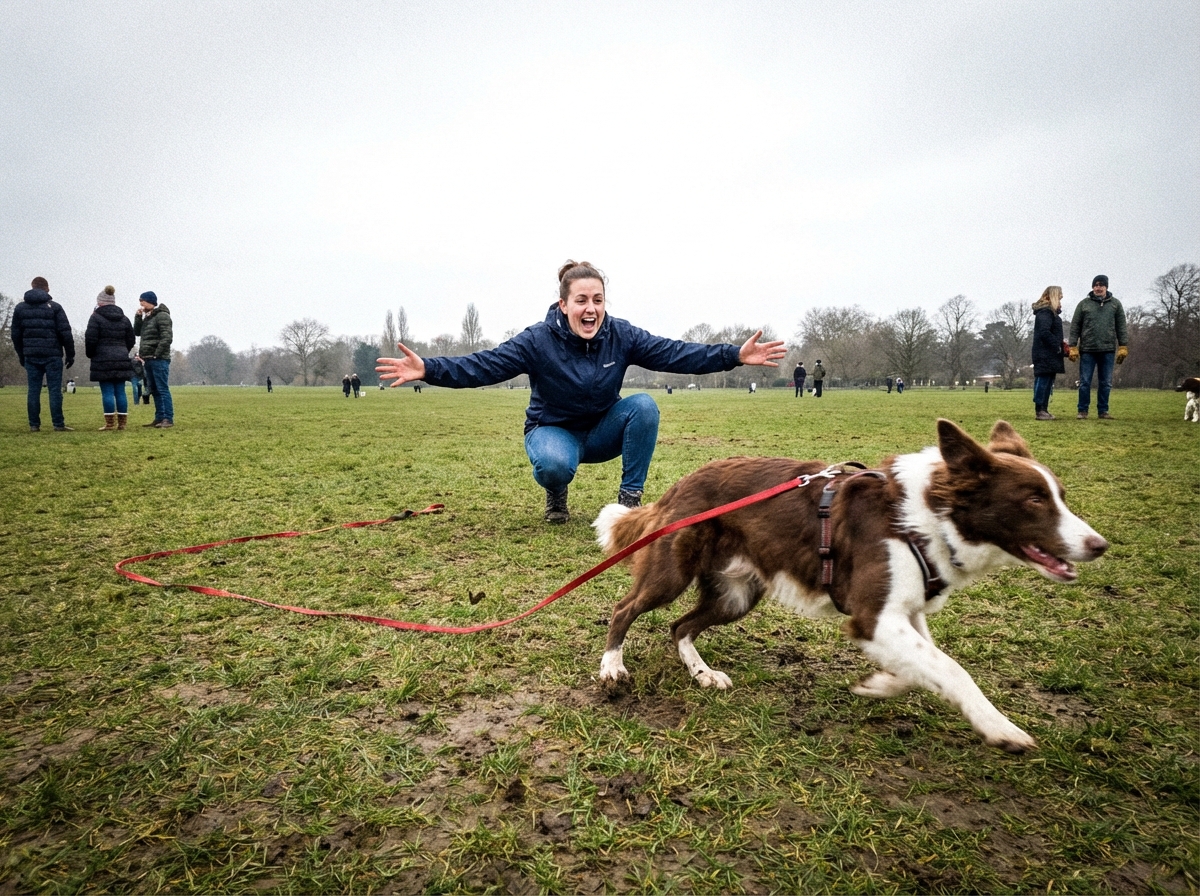
When you are working on long-distance requests, get big with your body language. Dogs are visual creatures, and seeing you clap your hands overhead or suddenly run backward away from them triggers a chase instinct that speeds up their return.
Avoid standing there like a statue and looming, which can feel intimidating or just plain boring. You need to make yourself the most interesting, dynamic object in the field.
As you push the distance out, let the dog explore the full length of that line. Wait for a moment when they are mildly distracted by a sniff (nothing too intense like a cat, just a regular smell), then give your cue.
If they whip around and sprint to you from 20 feet away, throw a literal party with treats. This confirms that responding to you is far more lucrative than whatever is on the ground, no matter how far away you happen to be.
Ensuring Safety: The Emergency Recall Command for Dogs
Every owner needs a “nuclear option” in their back pocket. This is the emergency recall command for dogs, using a word or whistle tone completely distinct from your everyday chatter.
This cue is reserved strictly for life-threatening scenarios, like a gate left open near traffic or a deer chase. Pick a word you almost never say, like “Emergency,” “Touchdown,” or a specific whistle pattern.
This command must be loaded with the highest value rewards you can possibly procure. Practice it very sparingly—think once a week—and never in a context where failure is an option.
When that word leaves your mouth, you should be ready to empty your entire treat bag on the ground or produce a piece of steak. The promise of the reward must be so immense that the dog stops thinking and simply reacts.
Crucially, never burn your emergency recall on mundane tasks like coming inside for dinner or leaving the park because you are tired. If you overuse it without that jackpot payout, it becomes just another background noise.
It must remain a sacred, powerful trigger that cuts through adrenaline and instinct to snap your dog back to safety instantly.
Taking the Leash Off: Off-Leash Training for Beginners
For many, the dream is hiking trails or beach walks with no tether. However, off-leash training for beginners demands a brutally honest look at your dog’s current reliability.
Is it safe to practice recall off-leash? Only in fully enclosed environments initially, such as a fenced tennis court or your own secured yard. Never unclip in an open area until your dog has proven 99% reliability on a long line in that exact same setting.
Transitioning to true freedom is a privilege that is earned, not a right. Start by letting the long line drag behind the dog on the ground (make sure there is no loop to snag on roots).
This offers the illusion of total freedom while leaving you a safety handle to step on if the dog decides to make a run for it. If they listen perfectly while dragging the line, you are inching closer to taking it off entirely.
Don’t forget that leash laws are there for a reason. Even if your recall is perfect, always carry a leash and be ready to use it out of respect for other dogs, wildlife, or people who may be fearful.
Training your dog to “check-in”—voluntarily looking back at you—while off-leash ensures they remain mentally tethered to you, even when the physical connection is gone.
Conclusion
Mastering how to train dog to come when called is a process that deepens the bond between you and your pet more than almost any other activity. It moves your relationship beyond simple control and into a space of mutual trust and communication.
By building a positive foundation, understanding what truly motivates your dog, and progressively challenging them with distraction and distance, you are weaving a safety net that lasts a lifetime.
Keep in mind that even the most sharply trained dogs have bad days. Patience remains your most valuable tool. Keep your sessions short, keep them fun, and keep the rewards coming.
Whether you are negotiating with a stubborn pup or polishing up an emergency whistle, the effort you invest today ensures your dog can enjoy the world safely and freely tomorrow.