
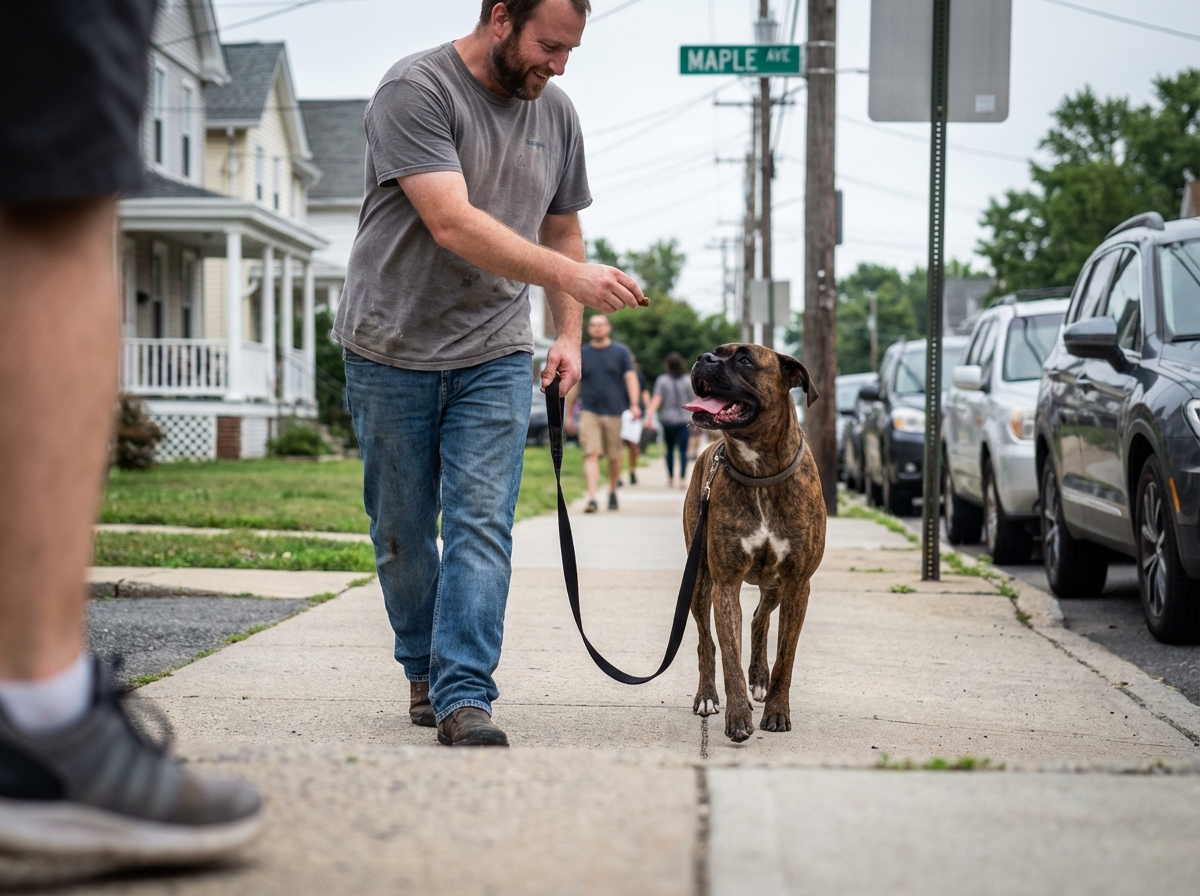
The daily promenade with your four-legged friend can unfortunately deteriorate from a moment of shared relaxation into a test of brute strength. You are certainly not the only one facing this tug-of-war; dealing with a dislocated shoulder is practically a rite of passage for new owners, ranking as the most frequent grievance.
Understanding how to train a dog to walk on leash is, without a doubt, the single most transformative skill you can cultivate together. It changes the narrative from a chaotic struggle into a structured, pleasant adventure where your canine companion remains tuned in to you, rather than dragging you imperiously toward every squirrel or fire hydrant that crosses your path.
This guide aims to look past simple mechanics to address the heart of the matter: genuine communication. We will delve into stress-free methodologies that teach your dog that the most rewarding place on earth is right by your leg, regardless of whether you are handling an enthusiastic puppy or an older dog with a lifetime of poor manners.
By implementing these techniques with patience and consistency, you can reclaim your walks, turning a chore into the absolute highlight of your day.
Essential Leash Training Equipment for Dogs
Before we can effectively tackle the training itself, we must address the tools we use to facilitate it. Selected wisely, the right gear can significantly accelerate your dog’s learning curve.
Although pet stores are awash with complex gadgets, leash training equipment for dogs should always prioritize safety and clarity of signal over clever marketing. For the vast majority of dogs, a classic 4-to-6-foot flat leash—whether crafted from leather or nylon—offers far superior control compared to a retractable lead.
The retractable lead maintains a constant, confusing tension, essentially teaching the dog that pulling is the mechanism that “unlocks” more freedom.
Navigate any dog park and you will likely hear owners debate: What type of leash and collar is best for leash training? While a flat collar is the traditional standard, a front-clip harness often proves to be a game-changer, particularly for dogs with respiratory concerns or those who pull like freight trains.
Is a harness better than a collar for a dog that pulls? In most scenarios, yes. By attaching at the chest, a front-clip harness utilizes physics to redirect your dog’s forward momentum back toward you, effectively neutralizing their pulling power without resorting to pain or choking.
It is vital to remember, however, that these tools are merely facilitators; the true transformation occurs through a comprehensive canine education approach that marries the correct equipment with consistent handling techniques.
Generally, it is best to steer clear of choke chains or prong collars unless you are under the direct supervision of a professional, as these can inadvertently create negative associations with the walk itself.
Understanding the Best Leash Training Methods for Dogs
There is rarely a single “magic button” in animal behavior, but grasping the underlying philosophy is essential for success. The best leash training methods for dogs invariably revolve around engagement and motivation rather than physical correction.
The objective is simple: ensure that following you is infinitely more rewarding than leading. A question that naturally arises for new owners is: What is the best age to start leash training a puppy?
The answer is immediately. You can begin acclimating your pup to the leash indoors as early as 8 weeks old.
Conversely, one might wonder, can older dogs be trained to walk nicely on a leash? Absolutely. While unwinding years of ingrained habits may require a bit more time, older dogs are entirely capable of absorbing new rules.
The fundamental concept remains the “stop and go” dynamic. If there is tension on the leash, the walk ceases; if the leash remains loose, the journey continues.
Occasionally, behavioral obstacles complicating the process will emerge. What should I do if my dog lunges at other dogs while on a leash? Such lunging is typically a symptom of reactivity or over-arousal, rather than a simple lack of leash manners.
In these specific instances, employing strategies designed for managing aggressive canine behavior or intense reactivity is far safer and more effective than standard obedience drills. Identifying the root emotion—be it fear or frustration—is the key to unlocking the solution.
Teaching a Puppy to Walk on a Leash Without Pulling
Puppies arrive as blank slates, a reality that presents both a wonderful opportunity and a distinct challenge. Teaching a puppy to walk on a leash without pulling begins by establishing the idea that the leash signifies fun rather than restriction.
It is wise to introduce the leash indoors initially, allowing the pup to drag it around harmlessly while you engage in play. Once you venture outdoors, however, the environment becomes a kaleidoscope of distractions.
If you find yourself wondering how long does it take to train a dog to walk properly on a leash, understand that patience is a prerequisite; the timeline can span weeks to months depending on your consistency and the dog’s natural drive.
A common, albeit opposite, issue with young dogs is a refusal to move at all. Why does my dog refuse to walk on a leash?
This “pancaking” phenomenon is usually rooted in fear. It is crucial never to drag a frightened puppy; instead, use gentle encouragement and high-value treats to lure them forward, effectively turning the movement into a rewarding game.
While you are in the thick of mastering the walk, keep in mind that puppies possess incredibly short attention spans. Keep your sessions brief and woven into their daily schedule, much like simple routines used for establishing successful toilet habits.
When the puppy inevitably pulls, stop dead in your tracks—”be a tree”—and wait for them to look back or introduce slack in the line before you resume walking.
Mastering Loose Leash Walking Training Techniques
Loose leash walking can be described as the art of walking with a relaxed “J” shape in the lead—zero tension, pure connection. Mastering loose leash walking training techniques demands that you become more interesting to your dog than the environment around them.
This is where the concept of observational learning plays a pivotal role; your dog watches your subtle cues to determine the pace and direction of the pack.
You might ask, How often should I practice leash walking with my dog? The answer is every single time the leash is clipped on—you are always training. Consistency is non-negotiable here.
If you allow them to haul you to the park but demand military precision on the return trip, you are merely broadcasting mixed signals.
Another frequent annoyance is the dog that weaves erratically across the path. How do I stop my dog from zigzagging while walking on leash? This behavior usually stems from having too much leash length or a lack of clear direction.
Try shortening the leash slightly (while keeping it loose) and heavily rewarding the dog for remaining on one specific side, typically the left.
If you are struggling with a dog that transforms into a sled dog the moment fresh air hits their nose, you may need to focus specifically on halting leash tension through dedicated stop-start drills before attempting longer excursions.
How to Get Your Dog to Heel on Leash Effectively
“Heeling” is a distinct skill, separate from loose leash walking. While loose leash walking permits the dog to sniff and explore provided the line remains slack, heeling is a structured command where the dog’s shoulder aligns precisely with your leg.
Knowing how to get dog to heel on leash is a vital safety tool for navigating crowded sidewalks or crossing busy intersections.
To teach this, hold a treat in your closed hand right at the level of your dog’s nose, guiding them magnetically by your side. utilize a specific cue like “Heel” or “Close.”
Be generous with rewards for eye contact. This degree of focus is mentally taxing for a dog, comparable to the intense concentration required for reliable recall procedures.
It is unrealistic to expect your dog to maintain a perfect heel for an entire 30-minute walk—that would be mentally exhausting for them. instead, deploy the heel command in short bursts when necessary, then release them back to a casual “loose leash” mode as a functional reward.
This balance keeps the dog sharp and responsive without inducing burnout.
Why Positive Reinforcement Leash Training Works Best
Traditional training often relied on “leash pops” or physical corrections, but modern behavioral science overwhelmingly supports positive reinforcement leash training.
A common query is: Should I use treats when teaching my dog to walk on a leash? The answer is an unequivocal yes. High-value food rewards essentially pay the dog for checking in with you rather than scanning the horizon for distractions.
utilizing positive reinforcement constructs a bond founded on trust rather than fear. When your dog realizes that proximity to you is a predictor of good things—treats, praise, access to sniffing—they will choose to stay close voluntarily.
Remember to gradually fade the treats over time. initially, you might reward every few steps; as the dog’s competency grows, reward every block, then every few blocks.
This variable reinforcement schedule actually strengthens the behavior over time. Ultimately, this approach creates a well-adjusted pet, which is the cornerstone of effective dog instruction, ensuring your walks remain safe and enjoyable for years to come.
Conclusion
Learning how to train a dog to walk on leash is a journey that demands patience, consistency, and the correct mindset. Whether you are guiding a puppy through their first tentative steps or convincing an older dog that “heel” is a superior option to “pull,” the principles remain constant: reward the behaviors you like, prevent the ones you don’t, and keep the experience stress-free.
By employing the right equipment, mastering loose-leash nuances, and leaning heavily on positive reinforcement, you will eventually reach that sweet spot where the leash acts as a safety line, not a steering wheel. Enjoy the process, and appreciate the teamwork involved in every step you take together.