
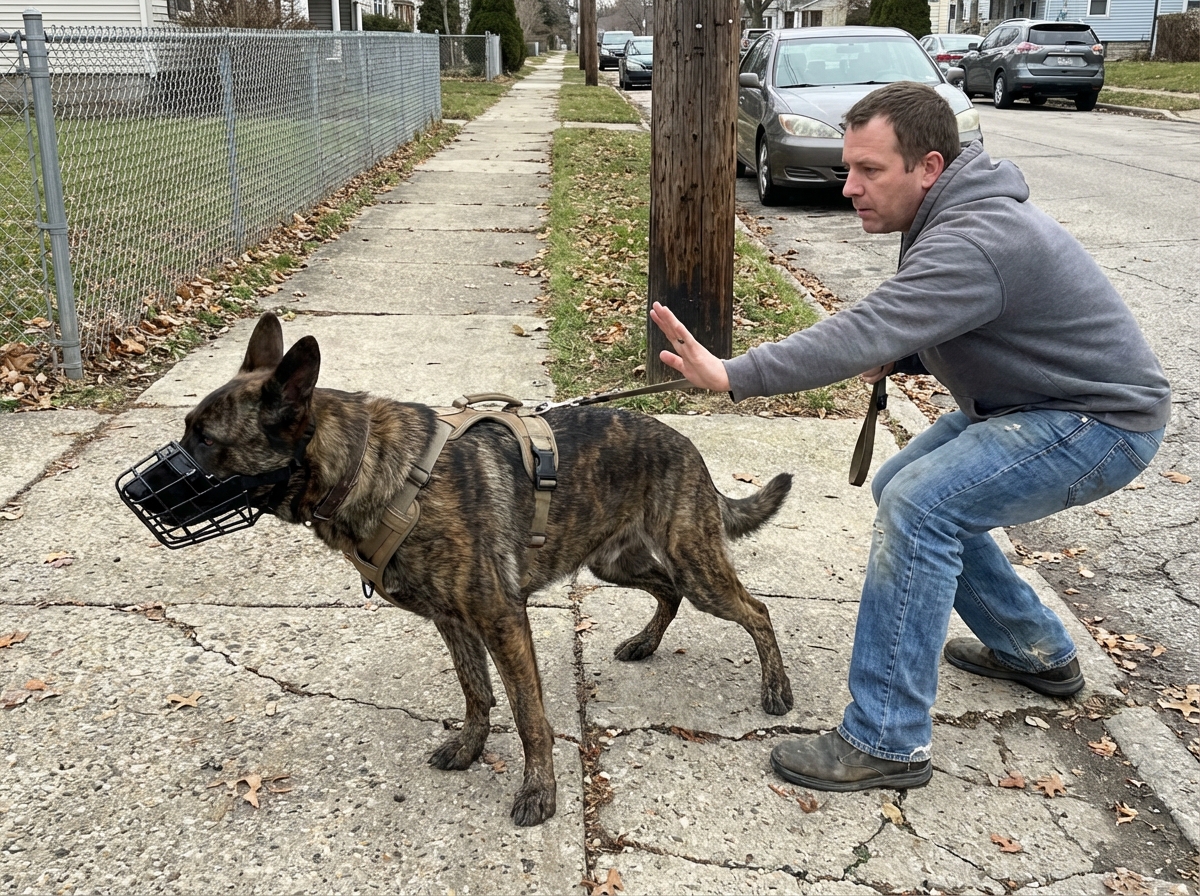
Sharing your life with a dog that lunges, growls, or snaps can feel like a sentence to solitary confinement, defined by unrelenting stress. The sensation of walking on eggshells becomes your new normal as you constantly scan the horizon, dreading the slightest movement or sound that might spark an explosion.
If you are currently scouring the internet for answers on how to train an aggressive dog, take a deep breath and realize you are not alone in this struggle; genuine hope for improvement exists. While aggression is undoubtedly a complex behavioral challenge often anchored in deep-seated emotions, it remains manageable through patience, the right tools, and an unwavering commitment to safety.
This guide intends to stand beside you during the rehabilitation journey, offering safe strategies to modify behavior while protecting both your family and your troubled four-legged friend.
Prioritizing Safety: Muzzle Training for Aggressive Dogs
Before we can even entertain the idea of behavior modification, we must establish the absolute bedrock of living with a reactive animal: safety. Many owners feel a deep reluctance to use certain protective tools, fearing social stigma or worrying their dog will look “mean,” yet a muzzle is truly a tool that grants freedom rather than restricting it.
Approaching Muzzle training for aggressive dogs effectively creates a necessary safety net, allowing you to execute training protocols with the confidence that, should a threshold be crossed, no physical harm will result. How do I keep my family safe while training? The answer lies in robust management strategies involving baby gates, secure crates, and most critically, a properly fitted basket muzzle.
We specifically recommend a basket style because it allows the dog to pant, drink, and accept food, which is non-negotiable for the positive reinforcement work ahead. We introduce this gear gradually, ideally showing the dog the equipment and immediately offering a reward.
The process progresses to placing a treat inside the basket so they must voluntarily insert their nose to retrieve it, ensuring we never force the plastic onto their face. We want the dog to associate this gear with positive experiences—like snacks and walks—rather than punishment or confinement.
Furthermore, removing the immediate risk of a bite significantly lowers your own anxiety levels. Since dogs are incredibly perceptive, if you remain calm because you trust your safety measures, your dog is far less likely to feed off your nervous energy. For a broader historical perspective on these protective devices, you can read about the Muzzle.
Understanding Triggers: How to Train a Fear-Aggressive Dog
To resolve a behavioral issue effectively, one must first comprehend the “why” driving the reaction. What are the main causes of aggression in dogs? While specific instances can certainly be attributed to predatory or territorial drives, the vast majority of aggression is deeply rooted in fear.
When a dog perceives a threat and feels trapped, they instinctively resort to the “fight” aspect of the fight-or-flight response to create distance. Learning how to train a fear-aggressive dog requires you to become a detective of sorts, identifying their specific triggers—be it men wearing hats, other dogs on leashes, or sudden, loud noises.
Crucially, you need to identify your dog’s distinct “threshold,” which represents the specific distance at which your dog notices a trigger but remains capable of thinking without reacting. If your dog is already barking and lunging, you have gotten too close, and learning has ceased because their brain has switched into survival mode.
Your objective is to work sub-threshold. Constant vigilance is key; watch for the subtle body language that precedes an explosion: a stiffening of the body, a tightly closed mouth, “whale eye” (where the whites of the eyes are visible), or a high, flagging tail.
Recognizing these precursors allows you to retreat from the scary situation before they feel compelled to react. This advocacy builds trust, demonstrating to your dog that you will handle the threat so they don’t have to.
Aggressive Dog Training Methods That Work: A Positive Approach
When addressing aggression, the methodology we choose is of paramount importance. Traditional tactics based on punishment—such as alpha rolls or shock collars—often merely suppress warning signals like growling without resolving the underlying emotional turmoil.
This is incredibly dangerous, as it can create a dog that bites without any prior warning because they have been taught not to communicate their discomfort. The scientific consensus on aggressive dog training methods that work points almost exclusively toward positive reinforcement and altering the animal’s emotional state.
What training methods work best for aggressive dogs? The gold standard in the field is Counter-Conditioning and Desensitization (CC&D). Desensitization requires exposing the dog to their trigger at a very low intensity, usually from a great distance, where no reaction occurs.
Counter-conditioning happens simultaneously by pairing that distant trigger with something the dog loves intensely, such as high-value chicken or cheese. Over time, this rewires the brain’s prediction mechanism: “See scary dog” transforms from predicting “danger” to predicting “delicious chicken.”
In certain scenarios where a dog’s baseline anxiety is simply too high for learning to take place, you might wonder: Can anti-anxiety medication help aggressive dogs? The answer is frequently yes.
Pharmaceuticals prescribed by a veterinarian can lower chemical stress levels just enough to open a window for training. It is not a magic “cure,” but rather a bridge to facilitate learning. For a deeper understanding of the psychological mechanisms at play, check out Desensitization.
Implementing Behavior Modification for Reactive Dogs
Translating theory into real-world success demands unyielding consistency from everyone in the household. Implementing behavior modification for reactive dogs is a lifestyle change, not merely a ten-minute daily session.
A highly effective technique to integrate into your walks is the “Look at That” (LAT) game. When your dog spots a trigger—like a stranger—and remains calm, you immediately mark that behavior with a specific word like “Yes!” or a clicker, followed by a reward.
This teaches the dog that checking in with you is far more rewarding than staring down a potential threat. A common question arises during this process: How long does aggression training take to see results? This is often the most difficult reality to accept: there is no fixed timeline.
Rehabilitation can span months or even years depending on the severity of the behavior and the dog’s past experiences. Neural pathways are being physically reshaped, and such radical changes do not happen overnight.
Another frequent concern is: Can an aggressive dog ever be fully rehabilitated? It is often safer and more realistic to think in terms of “management” rather than a total “cure.”
Many dogs learn to remain calm and happy in 99% of situations, yet they may always require a vigilant owner who manages their environment to prevent relapse. Success looks like a dog that turns to you for guidance when stressed, rather than reacting with their teeth.
Rehabilitation Training for Aggressive Rescue Dogs
Bringing a rescue dog with a history of aggression into your home presents unique challenges, primarily because the trauma they have endured is often a mystery to us. Rehabilitation training for aggressive rescue dogs requires a strict adherence to the “3-3-3 Rule”: 3 days to decompress, 3 weeks to learn the routine, and 3 months to start feeling truly at home.
Aggression in rescues often spikes during those first few weeks as the dog stops shutting down and begins expressing their fear of the new surroundings. Can aggressive rescue dogs be successfully retrained? Yes, absolutely.
Many rescue dogs act out simply due to the extreme, cortisol-soaked stress of the shelter environment and eventually flourish once they feel secure in a home. However, trust must be earned slowly. Hand-feeding meals can be an excellent way to build a bond without applying pressure.
Avoid “flooding” the dog, which means forcing them to face their fears all at once. Read more about the environment these dogs come from at Animal shelter to understand the stress they may have accumulated.
Is it dangerous to train an aggressive dog yourself? If the dog has a bite history or exhibits unpredictable aggression, relying solely on DIY methods can be dangerous. Rescue dogs, in particular, benefit from a slow, steady approach where safety is the priority.
Recognizing When to Hire a Behaviorist for Aggression
Eventually, you might encounter a plateau in your progress. If your dog has bitten someone, if the aggression is escalating despite your efforts, or if you feel frightened of your own companion, it is time to call in the professionals.
Recognizing when to hire a behaviorist for aggression is a sign of responsible ownership, not failure. It is crucial to note the distinct difference between a standard obedience trainer and a behavior expert.
Should I hire a trainer or veterinary behaviorist? For cases of aggression, you essentially want a Veterinary Behaviorist (DACVB) or a Certified Applied Animal Behaviorist (CAAB). These professionals possess a deep understanding of the ethology and neurology of aggression.
What is the success rate for aggression rehabilitation? While success rates vary, they skyrocket when you have professional guidance. An expert can construct a customized modification plan and assess risk accurately.
If you are struggling with how to train an aggressive dog, getting professional eyes on the situation can prevent tragedy and expedite the healing process for your nervous pup.