
Ensuring your canine companion stays safe and secure within the confines of your property is a vital responsibility for any owner. Boundary training for dogs is far more than just establishing physical barriers; it is about helping your pet develop a mental map that clearly defines where safety ends and potential danger begins.
Whether you are managing a sprawling rural estate or a compact suburban yard, teaching these “invisible walls” provides your dog the freedom to explore while granting you invaluable peace of mind. In 2025, the synergy of modern technology and proven behavioral science has made it more accessible than ever to achieve reliable results.
This guide examines the specific methodologies, tools, and the dedication to consistency required to transform your yard into a protected sanctuary for your pup.
The Fundamentals of Yard Boundary Training
The essence of successful boundary training for dogs rests on clear communication and unwavering feedback. Before you start introducing high-tech gadgets, it is important to recognize that dogs interpret their world through environmental cues.
To train a dog to stay in the yard, your first priority should be building a foundation of trust and engagement. We lean heavily on reward-based systems to ensure the dog instinctively connects staying on the property with positive experiences.
Utilizing positive reinforcement dog training techniques fosters a genuine desire in your pet to remain close to home, rather than venturing off toward tempting distractions.
Mapping out the timeline is a common concern: “What is the best age to start boundary training a puppy?” Typically, once a pup reaches 4 to 6 months and has a firm grasp on basic obedience, they are developmentally ready.
During these formative stages, it is best to practice in very quiet, low-distraction settings. You might also wonder, “Should I use treats or praise during boundary sessions?”
The most effective approach involves both; high-value treats are perfect for marking the exact second your dog chooses to move away from a boundary line, while enthusiastic verbal praise solidifies that behavior for the long haul.
By keeping your training sessions brief—roughly 10 to 15 minutes—you can prevent mental exhaustion and keep the atmosphere upbeat and productive.
How to Teach Your Dog to Respect Property Lines
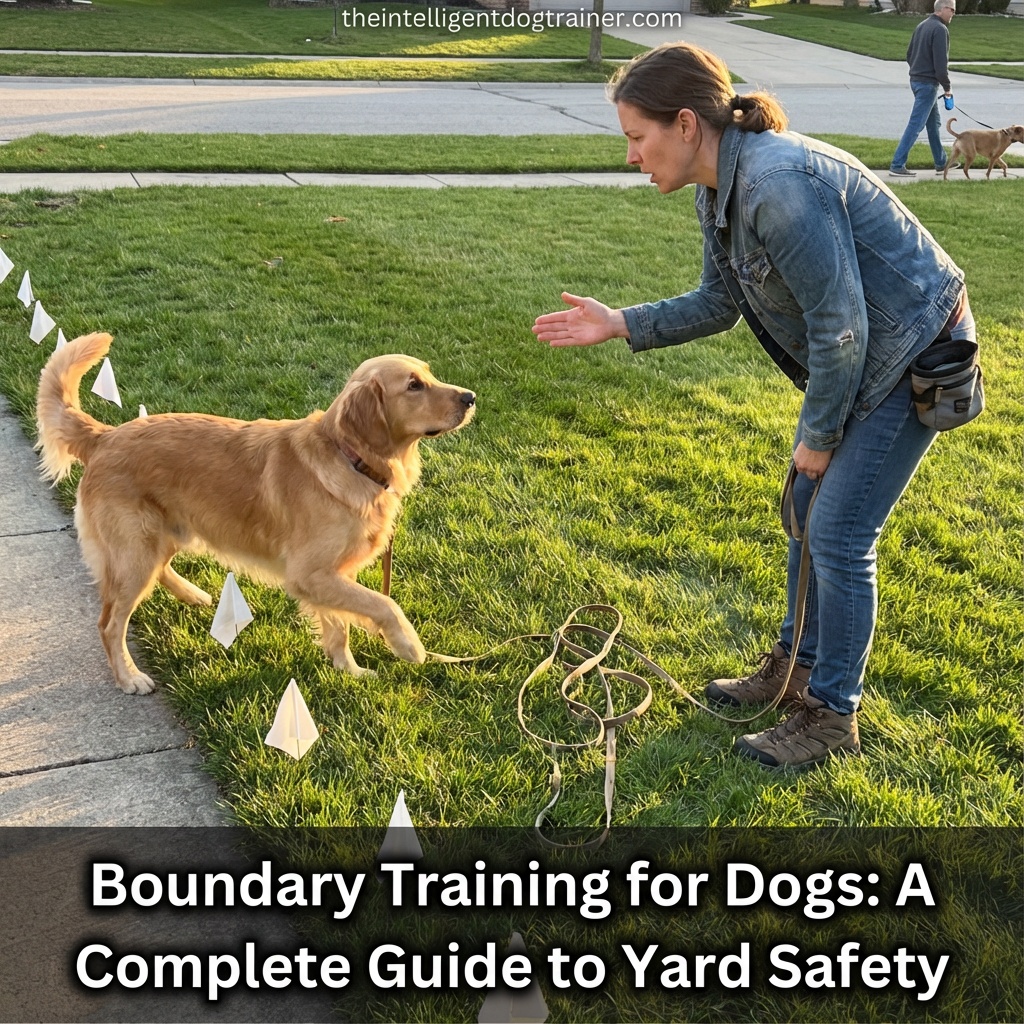
To effectively teach dog property lines, you have to make the abstract tangible. Dogs don’t naturally perceive where your deed ends and the neighbor’s begins, so we use physical markers like small flags or garden slats during the introductory phase.
Begin by walking your dog on a long lead around the perimeter. Every time they get close to the markers, use a specific “boundary” cue and gently guide them back toward the center of the yard.
This represents a vital phase in learning how to train a dog to stay within a set area without needing the constant restriction of a physical leash.
A frequent question from pet parents is: “How do I train my dog to stay in the yard without a fence?” This goal requires rigorous “proofing” against external triggers.
You need to practice while squirrels are active, cars are passing, or other dogs are visible across the street. People also ask, “How long does it take for boundary training to be effective?”
While every animal learns at a unique pace, most require 4 to 6 weeks of daily repetition to become truly reliable. How often should I practice boundary drills with my dog?
Success is built on frequency; two short drills per day are significantly more effective than a single marathon session once a week. As documented on Wikipedia, consistent reinforcement schedules remain the gold standard for establishing lasting behavioral habits.
Effective Use of Flags in Invisible Fence Training
Within the context of invisible fence training, flags act as a crucial visual bridge between the dog’s physical environment and an electronic warning tone. These markers allow the dog to visually identify a “danger zone” before they experience any corrective sensation.
How do I teach my dog to recognize boundary flags? The process involves walking them toward the flags to trigger the warning beep, then immediately retreating and rewarding them.
This creates a secondary association where the flag serves as a signal to “stop and check in.” At this stage, it is highly beneficial to teach a dog the watch me command so they learn to look to you for guidance when they reach those visual landmarks.
A recurring worry is: “Does invisible fence training hurt dogs?” When implemented correctly, the intent is never to cause pain, but to provide a surprising sensation—similar to a static pulse—that breaks the dog’s hyper-focus.
Over time, the flags become unnecessary and can be phased out as the dog develops a strong “spatial memory” of their territory. Even for those opting for a wireless dog fence training setup, flags are an essential part of the educational transition.
Without them, a dog can easily become confused or anxious about where they are allowed to go, which can lead to “porch sitting,” where the dog is too intimidated to move at all.
Safety Protocols for Electric Fence Training for Dogs
When you begin electric fence training for dogs, ethical considerations and safety must be the priority. This method is meant to be a supplement to traditional training, not a wholesale replacement for obedience work.
Before activating any electronic stimulation, ensure your dog has mastered the “retreat” behavior perfectly. You are essentially teaching your pet that they have the control to stop a beep or vibration by simply moving back into the safe zone.
Mastering how to train a dog to react calmly to these cues ensures the system functions as a clear communication tool rather than a punitive measure.
Owners often inquire: “What should I do if my dog crosses the boundary line?” If they happen to break through, you should never call them back across the line, as they might associate the correction with returning to your side.
Instead, go to them, deactivate the collar if possible, and lead them back through a designated “safe gate” or door. Can you boundary train a dog with a high prey drive?
It is certainly possible, though it demands a much higher level of impulse control work. For these driven dogs, the electronic correction is rarely enough to stop a high-speed chase unless the foundational respect for the boundary is absolute.
According to Wikipedia, electronic containment is most successful when used alongside professional behavioral modification techniques.
Modern Solutions with GPS Dog Fence Training
The most recent breakthrough in yard safety is gps dog fence training. Moving away from the old-school labor of burying copper wires, GPS systems allow you to design custom-shaped boundaries via satellite imagery.
This is especially helpful for properties with large or irregular terrain. Can wireless dog fence training work for large properties?
Absolutely; modern units can easily cover multiple acres with impressive precision. One of the best features of these systems is the lack of “blind spots” that often plagued older radio-frequency models.
Embracing these tools is a major leap toward the ultimate objective: being able to train a dog to walk off-leash with confidence.
With the current state of GPS tech, you can even establish “buffer zones” that trigger a vibration warning well before the dog reaches the actual edge of the property.
While this approach is tech-heavy, it still relies entirely on the dog’s understanding of their surroundings. Even with sophisticated satellite tracking in 2025, a dog must be taught that a vibration means “turn back.”
It is a high-tech way to grant freedom while maintaining a digital safety net that keeps your pet away from traffic or local wildlife.
Advanced Tips to Train a Dog to Stay in the Yard
The definitive test of boundary training for dogs involves “proofing” the behavior under significant stress. Advanced exercises might include “the open gate” challenge or “walking distraction” tests.
For example, have a friend walk another dog past your property while you remain focused on your pet. If your dog stays within their limits, reward them generously.
If they struggle, it may be time to go back to the fundamentals of how to train dog to come when called to ensure you have a reliable emergency recall. This recall serves as your ultimate insurance policy should any electronic or visual system fail.
It is helpful to remember that boundary awareness can be a perishable skill. Even a perfectly trained dog might test the rules as they get older or if a particularly irresistible distraction—like a stray cat—appears nearby.
Periodically putting the flags back out for a “refresher course” or running “boundary checks” once a month will keep the expectations clear.
By pairing modern innovations like gps dog fence training with classic consistency and positive reinforcement, you build a layered safety strategy that protects your dog throughout their life.
As noted by Wikipedia, the most successful training outcomes are those that balance physical containment with the dog’s psychological health and well-being.
Establishing effective boundaries is a multi-layered process that blends physical markers, steady reinforcement, and contemporary technology.
From the early days of flagging property lines to the deployment of advanced GPS perimeters, the objective never changes: cultivating a safe, confident dog that respects its limits.
By focusing on positive associations and testing behaviors against distractions, you can ensure your dog enjoys the outdoor life they love without the dangers of roaming.
Consistent practice and a commitment to seeing the world from your dog’s perspective remain your most powerful tools in creating a secure home environment.