
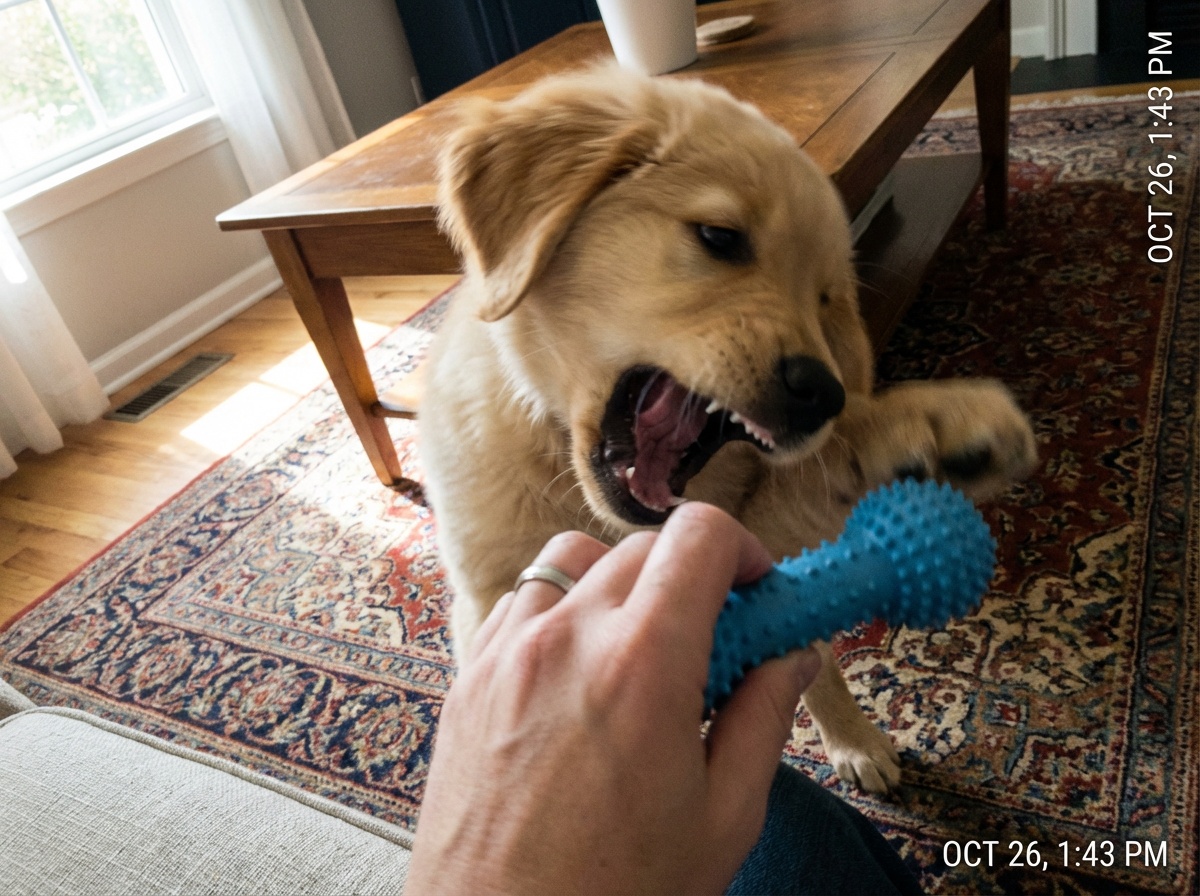
To tackle this behavior effectively, we really need to dig into the root of that all-too-common question: Why does my puppy constantly bite my hands and feet?
It is vital to keep in mind that puppies engage with their environment almost exclusively through their mouths. This oral fixation serves as their primary tool for exploration, social interaction, and finding relief from the significant discomfort of teething.
When you manage to reframe the nipping as a clumsy attempt at communication rather than an act of malice, dealing with the inevitable frustration becomes a far more manageable task.
That said, drawing a line between innocent roughhousing and genuine behavioral issues is crucial for your peace of mind.
Many owners find themselves asking, “How can I tell if my puppy is playing or being aggressive?”
In the vast majority of cases, play biting comes paired with a loose, wiggly body, exaggerated play bows, and happy, bouncy vocalizations.
True aggression—which is thankfully noticeably rare in young puppies—usually manifests with stiffened body language, a hard, unblinking stare, and curled lips.
If you find yourself concerned about behavior that seems unusually intense, remember that early intervention is your strongest ally.
Establishing the foundations of effective dog training the very moment your puppy arrives home helps define those necessary boundaries.
By redirecting their natural urge to nip onto appropriate items immediately, you teach them that human skin is fragile and off-limits, laying the essential groundwork for a gentle adult dog.
When Do Puppies Stop Biting? A Typical Timeline
Patience is a requisite virtue here, particularly on days when your forearms seem covered in fresh scratches.
A frequent question we encounter from exhausted owners is: How long does the puppy biting phase usually last?
While every individual dog follows their own unique rhythm, there is a general developmental trajectory you can reasonably anticipate.
The window between two and four months typically represents the peak of the “land shark” phase, a time when your puppy explores voraciously with practically zero impulse control.
As they progress from four to six months, the teething phase intensifies significantly; during this stretch, biting may feel more frantic as adult teeth fight to erupt through sensitive gum tissue.
By the time they reach six months and beyond, most puppies have successfully acquired their permanent teeth.
If your training has been consistent, the mouthing complexity should have decreased significantly by this point.
It is helpful to view this timeline alongside your dog’s other developmental milestones.
Just as you stick to a rigid schedule to learn how to potty train a puppy, you must remain equally consistent with your bite training protocols.
When do puppies stop biting completely? Typically, by the seven or eight-month mark, the behavior should be mostly extinguished, provided you haven’t accidentally encouraged it during rough play.
Essential Steps for Puppy Bite Inhibition Training
What is bite inhibition and how do I teach it? This concept is perhaps the single most critical element in the process of raising a safe dog.
Puppy bite inhibition training doesn’t mean stopping the biting immediately; rather, it focuses on teaching the puppy to consciously control the force of their jaw.
Before a puppy can learn “don’t bite,” they must first master the concept of “bite gently.”
Watch a litter of puppies, and you will see them teach each other this lesson naturally. If one pup bites too hard, the sibling yelps loudly and withdraws from the game.
You can try to mimic this dynamic, but proceed with caution.
Does yelping really help stop puppy biting? For some sensitive dogs, a sharp “Ouch!” works wonders to interrupt the behavior.
However, for high-drive puppies, that high-pitched noise might sound dangerously like a squeaky toy or dying prey, serving only to incite them to bite harder.
If yelping seems to ramp up your dog’s excitement levels, switch tactics to a calm “Too bad” marker and immediately pause the interaction.
Is it normal for puppies to bite hard during play? Yes, it is quite common, especially if they haven’t learned where the boundaries lie yet.
By consistently withdrawing your attention the moment they clamp down, you clearly define the rules of engagement.
Mastering this inhibition is vital, as it prevents you from having to research how to train an aggressive dog later down the road simply because an adolescent dog never learned how to moderate their mouth pressure.
Practical Tips for Puppy Biting Hands and Feet
One of the most frustrating scenarios owners face is the sudden “ankle attack” while simply walking down the hallway.
Puppy biting hands and feet is often triggered by movement itself.
To a puppy’s instinctual brain, your moving legs look remarkably like prey, triggering an automatic chase response.
How do I stop my puppy from biting when excited? The most effective tactic available is to become incredibly boring.
If your puppy attacks your feet, stop moving immediately. Cross your arms and deliberately look away.
Without the stimulation of movement, the “game” dissolves quickly. Once the puppy calms down, you can then praise them or offer a toy as a reward.
Another major factor to consider is arousal levels. Can overtiredness cause increased biting in puppies? Absolutely.
If your puppy has the “zoomies” and is biting frantically, they likely need a nap, not more training sessions.
Managing these arousal levels is similar to learning how to stop dog pulling on leash; in both cases, an over-stimulated brain simply cannot make good choices.
When the biting becomes frantic, place the puppy in their crate or pen for some quiet decompression time.
Best Toys for Teething Puppies to Redirect Focus
Management is just as important as training in this phase.
You cannot simply tell a puppy no; you must also tell them yes by providing a viable alternative.
Finding the best toys for teething puppies allows you to redirect that chewing energy onto something safe and satisfying.
What are the best toys to help with puppy teething? Look for variety in texture to keep them interested.
Frozen toys—such as a resilient rubber toy stuffed with wet food—provide immense relief for sore, hot gums.
Rope toys are great for flossing teeth, provided the play is strictly supervised, while soft plushies are good for gentle mouthing, assuming the puppy doesn’t destroy them immediately.
When your puppy approaches you with an open mouth, try to intercept them with a toy before teeth make contact.
This isn’t just a distraction; it’s a valid behavioral modification technique.
You are effectively conditioning the dog to look for a toy when they feel the urge to chew.
Every time you successfully swap your hand for a chew toy, you should incorporate this win into your dog training routine as a step toward a polite and well-adjusted adult dog.
How to Discipline a Puppy for Biting the Right Way
The word “discipline” often carries a negative connotation, but in the context of dog training, it simply means providing structure and consequences.
How to discipline a puppy for biting involves “negative punishment”—which technically means taking away something desirable (your attention) to reduce a specific behavior.
How should I react if my puppy bites me? Never use physical punishment, such as hitting or holding the mouth shut.
This approach can erode trust and cause deep-seated fear. Instead, use a “time-out” method.
If the puppy bites, say “Oops!” and leave the room for 10 to 20 seconds. The fun stops instantly.
Consistency is non-negotiable here. If you let the puppy mouth your hand one day because it’s “cute” but scold them the next, they will remain perpetually confused.
Building this consistency relies on the same principles used to teach commands like how to train dog to come when called; clear communication and predictable outcomes are what create a secure, well-behaved pet.
Conclusion
Learning how to stop puppy biting is a true rite of passage for every dog owner.
It requires a balanced mix of patience, consistent redirection, and a deep understanding of your dog’s developmental needs.
Remember that this phase, while undeniably painful, is temporary.
By teaching bite inhibition, managing arousal levels, and providing appropriate outlets for chewing, you are shaping a dog that is gentle and safe to be around.
Take a deep breath, keep plenty of toys handy, and stay consistent—your well-mannered best friend is in there, waiting to emerge.