
Living with a four-legged friend who feels the need to announce every rustling leaf or shifting shadow can quickly wear down the patience of even the most loving pet parent. While we have to respect that vocalizing is a completely natural form of communication for our dogs, relentless noise has a knack for shattering household peace, creating friction with neighbors, and often signaling that your companion is struggling with deep boredom or stress.
Whether you are navigating the chaotic puppy phase or attempting to reshape the ingrained behaviors of a senior pet, understanding how to stop a dog from barking unnecessarily is arguably one of the most sanity-saving skills you can acquire.
The good news is that this sort of nuisance barking is rarely a calculated act of spite; almost invariably, it is a symptom of an unmet need or an overflow of emotion. By figuring out exactly what is driving the noise and applying consistent, positive training methods, you can successfully bring a sense of calm back to your home.
Throughout the next few paragraphs, we will look at practical strategies to curb excessive noise, work on impulse control, and cultivate a significantly calmer environment for both you and your dog.
Identifying the Root Causes of Nuisance Barking
Any effective behavior correction relies entirely on digging up the specific motivation behind the noise. Many owners, at their wits’ end, find themselves asking, “Why is my dog barking excessively at nothing?”
The truth, however, is that they are rarely barking at “nothing.” Our dogs navigate the world with sensory capabilities far superior to our own, meaning they might be responding to a siren wailing miles away, a critter scurrying inside the walls, or a subtle vibration we simply cannot perceive.
Beyond these sensory triggers, the real culprits for persistent noise usually come down to boredom, fear, territorial instincts, or plain frustration.
You might engage with the common question: Can increasing exercise help stop excessive barking? The answer is a resounding yes.
A dog that is physically tired is almost always a quiet dog. If your companion isn’t getting enough physical or mental stimulation, they may vocalize simply to alleviate their own boredom or to burn off that restless energy.
Making sure your dog’s daily routine includes sufficient activity serves as the foundation of successful dog training and acts as the crucial first step in any plan to modify behavior.
It is equally important to tell the difference between a quick alert bark and obsessive vocalization. Experts like Ethologists point out that barking often functions as a distance-increasing signal—essentially, the dog is telling a perceived threat to back off.
Accurately identifying whether your dog is barking to alert you, to demand a specific outcome, or out of pure anxiety effectively dictates which specific training protocol you should employ to solve the problem.
Step-by-Step Guide to Teach Your Dog the Quiet Command
One of the more interesting paradoxes in dog training is that to extinguish noise, you sometimes have to encourage it first. How do I teach my dog the ‘quiet’ command effectively?
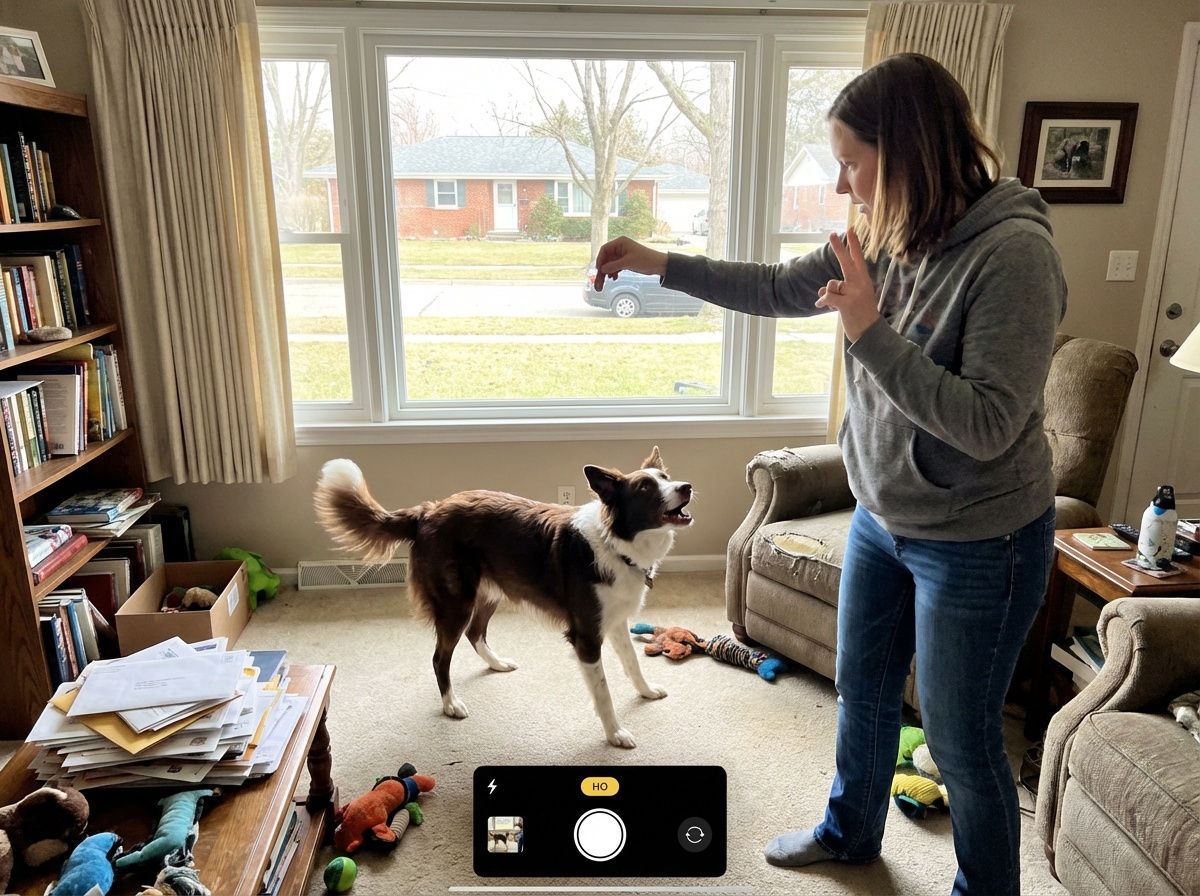
The most reliable approach involves teaching two distinct cues: “Speak” and “Quiet.” You can start by triggering a bark—perhaps by knocking on a wall—and then praising that noise with a “Speak” cue; immediately follow this by presenting a high-value treat right near their nose.
As their barking naturally stops so they can sniff the treat, you simply say “Quiet” and reward them.
Regarding the specific methodology, owners frequently ask: What are the best positive reinforcement methods for quiet behavior? The secret ingredient here is timing.
You have to mark the precise moment silence occurs. Over time, you can gradually increase the duration the dog must wait in silence before the reward is delivered.
This process builds impulse control, mirroring the focus required when mastering the recall command amidst heavy distractions.
On the flip side, Is punishment effective to stop a dog from barking? Generally speaking, no.
Yelling at a barking dog is often interpreted by the animal as you joining in on the chaos, which only serves to ramp up their excitement levels. While tools like shock collars or harsh corrections might suppress the noise temporarily, they often worsen underlying anxiety or aggression, leading to more severe behavioral fallout down the road.
Positive reinforcement fosters lasting change because the dog learns that meaningful silence is what actually pays off.
How to Stop Demand Barking and Attention Seeking
Demand barking crops up when your dog uses their voice to get something they want, whether that’s a toy, food, or just your eyes on them. If you look at them, speak to them, or give in to their request, you have effectively reinforced the behavior.
Does ignoring a dog actually help stop them from barking? Yes, but this technique requires nerves of steel.
When you initially ignore demand barking, the behavior will likely get louder and more intense before it improves; this phenomenon is known as an “extinction burst.” Essentially, the dog tries harder because that strategy used to work for them.
To stop demand barking, you must strictly remove all potential rewards. When the noise starts, turn your back completely or walk out of the room, ensuring you make absolutely no eye contact.
Wait for at least three seconds of silence before you calmly praise or offer what they wanted, provided it is appropriate to do so. This teaches the dog that politeness, rather than noise, is the key to unlocking what they want.
This type of impulse control shares a close relationship with other frustration-based behaviors. Just as you would work on loose leash walking techniques to prevent a dog from dragging you toward an interesting scent, you need to teach them that patience yields results.
How long does it take to fix nuisance barking behaviors? The timeline varies depending on how long the behavior has been practiced, but if you maintain absolute consistency during the extinction burst phase, you can often see significant improvement within two to three weeks.
Managing Reactivity and Dog Barking at Strangers
Territorial barking frequently happens at the window or front door, leading owners to ask: How can I stop my dog from barking at the doorbell?
This issue usually requires a process known as desensitization and counterconditioning. The goal here is to shift the dog’s emotional response to the trigger from “Intruder!” to “Treat opportunity!”
You can start by recording your doorbell sound and playing it at a low volume while feeding your dog high-value treats, gradually increasing the volume over several sessions as long as the dog remains calm.
However, if your dog is lunging and barking fiercely at people during walks, you are dealing with reactivity. When should I hire a professional trainer for barking issues?
If the vocalization is accompanied by growling, snapping, or an inability to be redirected, it is time to seek professional help. Safety must remain paramount when managing aggressive canine behavior, and a qualified professional can help distinguish between fear-based reactivity and true aggression.
For the habitual window barkers, management often proves to be the best immediate solution. Applying opaque window film to block the visual stimulus of passing strangers can significantly reduce the adrenaline spikes your dog experiences throughout the day; this makes future training sessions more effective because the dog’s stress hormones have had time to settle back to baseline levels.
Addressing Separation Anxiety Barking When Home Alone
Barking that occurs exclusively when you leave the house acts as a sign of distress rather than disobedience. How do I stop my dog from barking when left home alone?
You must address the panic itself, not just the noise. Dogs suffering from separation anxiety are genuinely terrified of abandonment.
To help them, you must desensitize them to your departure cues—picking up keys, putting on shoes—by performing these actions without actually leaving, so they lose their predictive power.
You can begin this process by stepping out the door for a single second and returning immediately, before the dog has a chance to bark. Gradually build up the duration of your absence from seconds to minutes.
Providing a long-lasting frozen treat or puzzle toy can also help create a positive association with your departure.
This process requires a highly structured approach, much like any comprehensive training program for dogs. It is imperative that you never punish a dog for separation anxiety barking; doing so will only increase their fear and panic the next time you leave.
If the anxiety appears severe, consult your veterinarian, as behavior modification medication may be needed to facilitate the training process.
Proven Solutions to Stop Dog Barking at Night
Nighttime barking can be exhausting for the entire family. The first step involves ensuring all physical needs are met: has the dog had enough exercise, and have they visited the bathroom?
Sometimes, effective stop dog barking at night strategies are as simple as adjusting the environment. If your dog sleeps in a crate and barks, covering the crate with a blanket can create a den-like atmosphere and help dampen outside noises.
White noise machines or calming classical music can also mask the sounds of nocturnal wildlife that might trigger your dog’s protective instincts. If you are dealing with a puppy, night barking is often a legitimate request for a bathroom break.
In this context, handling it correctly forms part of successfully house training your puppy. Take them out on a leash strictly for business, keeping interactions boring with no play or talking, then immediately return them to their sleeping area.
For older dogs, night barking could signal cognitive decline or physical discomfort. If a typically quiet senior dog suddenly starts vocalizing at night, a veterinary checkup becomes essential to rule out medical issues before assuming it is purely a behavioral problem.
Conclusion
Learning how to stop a dog from barking is rarely an instant fix, but rather a journey anchored in communication and consistency. Whether you are working to stop nuisance barking at squirrels, curb demand barking for treats, or soothe separation anxiety, the principles remain the same: identify the root cause, remove the reward for the noise, and heavily reinforce the silence.
By remaining patient and avoiding punishment, you build a relationship based on trust rather than fear. Your ultimate goal isn’t to silence your dog completely—after all, it is their voice—but to teach them when using that voice is appropriate.
With time and practice, the “Quiet” command will become just another fluent part of your shared language.