
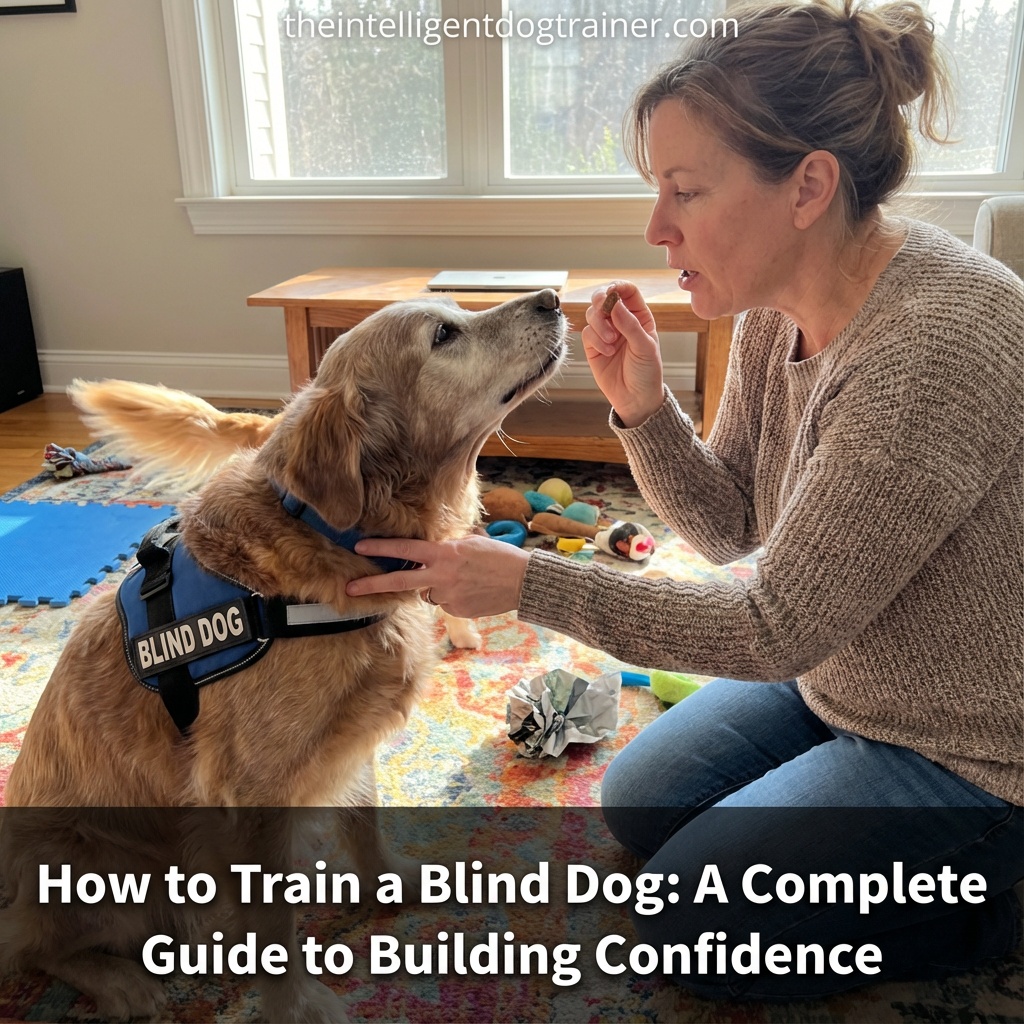
When a beloved dog loses their sight—whether it’s a gradual decline due to age, a sudden medical emergency, or a condition they’ve lived with since birth—it can feel as though the world you share has shifted entirely.
However, learning the specifics of how to train a blind dog is a deeply rewarding path that often builds a more intuitive, profound connection between pet and owner.
It is heartening to remember that dogs don’t experience vision loss with the same emotional weight that humans do; instead, they pivot toward their incredible olfactory and auditory senses to navigate their environment.
By adopting structured training and making a few observant changes to your home, you can help your visually impaired companion regain their independence and live a vibrant, happy life.
This guide looks at proven techniques and sensory methods designed to boost your dog’s confidence now and in the years to come.
The Fundamentals of Blind Dog Obedience Training
Stepping into the world of blind dog obedience training necessitates a change in perspective. You’ll need to transition away from visual hand signals and toward a rich language of sound and physical contact.
The primary objective is to create a culture of safety through absolute consistency and predictable daily rhythms. As a dog’s vision fades, they often become much more sensitive to subtle vibrations and environmental sounds.
This heightened awareness is why positive reinforcement dog training remains the gold standard for success here.
In this new landscape, high-value treats and an encouraging, warm tone of voice become your dog’s most trusted navigational tools. Can you use a clicker to train a blind dog? Absolutely.
A clicker provides a sharp, distinct sound that marks the exact moment of success, though many people prefer a consistent “marker word” such as “Yes!” to keep the interaction more personal and vocal.
Patience is the cornerstore of this entire transition. It’s important to stay grounded regarding how long it takes for a blind dog to adjust to a new home or the onset of a disability.
Generally, this adjustment period lasts anywhere from a few weeks to several months, depending on your dog’s individual temperament. During this phase, keeping their environment stable is paramount.
How do I map my house for a blind dog? A simple yet effective strategy involves using different textures—like area rugs or braided runners—to act as “tactile landmarks” for specific rooms.
This physical feedback helps your dog construct a reliable mental blueprint of their surroundings. Avoid the urge to rearrange the furniture, as predictability is the best remedy for a blind dog’s anxiety.
As discussed on Wikipedia, operant conditioning allows dogs to learn through the direct consequences of their actions, which is why rewarding even the smallest movements toward a goal is vital for a dog learning to navigate the dark.
Developing Essential Verbal Commands for Blind Dogs
Because your pet can no longer rely on watching your body language, the verbal commands for blind dogs you utilize must be clear, distinct, and highly descriptive. Essentially, you are becoming their personal GPS.
While they should still know “sit” and “stay,” you’ll need to add directional cues like “Step up,” “Step down,” “Left,” and “Right” to their vocabulary.
Perhaps the most critical safety habit is a flawless recall. Understanding how to train a dog to come when called is significantly more important when your dog cannot see potential hazards ahead.
For a blind dog, the “come” command is often more successful when paired with a whistle or a rhythmic clap, as these sharp, percussive sounds are much easier for a dog to track and follow across a distance.
What are the essential starting commands for a blind dog? You should prioritize “Wait” and “Careful” above almost everything else. The “Careful” cue acts as an early-warning system, alerting them that they are approaching a solid object.
How do you teach a blind dog not to bump into objects? By softly saying “Careful” just a moment before they walk into a wall or a coffee table, they learn to shorten their gait and investigate the air with their whiskers or nose.
In time, that word becomes a signal to slow down and probe the path ahead. For dogs that might feel unsettled or suffer from separation issues, what helps a blind dog feel secure when left alone?
Creating a “safe harbor”—a dedicated spot where their bed, water bowl, and favorite toys are never moved—offers a much-needed sense of sanctuary.
Keeping a radio or white noise machine on can also provide a steady auditory anchor, ensuring the house never feels confusingly silent.
Navigating the Outdoors: Techniques for Walking a Blind Dog
Going for a walk requires you to be an active, watchful partner in your dog’s safety. When walking a blind dog, you effectively become their sighted guide.
A common question for many owners is: what kind of leash is best for a blind dog? Generally, a standard 4-to-6-foot fixed leash is far superior to a retractable one.
The consistent length creates a predictable “safety bubble” and allows you to transmit subtle vibrations and directional guidance directly through the leash to the harness.
It can also be helpful to use a “Blind Dog” vest or a specific leash sleeve to let others know they should approach your pet calmly and avoid any sudden movements that might startle them.
How do I socialize my blind dog with other dogs? This requires a very gentle approach, as a blind dog cannot read the subtle ear flicks or tail positions of other animals.
It’s best to arrange meet-ups with calm, sociable dogs in quiet areas, and always announce your presence to other owners.
While moving through your local neighborhood, you can use the best ways to train a dog to walk on leash and incorporate a “voice stream.”
This technique involves talking softly and continuously to your dog while you walk, which is sometimes called “chatter.” This constant sound helps them pinpoint exactly where you are at all times, removing the fear of feeling disconnected.
Don’t forget that the outdoors is a symphony of scents—one of the greatest joys for a dog who perceives the world through their nose.
Success with Potty Training a Blind Dog
Many owners wonder: is it harder to potty train a dog that cannot see? Generally speaking, the answer is no, provided you lean on scent and physical boundaries rather than visual cues.
Potty training a blind dog relies on their ability to distinguish the “bathroom” area from the rest of the world through their paws and nose.
You can simplify this by using a specific ground cover, such as a patch of artificial grass or a unique type of mulch, in their designated spot. The tactile change under their feet acts as a clear signal that they have arrived.
Much like the standard tactics for potty training a puppy, success is built on a very strict schedule.
Take your dog outside frequently, especially after they wake up or finish a meal. Use a specific phrase like “Go potty” the moment they start, and always provide a high-value reward immediately after.
If they have an accident inside, don’t scold them; simply use an enzymatic cleaner to ensure the scent is completely neutralized.
Since a blind dog can’t look for the door, try hanging a bell at nose level or using a tiny bit of pet-safe scent (like diluted vanilla) near the exit.
This allows them to navigate to the door independently whenever they need to go out.
Using Tactile Cues and Physical Mapping for Safety
When vision is out of the equation, the skin and paw pads become incredibly sensitive collectors of information. Using tactile cues for blind dogs means building a sensory “map” of your home with various floor textures.
For example, placing a specific yoga mat or a textured rug at the top and bottom of the stairs serves as a physical warning.
This is also a perfect time to teach a dog to touch your hand or a specific target on command, which serves as a grounding behavior.
If they ever seem to lose their bearings, a quick “touch” command brings them right back to your side for guidance.
Effective safety mapping can also include “scent landmarks.” You might choose to apply small amounts of pet-safe essential oils (properly diluted) to certain door frames.
A whiff of lavender on the bedroom door and a touch of peppermint at the kitchen entrance helps a dog differentiate between rooms.
Wikipedia notes that spatial mapping is a complex mental process; for a blind dog, this is fueled primarily by touch and smell.
By keeping the furniture in place and using these sensory anchors, you can significantly reduce the risk of your dog feeling lost or bumping into things.
Mental Enrichment Through Blind Dog Sensory Games
Just because a dog can’t see doesn’t mean they don’t need mental “work.” In fact, blind dog sensory games are crucial for keeping their spirits high and warding off boredom.
Can blind dogs still play fetch or interactive games? They can—you simply have to shift the focus from the eyes to the ears and nose.
Look for toys like “beeper balls” that emit a constant sound or toys that have a very distinct, inviting scent.
A game of “find it” using hidden treats in a safe room allows your dog to use their natural tracking instincts, which builds immense confidence and reminds them that they are still capable “hunters.”
Engaging in scent work training for dogs is perhaps the most natural way to enrich the life of a visually impaired dog.
Sniffing is a self-soothing activity that uses a massive portion of the canine brain. You can set up simple “scent trails” or use puzzle toys that require the dog to nudge or paw at an object to find a reward.
These activities prove to a blind dog that their world is still full of interesting mysteries.
By focusing on everything your dog can still do, rather than what has changed, you ensure they remain a happy and engaged member of the family who lives life with genuine self-assurance.
Helping a dog navigate the loss of their sight is a beautiful testament to the resilience of our pets.
By mastering clear verbal signals, creating a tactile map of your home, and playing to their strengths with sensory games, you give your dog the keys to their own freedom.
This transition certainly requires patience and a solid plan, but the result is a confident, independent dog who shares an unbreakable bond of trust with you.
With some positive reinforcement and a thoughtfully prepared home, your blind dog won’t just adjust—they will absolutely thrive.