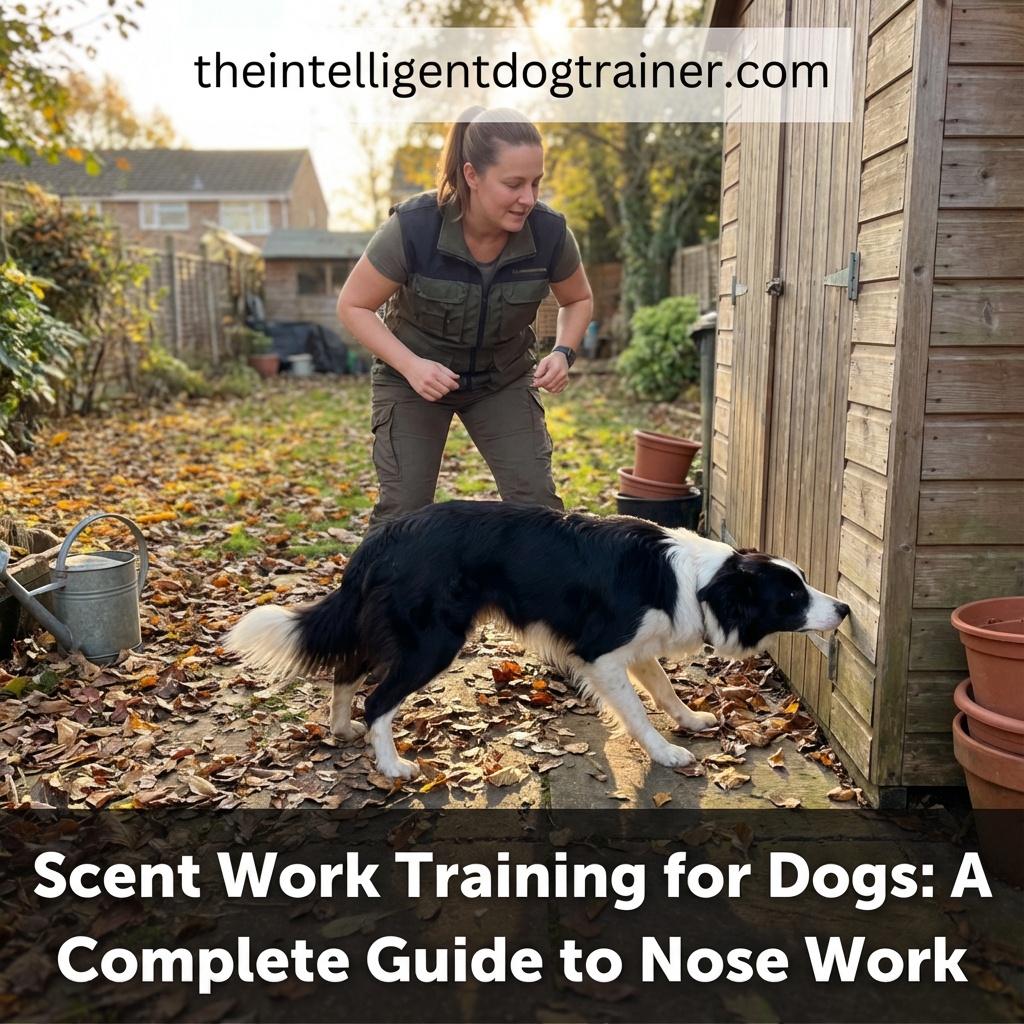
Have you ever considered that a dog’s nose is roughly 10,000 to 100,000 times more sensitive than our own? Diving into scent work training for dogs isn’t just a quirky pastime; it’s an invitation for them to lean into their natural biological superpower.
This practice offers a fantastic vent for mental energy, essentially transforming a dull, rainy afternoon into a high-stakes scavenger hunt. Whether your goal is to settle a restless puppy or find a low-impact hobby for an aging companion, nose work provides a fulfilling challenge that fosters confidence and deepens the bond you share.
This guide covers the full spectrum, from simple home games to sophisticated scent discrimination.
Introduction to Scent Work Training for Dogs
Scent work is a modern canine sport inspired by the rigorous tasks of professional detection animals, such as those on Search and Rescue teams. A frequent point of curiosity for pet owners is: What is the difference between nose work and tracking?
While tracking involves following a physical trail left on the ground by a person or animal, nose work is about pinpointing and identifying specific target smells across various environments. This distinction matters because it encourages a dog to work with more independence, utilizing air-scenting to locate hidden caches of essential oils.
Many people find themselves asking, How does scent work provide mental stimulation compared to physical exercise? Most trainers and researchers agree that intensive sniffing is cognitively draining for dogs.
While a long walk might only scratch the surface for a high-energy breed, a brief 15-minute scent session can leave them completely tuckered out. This happens because the olfactory bulb constitutes a significant portion of a dog’s brain, and decoding complex odors requires intense neurological effort.
If you’re looking to tire out your dog indoors, recognizing the value of mental stimulation for dogs is key to a well-rounded routine. Another major benefit is how inclusive the sport is.
Is scent work suitable for senior dogs with limited mobility? It certainly is. Since it doesn’t require high-speed running or jumping, it serves as the perfect low-impact activity for older dogs or those in post-surgery recovery.
Getting started doesn’t require a hefty investment either. Do I need special equipment to teach my dog scent work? Initially, you won’t—a few cardboard boxes and some high-value treats are all you need to ignite their search drive and build a positive association with the game.
Engaging Beginner Nose Work Games for Home
Launching into this activity is simpler than you might expect. To answer the question How do I start scent training my dog at home?, the best approach is to begin with basic find it exercises.
Try placing treats inside open boxes and letting your dog self-reward as they sniff them out. As they grow more confident, you can start hiding the boxes or tucking the lids closed. These beginner nose work games establish the core mechanics of searching and teach your dog that following their nose results in a significant reward.
Success here is built on consistency; keeping sessions brief and positive ensures the fastest development. How long should a nose work training session last? For beginners, 2 to 5 minutes is plenty.
It’s possible for dogs, particularly puppies, to experience scent fatigue, where their olfactory receptors temporarily lose their edge. By ending the game while your dog is still eager for more, you maintain their motivation for the next session.
To pinpoint the exact moment your dog finds the hidden treasure, many owners choose to clicker train a dog to signal the find. This clear line of communication ensures the dog understands exactly which behavior earned them the reward.
One of the standout benefits of nose work for high-energy dogs is the secondary focus it develops. Rather than sprinting around the house, the dog has to channel that physical intensity into a concentrated, quiet task.
This shift from physical chaos to mental concentration is a win for both the owner and the dog’s biology. By utilizing high-value rewards like cheese or liver, you create a lasting positive link with the search process, making it a stellar tool for behavior management in 2025 and beyond.
How to Teach Your Dog Directly to Odor
After your dog has mastered the find it game with food, you can begin the transition to AKC scent work target odors. These typically involve specific essential oils like Birch, Anise, Clove, and Cypress.
You might wonder, What specific oils are used for dog scent detection training? These four serve as the professional standard for competitive events. To teach dog directly to odor, you place a scented cotton swab inside a scent vessel—perhaps a small metal tin with air holes—and pair it immediately with a treat.
When the dog investigates the tin, they receive their reward right at the source. This training phase relies on the core tenets of positive reinforcement dog training to ensure the dog develops a genuine love for the target scent.
The goal is for the dog to realize: Every time I locate this Birch smell, amazing things happen! After enough repetition, you can stop placing the treat directly on the tin and only reward the dog once they have sniffed the scented object.
This develops a Pavlovian response where the smell itself triggers the expectation of a reward. A common question for novices is: How do I know if my dog has found the target scent? You should look for a change of behavior (COB).
This could be a quick head-snap toward the source, a localized freezing of the body over the scent, or an intense, focused sniffing. With practice, you won’t have to guess; their body language will clearly communicate I found it!
Rewarding this moment of discovery solidifies their dedication to the search, even as you introduce more distractions or harder-to-find hides.
Advancing to Scent Discrimination Training
Scent discrimination training represents the next level of proficiency. At this stage, your dog learns to ignore distractor smells—such as food, toys, or the scent of other animals—to focus entirely on the target oil.
This requires a significant amount of impulse control. In professional K9 units, this specific skill allows a dog to locate illegal substances in a crowded airport teeming with different people and food smells.
In a home setting, it means your dog can track down a specific scent even if there’s a plate of snacks nearby. To build this skill, you can set out several containers where only one holds the target scent while the others are cold or contain distractions.
If your dog wanders toward a distraction, simply wait them out. When they redirect themselves back to the target, reward them enthusiastically. This effectively helps you teach a dog to leave it when it comes to irrelevant smells.
Eventually, the dog learns that fringe odors are a dead end and only the target scent leads to a payoff. This advanced phase is often where a dog’s confidence truly peaks.
They start to realize they possess a form of knowledge that their human partner doesn’t. Because we can’t see scent plumes or air currents, we have to rely entirely on the dog’s expertise.
This shift in the relationship—where the dog is the specialist and the human is the student—is an incredibly empowering experience, often resulting in a more stable and self-assured dog in a variety of daily life situations.
Practical Nose Work for Reactive Dogs
It is quite interesting that nose work for reactive dogs is frequently suggested by behavior specialists as a form of therapy. Can scent work help a fearful or anxious dog?
Yes, largely because it shifts the dog into a seeking mindset, which is neurologically incompatible with a state of fear. When a dog is focused on a search, they are using the analytical part of their brain, which helps to dampen the reactive, emotional response.
For a dog that typically struggles with leash lunging, a focused sniffing task can become a calm retreat. Incorporating scent work into leash reactivity training allows a dog to interact with their environment in a more controlled manner.
By placing hides in outdoor spots where other dogs may have passed, you give your reactive dog a specific mission. Instead of scanning for threats, they are scanning for rewards.
This focus can significantly lower stress levels and make outings much more manageable for the owner. The beauty of scent work in a professional or guided setting is that it can be done in blind environments where the dog isn’t exposed to other animals.
Many classes specifically serve reactive Rovers by ensuring no two dogs ever make visual contact. This provides a safe environment for the dog to succeed without the social pressure.
Over time, these successes build a confidence buffer that carries over into other areas of their life, helping them feel more secure even when they aren’t on the job.
Instruction to Teach a Dog to Find Lost Objects
One of the most useful applications of these skills is the ability to teach a dog to find lost objects. Imagine misplacing your keys in a park or losing the remote in a cluttered room; your dog could solve the problem in a heartbeat.
To start, you’ll need an object that carries your specific human scent. In scent detection circles, this is done by handling an item—like a leather pouch—extensively to load it with your natural oils and skin cells.
The process begins similarly to a game of fetch, but with a unique twist. Instead of just bringing the item back from plain sight, you hide it in tall grass and give the find command.
Since the dog likely already has the motivation to teach a dog to fetch, they will naturally want to retrieve it. You are simply asking them to use their nose to complete the mission.
As they improve, you can hide the object in more complex locations, such as under leaves or at various heights, to keep the challenge fresh. Not only does this training offer excellent mental engagement, but it also turns your dog into a genuinely helpful member of the family.
By practicing in different settings—like woods, backyards, or inside the house—you reinforce the idea that the game is applicable anywhere. It turns a routine walk into a purposeful mission.
By the time you reach this skill level, your dog has become an olfactory athlete, capable of solving intricate puzzles and enjoying a level of mental fulfillment that few other activities can match.
Scent work training for dogs is a journey that starts with a simple treat in a box and evolves into a sophisticated partnership built on instinct and trust. By progressing from basic games to complex discrimination and real-world searches, you give your dog an unmatched outlet for their innate talents.
This activity is open to every dog, regardless of their age or background, offering a unique and modern way to enrich their lives in 2025 through the sheer power of their nose.