
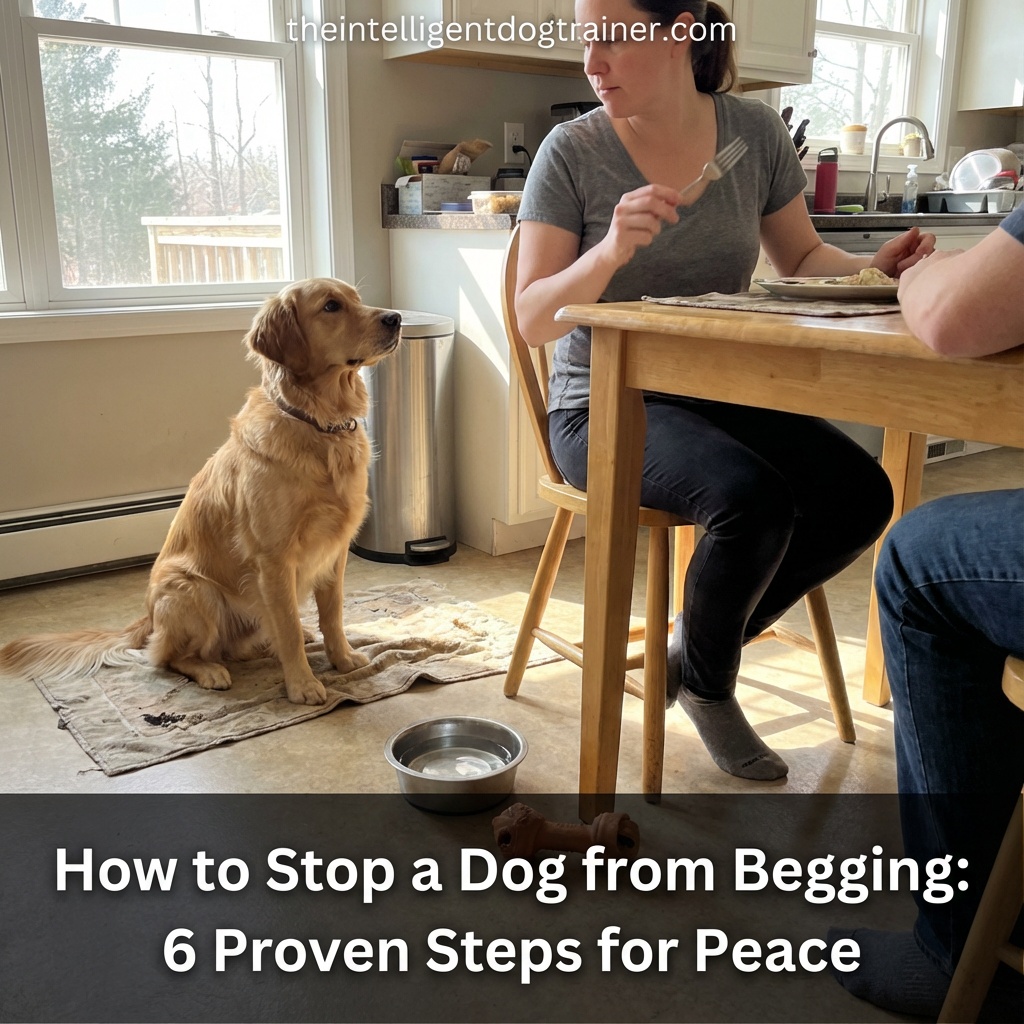
Maintaining a meal in peace can often feel like a distant dream when a dog is shadowing your every move, locked in with those deep, soulful eyes. If you find yourself searching for ways to stop a dog from begging, you are certainly not alone; this remains one of the most frequent behavioral hurdles encountered by pet owners in 2025.
This habit represents more than a minor nuisance; it creates a lingering tension for both the family and the canine involved. However, by looking into the underlying psychology of the behavior and applying structured training protocols, you can regain control of your dining room.
This guide explores evidence-based tactics designed to shift your dinner hour from a constant battle of wills into a quiet, respectful routine.
Understanding why your dog begs at the table
To successfully stop a dog from begging, it is helpful to first identify the biological and psychological motivations at play. By their very nature, dogs are opportunistic scavengers—a survival trait woven into their evolutionary biology.
Generally, when a dog begs, they are acting on a past history of success. A question many owners pose is: Why is feeding table scraps bad for begging behavior?
The reality is straightforward: even a single piece of chicken or a stray pizza crust serves as a high-value jackpot. This reinforces the idea that persistence eventually yields a reward, creating an intermittent reinforcement schedule—arguably the most difficult habit pattern to extinguish.
Owners also frequently ask: Why does my dog beg even after they have just eaten? For most dogs, this behavior has little to do with actual physical hunger.
Instead, it is triggered by the potent aroma of human meals and the social dynamics centered around the table. If you find that setting these initial boundaries is a struggle, mastering the basics of how to train a dog can provide the foundation of focus and respect you need.
Recognizing that this is a learned response, rather than a sign of a hungry pet, is the essential first step toward meaningful change.
The power of consistency: Why you must ignore dog begging behavior
In any behavioral modification plan, consistency is the one rule that cannot be broken. If the goal is to ignore dog begging behavior effectively, every person in the house must follow the same protocol.
If one family member secretly offers a treat while others are being firm, the dog simply learns to try harder or target the “weakest link” in the chain. You might wonder: Is ignoring the dog the most effective way to stop begging?
In the short term, “planned ignoring” is highly successful because it cuts off the reward system entirely. However, be prepared for an “extinction burst”—a phase where the behavior temporarily intensifies or becomes more dramatic right before the dog finally gives up.
While navigating this stage, it is crucial to avoid eye contact or even verbal reprimands, as certain dogs perceive any attention as a win. A common concern is: How long does it take to stop a dog from begging?
Usually, if the behavior is met with a total lack of engagement 100% of the time, you will notice a significant change within two to three weeks. To ensure your approach is backed by solid science, it is often helpful to study dog training techniques that prioritize rewarding positive choices rather than simply reacting to mistakes.
By staying composed at the dinner table, you send a clear message that the “begging game” has reached its end.
Using the place command to discourage dog from begging
A powerful way to handle the dining environment is to assign your dog a specific “job” while the family eats. Rather than focusing solely on what they should not do, provide a productive alternative.
You can discourage dog from begging by establishing a clear boundary stay. You may ask: Can using the ‘place’ command prevent begging at the table?
It certainly can. By directing your dog to a raised cot or a dedicated mat positioned away from the table, you remove the physical proximity that fuels the temptation to beg.
When you teach a dog the place command, you are essentially coaching them in impulse control based on operant conditioning concepts.
The objective is for the dog to see that staying on their bed is ultimately more beneficial than loitering by your chair. Offering a long-lasting chew or a food-stuffed toy on their mat can help keep them focused.
This leads to another question: Does feeding my dog before I eat help reduce begging? While a full stomach might take the edge off their enthusiasm, it won’t dismantle the habit itself. A solid “Place” command is a far more sustainable fix for long-term behavior.
Essential dog begging for food training techniques
Productive dog begging for food training relies on a bedrock of basic obedience. If a dog lacks a reliable “sit” or “down,” they will often struggle with the level of self-control required to stay away from the table.
To stop a dog from begging, try rewarding “settle” behaviors during quiet times of the day first. People often ask: How do I train my dog to stop begging for food?
A great method is “capturing” naturally calm moments and rewarding that stillness with a treat. This teaches the dog that being relaxed, rather than pestering, is the most effective path to a reward.
Before you sit down for dinner, try to ensure your dog has burned off some physical and mental energy. A tired dog is much more likely to settle without a fuss.
If your dog finds the basics challenging, it might be time to teach a dog to sit and stay even when distractions are present. If the habit is particularly deep-seated, you might wonder: Will professional training help with persistent begging?
Expert help is frequently beneficial for high-drive dogs or multi-pet homes where the competition for food can make the behavior more difficult for an owner to manage alone.
Effective cues and the command to stop begging
If your dog begins to wander toward the table, having a clear, certain command to stop begging is your best defense. While the “place” command is a proactive setup, a “Leave It” cue serves as a vital reactive boundary.
This tells the dog to immediately turn their attention away from the object of their desire, whether that is the scent of a steak or a piece of food that hit the floor.
To successfully stop a dog from begging, you should practice this cue away from mealtime using low-value items before testing it against the high stakes of a family dinner.
It is highly effective to teach a dog to leave it through a system that proves following your direction is more rewarding than the item they are eyeing.
Owners often ask: Should I put my dog in another room while I eat? If you are in the middle of the training journey and cannot supervise them closely, using a crate or a separate room is a perfectly valid management choice.
It prevents the dog from repeating the bad habit while you are preoccupied. Using clear verbal cues builds a communicative bridge, ensuring your dog understands which behaviors are no longer welcome in the home.
How to stop dog staring while eating during family meals
Perhaps the most uncomfortable aspect of this behavior is that unwavering, unblinking stare. To stop dog staring while eating, you have to manage both the dog’s physical distance and their mental focus.
Staring is usually the first sign that more active begging, like whining or pawing, is about to start. You might ask: What is the best way to handle a dog staring during meals?
The most effective answer is to redirect their attention completely. If they are staring, they aren’t relaxed. Send them back to their designated spot immediately to break that “laser focus” on your plate.
Using environmental management to block the line of sight is a classic strategy in applied animal behavior. This could mean moving the dog’s bed behind a piece of furniture or using a gate.
This approach is quite similar to the methods used to stop a dog from counter surfing, as both involve managing a dog’s proximity to human food.
By rewarding your dog for looking away or simply resting quietly, you replace the staring habit with a much calmer posture. Over time, your dog will realize that your dinner time is a time for them to rest elsewhere, eventually opting for a nap over monitoring every forkful you take.
In summary, resolving a begging habit requires a blend of environment management, a commitment to ignoring unwanted actions, and teaching alternative behaviors like the “place” command.
By eliminating the reward of table scraps and setting firm boundaries, you help your dog understand exactly how to behave during family meals. This structured approach leads to a more peaceful home and a happier, more disciplined dog who understands that patience is rewarded far more than persistence.