
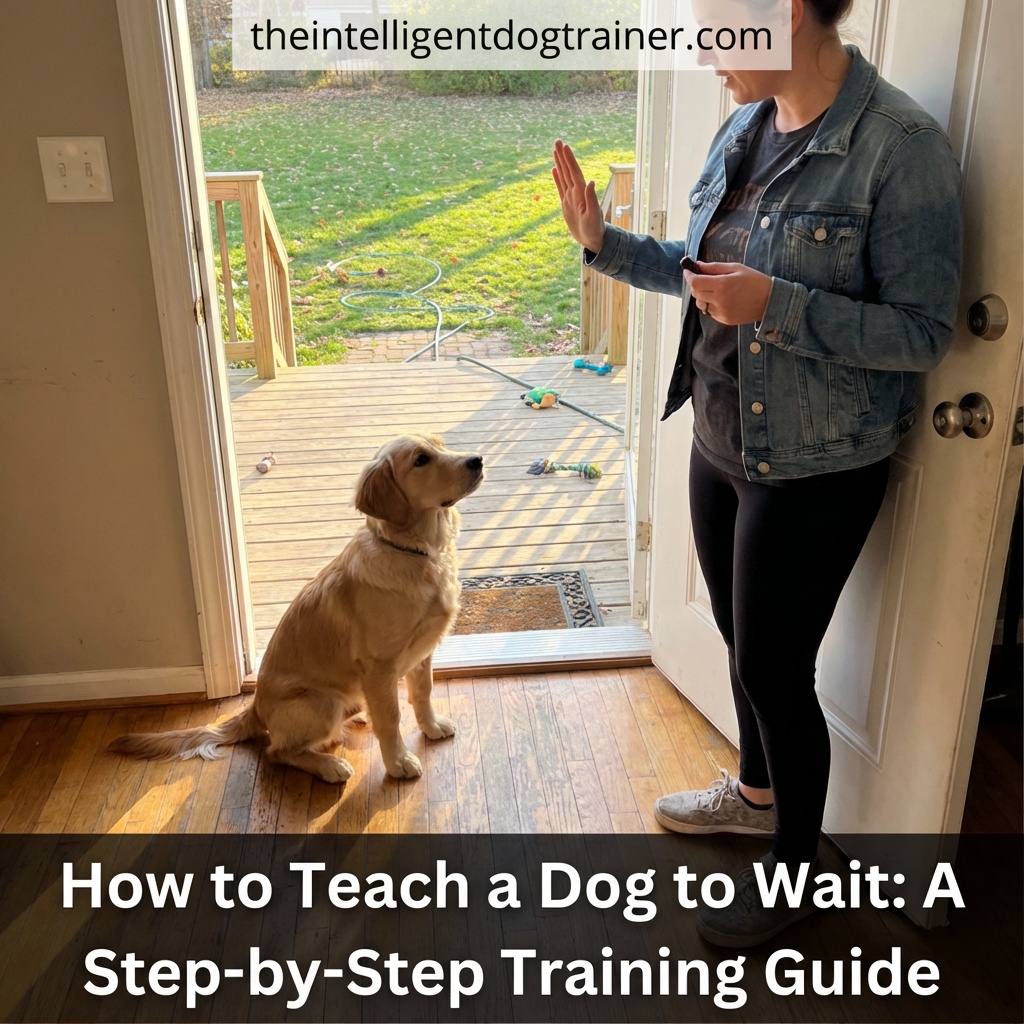
Helping your canine companion master the art of the pause is perhaps one of the most functional skills you can cultivate as a team. When you teach a dog to wait, you are doing much more than just practicing a simple trick.
You are establishing a vital channel of communication that promotes safety and brings a sense of composure to your home. Whether your goal is to prevent a frantic dash across a busy road or simply to manage that high-energy excitement when dinner is served, wait functions as an essential tool for modern living.
Throughout this guide, we will explore how to refine your dog’s instinctive impulses into sophisticated manners using evidence-based reinforcement.
Understanding the Difference: Wait Command vs Stay
It is quite common for pet owners to use wait and stay interchangeably, yet in the realm of professional Wikipedia: Dog training, these cues serve very different roles.
What is the difference between the wait and stay commands? In the simplest terms, stay is a duration-based command where the dog is expected to maintain a specific posture—such as a sit or a down—until you physically return to their side.
Conversely, the wait command vs stay distinction centers on the eventual outcome; wait acts as a temporary yellow light, signaling that the dog will shortly be invited to move forward.
When you issue a wait, you are asking your dog to hold their current position until a release word is spoken, though they aren’t strictly required to remain in a frozen statue-like pose.
This flexibility makes it a perfect choice for handling transitions at doorways or navigating staircases. To prevent any potential confusion, many trainers suggest you first train a dog to stay to build a solid foundation before introducing the more versatile wait cue.
Gaining proficiency in both ensures your dog understands exactly what is required across various daily scenarios (a bit of clarity goes a long way in preventing frustration for both of you).
The Benefits of Impulse Control Training for Dogs
At its heart, the process of teaching wait is a fundamental exercise in impulse control training for dogs. This form of mental conditioning helps a dog learn to bypass their immediate urges—whether that’s the desire to chase a passing squirrel or snap up a dropped treat—in favor of a reward provided by the handler.
Why is impulse control training important for dogs? Left to their own devices, dogs often act purely on instinct, which can unfortunately lead to destructive habits or even physical danger.
By practicing the art of patience, your dog learns better emotional regulation and develops a much higher tolerance for frustration. Utilizing contemporary dog training techniques often means rewarding the non-event or the absence of a frantic behavior.
For instance, when you teach a dog to wait, you are essentially reinforcing the moment they choose to offer you eye contact instead of fixating on a high-value distraction.
How long does it take to teach a dog the wait command? While most dogs can pick up the basic concept within a few short sessions, building reliability in distracting environments might take a few weeks of diligent practice.
To accelerate their progress, many people wonder: is it better to use a clicker for wait training? While you can certainly train without one, a clicker and its precise timing help mark the exact moment of stillness, making the learning process much clearer for the dog.
If you are curious to learn more, you can delve into various dog training techniques that prioritize positive reinforcement.
Mealtime Manners: How to Teach a Dog to Wait for Food
The kitchen provides an excellent, low-stakes environment to begin this journey. To teach dog to wait for food, start by holding their meal bowl at chest height.
As you slowly lower it toward the ground, watch their reaction; if they lunge forward, simply raise the bowl back out of reach. It is only when the dog remains calm and composed that you continue the descent to the floor.
Should I make my dog wait before eating meals? Doing so is highly recommended. It subtly reinforces the idea that you manage the access to resources, which encourages your dog to look to you for guidance rather than demanding what they want immediately.
Furthermore, wait training serves as a proactive way to steer clear of behavioral friction. Does the wait command help with resource guarding? While it isn’t a standalone fix for deep-seated aggression, it creates a baseline of trust where the dog realizes that patience leads to the reward they crave.
If you are already noticing a bit of tension around treats or toys, understanding how to stop resource guarding in dogs is a logical and necessary next step.
What should I do if my dog breaks the wait before rewarded? There is no need for a heavy-handed correction; simply reset the exercise. The temporary loss of the reward is the lesson itself, showing them that breaking the pause only delays their dinner.
Effective Dog Boundary Training for Home Safety
Implementing dog boundary training is incredibly helpful for homes with open layouts or multiple rooms. This involves showing your dog that certain thresholds represent invisible lines they shouldn’t cross without an invite.
This can be seen as a more advanced version of the teach a dog to wait protocol, as it asks the dog to apply the wait concept to a physical location rather than just responding to a verbal cue.
A highly effective strategy is to pair this boundary work with a stationary place command. By directing your dog to a specific mat or bed and asking them to wait there, you give them a clear safe zone during busy times, like when guests arrive or the doorbell rings.
Learning how to teach a dog the place command can beautifully complement your boundary training, keeping your pet comfortably settled until the chaos subsides.
This level of discipline is also a core focus for those researching how can wait training help with service dog preparation? because service animals must navigate public spaces with impeccable composure, never interfering with the flow of people.
How to Stop Your Dog from Bolting Out the Door
The habit of door dashing is not only annoying but represents a genuine safety hazard. To effectively stop dog bolting out door, the entryway needs to become a zone of calm communication.
Begin by putting your dog on a leash and approaching the door together. Ask for a wait before your hand even touches the door handle. If you feel them lean forward as the latch clicks, stop the movement and try again.
How do I teach my dog not to bolt out the open door? The objective is to shift the dog’s perception so that an open door becomes a signal to check in with you, rather than a green light to sprint.
Try opening the door just an inch at a time, closing it immediately if the dog tries to nudge through. With repetition, they will understand that only a relaxed wait earns them the privilege of heading outside.
This skill can truly be a lifesaver if a guest accidentally leaves the front door ajar. While wait keeps them safely inside, it is also wise to ensure they have a reliable recall as a backup.
Mastering how to train dog to come when called adds a vital second layer of protection. Applying consistent Wikipedia: Operant conditioning during these exercises will help the behavior become second nature.
Applying the Wait Command at the Car Door Safely
The vehicle is often the ultimate test of a dog’s patience. Utilizing the wait command at car door prevents your pet from jumping out into moving traffic or leaping into a muddy puddle before you are ready.
Can I use the wait command to stop my dog from jumping out of the car? Absolutely, and it is the most responsible way to unload your dog. Before fully opening the door, crack it slightly and give your wait signal.
Your dog should stay put inside the car until the leash is secure in your hand and you offer the release word. It is always best to practice this in quiet, familiar areas before trying it at a bustling park.
Once your dog can reliably hold their position until you are ready, you’ll find a newfound sense of freedom during your adventures. For those looking to progress even further, these milestones in impulse control are the very building blocks needed to eventually train a dog to walk off leash in safe, designated zones.
At the end of the day, a dog that can wait is a dog that is thinking and checking in, rather than just reacting, which makes every trip much more pleasant.
Training a dog to wait is a deeply rewarding investment in your life together. By distinguishing wait from stay, you provide your dog with a clear framework for movement and self-control.
From curbing mealtime frenzy to ensuring safety at the front door or the vehicle, these techniques cultivate a relationship rooted in trust and clarity. With a bit of consistency and a lot of positive reinforcement, your dog will soon be looking to you for direction at every transition, making your daily life both safer and more harmonious.