Training your canine companion to perform tricks goes far beyond just winning a bit of applause at the local park; it functions as a deeply effective tool for cementing the emotional connection between you.
When you decide to teach a dog to roll over, you are essentially challenging their cognitive abilities, fostering a sense of mutual trust, and offering a productive way to burn off restless energy.
This particular maneuver is a quintessential example of dog tricks for beginners, providing a gratifying milestone that the majority of dogs can achieve provided they have a patient owner and a handful of irresistible treats.
Throughout this guide, we will dissect the physical mechanics of the roll, starting with the necessary foundations and moving toward sophisticated troubleshooting for those pups who might be a bit more hesitant to flip.
Essential Foundations and Dog Tricks for Beginners
Before you attempt to guide your dog through a full rotation, it is crucial that they have a solid grasp of basic communication. What commands should my dog know before learning to roll over?
At the very least, your pet needs a dependable “down” command, because the mechanics of a roll over naturally begin from a lying position.
Many pet parents find that starting with simpler dog tricks for beginners helps create a shared training vocabulary that makes future learning much smoother.
It becomes significantly easier to describe complex physical movements once your dog has learned that specific actions lead directly to positive rewards.
Setting the right stage is another vital component of your preparation. Should I practice this trick on a hard floor or a soft surface?
You should always prioritize a cushioned area such as a thick rug, a patch of grass, or a carpeted room. The act of rolling places direct pressure on a dog’s spine and pelvic bones.
Performing this on timber or tile can be physically jarring, which might lead your dog to associate the trick with pain.
If your dog hasn’t quite perfected the starting posture, it is essential to teach a dog to lie down with total confidence before moving forward.
Can puppies learn to roll over during early training? They certainly can! Young pups are remarkably receptive to new information.
Provided you keep the sessions brief (ideally between 2 and 5 minutes) and upbeat, they can begin practicing these movements as soon as they are comfortable lying down on command.
As noted by Wikipedia, utilizing positive reinforcement remains the most successful strategy for building these foundational behaviors.
Mastering Lure Training for Dogs to Guide the Motion
The most intuitive way to explain a new movement to a dog is through lure training for dogs. This method utilizes a high-value incentive to guide your dog’s nose through a specific path.
Because a dog’s body almost instinctively follows the direction of its head, the treat essentially becomes a steering mechanism.
For pets with a lot of “go” in them, the quality of the reward is the primary driver of success. What is the best reward to use for high-energy dogs?
Opt for “high-value” snacks that are pungent, moist, and small enough to be swallowed quickly, ensuring their wandering focus stays glued to your hand.
Professional trainers frequently employ a “bridge” signal, such as a clicker, to capture the precise moment the dog executes the right move.
Do I need a clicker to teach this trick effectively? While you can certainly succeed without one, a clicker helps you mark the exact climax of the roll.
If you are unfamiliar with this approach, discovering how to effectively clicker train a dog can drastically sharpen your timing and clarity.
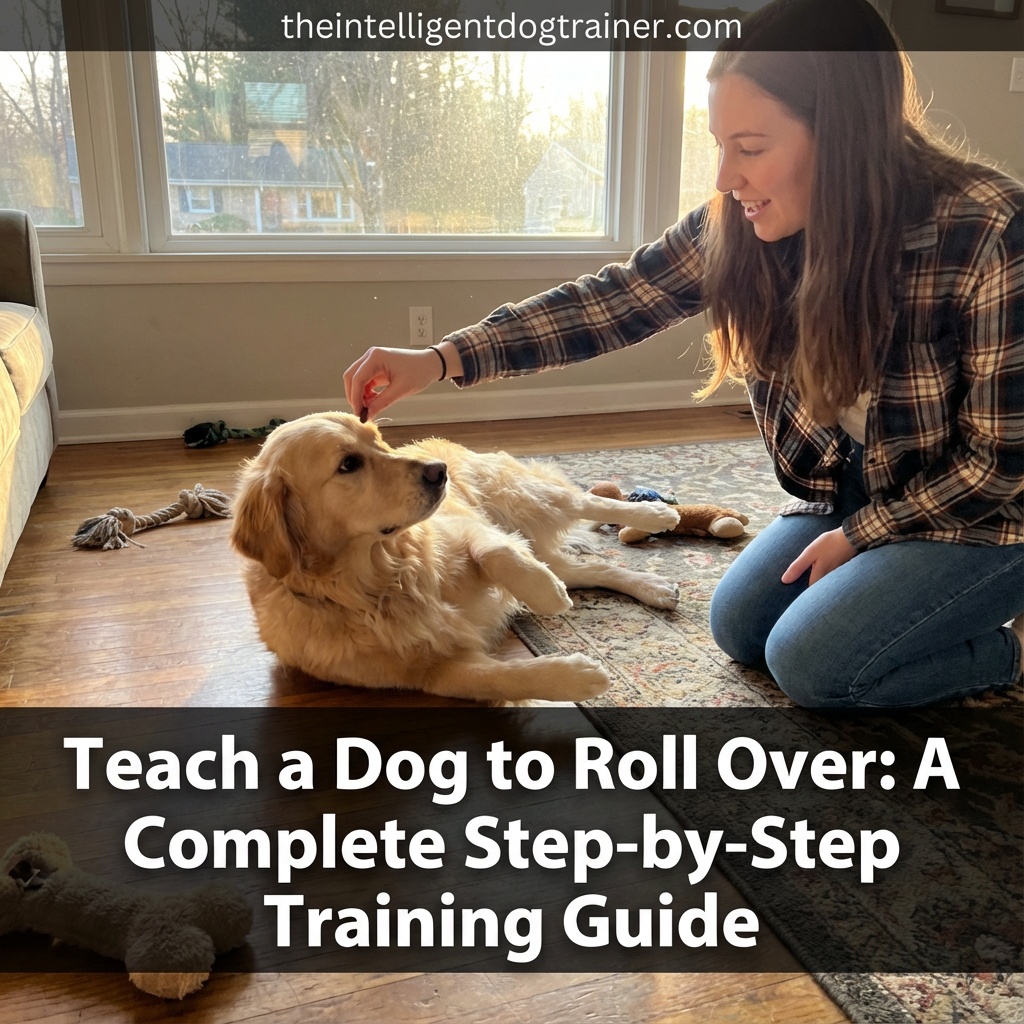
During the luring process, move your hand at a measured pace from the dog’s snout toward their shoulder blade. This movement shifts their center of gravity, naturally prompting them to flop onto their side.
How to Teach a Dog to Roll Over Step by Step
To ensure the behavior sticks, let’s explore how to teach a dog to roll over step by step using a method designed for long-term memory.
Begin by asking your dog to settle into a “down” position on a comfortable surface. Hold the lure right at their nose, then draw a slow arc toward their shoulder or hip.
As the dog twists their head to keep the treat in sight, their weight will naturally start to tip. How long does it typically take to teach the roll over trick?
Most dogs can figure out the basic physical movement within a few short 10-minute intervals, though it may take a week or two of daily repetition before they respond reliably to a verbal command alone.
As your dog lands on its side, keep the treat moving in a circular path toward their spine. This motion encourages them to continue over their back until they reach the other side.
The moment they complete the 360-degree turn, give them a “jackpot” of several treats at once.
If the progress feels stagnant, it might be helpful to revisit the core principles of how to train a dog through the use of incremental shaping.
How can I teach my dog to roll over without using treats? The goal is to eventually transition to a hand signal.
You can do this by mimicking the luring motion with an empty hand and then rewarding the dog with a treat from your pocket or a quick game with a toy once the movement is finished.
Expanding the Routine: Teach a Dog to Play Dead
Once your dog is rolling with enthusiasm, you have the perfect foundation to teach a dog to play dead by simply pausing the movement halfway through.
When your dog reaches the point of lying on their back or side, introduce a “stay” or “freeze” command rather than luring them all the way over.
This creates a sophisticated performance that asks for a high level of impulse control. Research from 2025 indicates that chaining these types of tricks significantly boosts mental flexibility.
Moving from a fluid roll to a stationary hold requires a very dependable “stay.”
If your pup finds it difficult to remain still while exposed, you might find it beneficial to train a dog to stay in more traditional positions first.
By halting the lure mid-roll and rewarding that brief moment of stillness, you can easily develop the “Bang!” or “Play Dead” routine.
Troubleshooting Dog Roll Over Training Challenges
It is perfectly normal for a dog to struggle with this trick initially, and troubleshooting dog roll over training is simply part of the educational journey.
Why does my dog refuse to roll onto their back? For some dogs, the act of exposing their belly feels like a vulnerable or submissive position they aren’t ready for.
Is it safe to teach large breed dogs to roll over? In most cases, yes, but you must be particularly cautious with breeds that have deep chests and a higher risk of bloat (GDV).
As documented on Wikipedia, intense physical activity too close to mealtime can be hazardous.
If you are working with an older companion, you might ask, can I teach an older dog to roll over? The answer is a resounding yes, although you must take extra care regarding joints.
If your senior pet seems hesitant, it is well worth exploring how to properly train an older dog with specific adjustments that prioritize physical comfort.
If your dog only makes it halfway and then stands up, try “shaping” the behavior by rewarding them just for lying on their side several times before asking for the full rotation.
Mental Stimulation Tricks for Dogs and Long-Term Success
Making mental stimulation tricks for dogs a regular part of your day is an effective way to head off common behavioral problems like destructive chewing or nuisance barking.
Tricks such as the roll over demand real problem-solving and provide the “job” that many intelligent breeds instinctively desire.
The mental effort spent deciphering your hand signals and verbal markers is often just as tiring and satisfying for a dog as a long walk.
To keep the momentum going, ensure that your training remains varied and fun. You can find more inspiration regarding the advantages of enrichment and mental stimulation for dogs.
Always aim to wrap up your practice on a successful note, even if you have to ask for a very simple “sit” to ensure your dog ends the session feeling like a winner.
Training your dog to roll over is a rewarding process that relies on patience, clear communication, and plenty of positive reinforcement.
By mastering the art of the lure, providing a comfortable training surface, and breaking the movement down into manageable pieces, you can help your dog succeed.
Whether you are guiding a playful puppy or a dignified senior, the emotional and cognitive benefits of trick training are immense.
Keep your sessions brief, your rewards high-quality, and cherish the time spent building a stronger partnership with your best friend.