
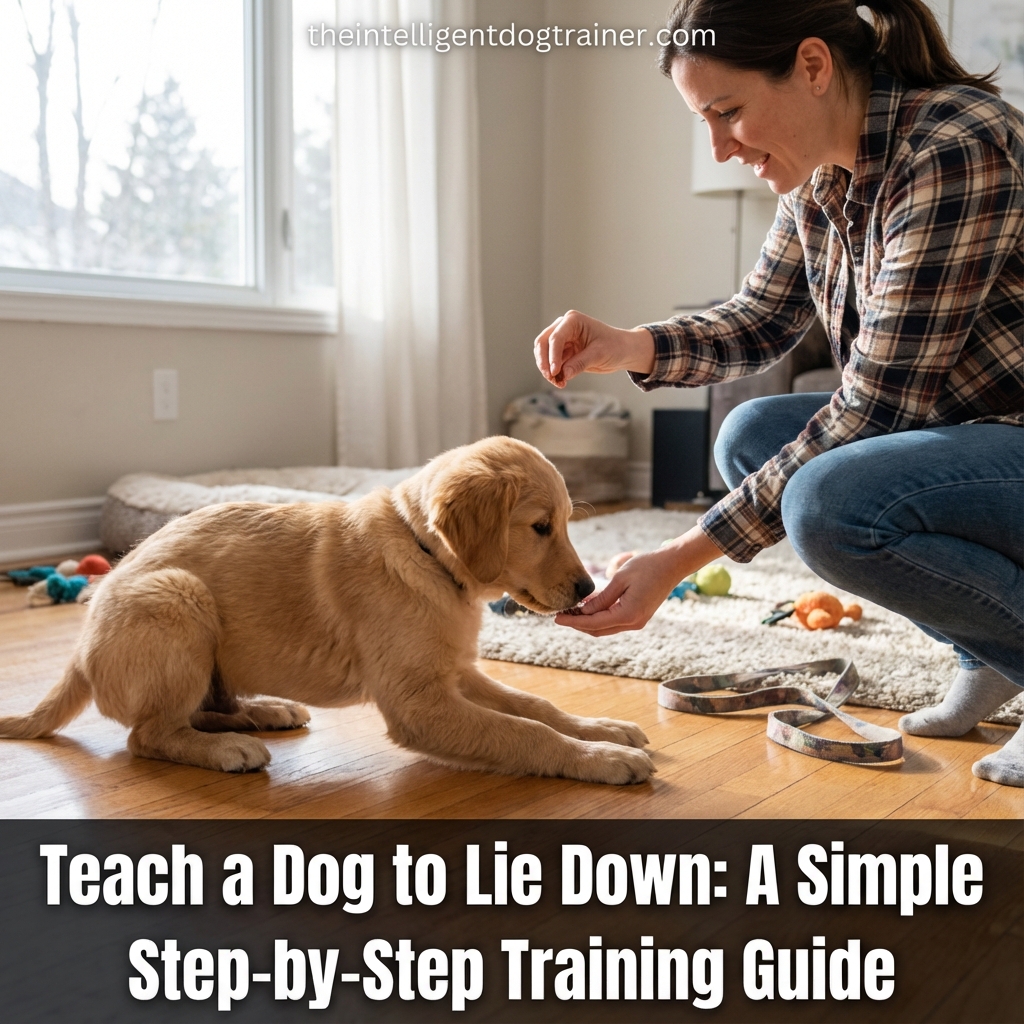
Guiding your furry companion to settle on cue is one of those deeply rewarding milestones in your shared journey. Beyond being a simple trick, it creates a vital foundation for calm behavior and helps keep your dog safe in hectic or unpredictable environments.
Whether you are nurturing a spirited new puppy or bonding with an older rescue, discovering how to teach a dog to lie down is a fundamental skill that strengthens your connection and sharpens your mutual communication. In the following guide, we will explore the most effective ways to cultivate a dependable “down” using positive reinforcement and intuitive signals.
Introduction to the Down Command for Puppies and Dogs
The “down” command carries much more weight than a mere parlor trick; it is a functional tool that encourages relaxation and builds impulse control. Naturally, many owners find themselves asking: Should I teach my dog to sit before teaching them to lie down?
While it is not a strict requirement, starting from a seated position often makes it physically simpler for the dog to tuck their hindquarters as they transition to the floor. As you start your journey to train a dog, you will find that consistency acts as your most powerful asset.
Because younger dogs have notoriously short attention spans, you might also wonder, how long should training sessions for the down command last? The sweet spot for these sessions is typically between five and ten minutes; this keeps the energy high and prevents your dog from feeling frustrated or burnt out.
It is equally important to distinguish this posture from other safety-related cues. What is the difference between the down and drop it commands? Essentially, “down” describes a physical orientation toward the ground, while “drop it” is an instruction to release whatever is currently in their mouth.
If you are working with a senior companion, do not feel discouraged—you absolutely can teach an older dog to lie down, though a gentler pace is helpful if they deal with joint stiffness. As noted on Wikipedia, positive reinforcement remains the gold standard for establishing these lasting habits in 2025.
Lure Training Techniques to Encourage a Natural Down Position
The most intuitive way to spark this behavior is through lure training dog to lie down. This technique uses a high-value treat as a sort of “magnet” to lead your dog’s nose toward the floor.
Begin with your dog in a sit, holding a treat right at their snout. Slowly draw your hand straight down toward the ground, landing between their front paws. As their nose tracks the treat, their elbows should naturally brush or rest on the floor.
The moment they are fully settled, offer enthusiastic praise and provide the reward immediately. For those looking to refine their timing, you can efficiently clicker train a dog to pinpoint the exact second their chest makes contact with the surface.
A common hurdle many face is: what should I do if my dog only lies down halfway? Usually, this suggests a bit of uncertainty or a lack of clarity in the movement. In these instances, reward the small step toward the floor first, then gradually raise the bar for “depth” before the treat appears.
Also, consider the environment; your dog might be hesitant to lie down on hard surfaces because they find the floor too chilly or uncomfortable. Trying the exercise on a soft rug or a patch of grass can make a world of difference.
Mastering the Hand Signal for Clear Communication
Dogs are remarkably visually oriented, often processing physical gestures much faster than spoken words. The standard hand signal for down dog training involves a flat palm facing the ground, moved in a deliberate downward motion.
This gesture serves as a clear, silent instruction that your dog can recognize even from a distance. Integrating these visual cues is also an excellent way to help socialize a puppy, as it teaches them to focus on your body language even when the world around them is distracting.
Once your dog follows the lure with ease, you may ask: how do I transition from luring to a verbal down command? The secret lies in “predicting” the action. Clearly say the word “Down,” wait a brief second, and then follow up with your hand signal.
Before long, the dog will begin to anticipate the gesture and settle as soon as they hear the verbal cue. If you prefer not to rely on food indefinitely, you might wonder how to teach a dog to lie down without using treats. Once the physical movement is understood, you can substitute treats with a favorite toy or a burst of genuine physical affection.
How to Train Your Dog to Lay Down From a Standing Start
While the sit-to-down transition is the traditional starting point, the ultimate level of proficiency is to train dog to lay down from stand. This “fold-back” style of lying down is more athletic and can be a lifesaver in emergency scenarios.
To guide them through this, hold the reward at their nose and move it slightly inward toward their chest and then downward. This motion encourages the dog to shift their center of gravity backward, folding into a down position without needing to sit first.
Mastery of this move requires a solid handle on various dog training techniques combined with a healthy dose of patience. This specific drill is excellent for building core strength and general body awareness.
If your dog finds the mechanics difficult, try placing a low bar or even your own leg at chest height so they have to go “under” it, which naturally prompts a down from a standing start. It is helpful to keep the energy level calm; if things get too exciting, a dog is likely to stay on its toes rather than settling down.
Applying operant conditioning principles ensures that your dog learns to associate the physical effort of “folding” with a consistently positive outcome.
Effective Solutions When Your Dog Refuses to Lie Down
It is easy to feel a bit stuck when a dog refuses to lie down, but this usually boils down to a lack of understanding or physical discomfort rather than a “stubborn” attitude. If your dog seems to grasp the concept but won’t quite commit to the floor, check the surface beneath them.
Cold tiles or abrasive pavement are very common deterrents. You might also encounter the “pop-up” phenomenon. Why does my dog keep standing up immediately after lying down?
This often happens because the dog assumes the task is finished the moment their belly hits the ground. To counter this, try delaying the reward by a few seconds to teach a dog to stay in that settled position.
If your efforts to teach puppy down command aren’t clicking, take a look at your lure height. If you hold the treat too far forward, your dog will likely just walk toward it. Try moving the treat in a “7” shape: straight down to the paws, then sliding it slightly outward along the floor.
This provides a clear, unmistakable path for them to follow. Finally, ensure the whole family is on the same page; if everyone is using the same cues and language, it prevents the mixed signals that can often confuse a pet.
Advanced Tips for Consistent and Lasting Obedience
Once you successfully teach a dog to lie down in the quiet comfort of your home, the next step is proofing that behavior in the real world. True obedience means your dog can respond even when a squirrel darts past or a guest arrives at the front door.
Practicing in varied environments helps the dog generalize the command beyond the living room. For dogs that tend to get over-stimulated during greetings, the down command is a perfect tool to stop a dog from jumping on visitors, as it is physically impossible to jump while their belly is on the carpet.
Keep your teach dog down command practice sessions engaging by mixing up the rewards. Use high-value bits of chicken for challenging outdoor work and standard kibble for easy maintenance indoors. This variety keeps your dog motivated and attentive.
While achieving a “bomb-proof” down takes time and repetition, the result is a dog that is calmer, safer, and a much more welcome guest in public spaces. Always wrap up your training on a high note with a clear “release” word like “Okay!” so your dog knows exactly when their job is done and they are free to move.
Cultivating a dependable “down” command is a cornerstone of being a responsible and connected dog owner. By utilizing lure training, clear physical signals, and advancing from a sit to a standing transition, you build a transparent line of communication with your pet.
Stay patient, be mindful of their comfort on different textures, and lean into positive reinforcement to bolster their confidence. With a bit of steady practice and short, lively sessions, you will soon have a companion who settles instantly, no matter the distractions of the world around them.