
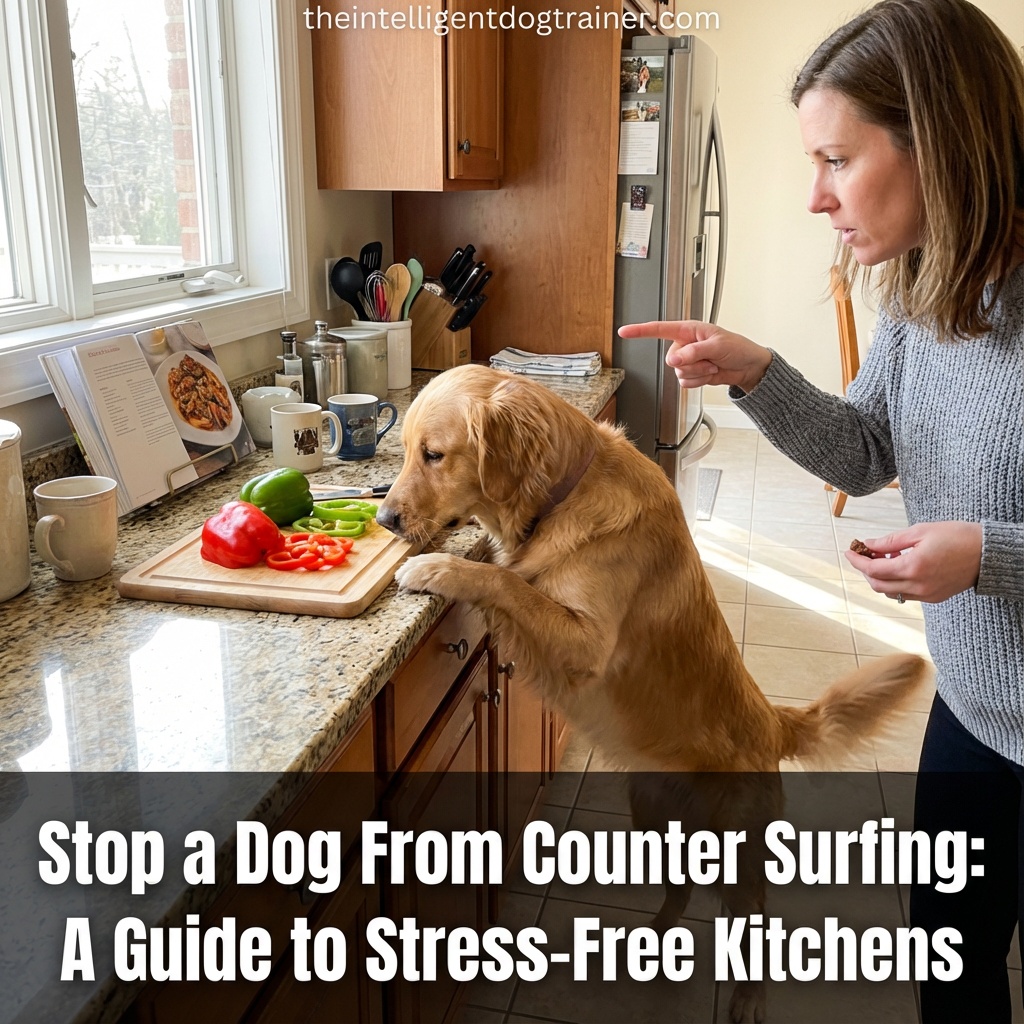
It has happened to almost everyone: you walk into the kitchen only to find that the Thanksgiving turkey has mysteriously vanished or your favorite artisanal sourdough is missing a significant chunk. Living with a “four-legged thief” is undoubtedly one of the more exhausting hurdles of pet parenthood.
However, mastering how to stop a dog from counter surfing is a perfectly reachable goal when you approach it with a little strategy and a lot of consistency. It helps to remember that your dog isn’t acting out of “spite”; they are simply following a deep-seated scavenging instinct.
In this guide, we will explore why this habit forms and provide practical, compassionate ways to help you reclaim your kitchen and keep your pet safe throughout 2025.
Understanding Why Dogs Steal Food From Kitchen Counters
To tackle this issue effectively, we have to look at the world through a dog’s eyes. Many frustrated owners often wonder, “Why does my dog continue to counter surf despite being fed?”
The answer is quite simple: to a dog, food left on a counter is “unclaimed” treasure that provides an immediate, delicious reward. This is a textbook self-reinforcing habit; every successful heist makes the next one more likely.
Furthermore, if you are curious whether there are specific breeds more prone to counter surfing, the reality is that any food-motivated dog with enough reach will eventually take the gamble.
While big breeds like Labradors or Golden Retrievers are famous for their kitchen raids, even a small, determined dog can find a way onto a chair or stool to reach the prize.
This drive is rooted in the basic canine instinct to hunt for high-value calories. The second they snag a morsel, their brain releases a hit of dopamine, effectively making your kitchen counter the most exciting “slot machine” in the house.
Understanding these behavioral reinforcements is the primary step toward using effective dog training techniques that address why they do it, rather than just reacting to what they did.
Once you accept that they are just following their biological code, you can move past the irritation and focus on a plan that shapes their choices through clear, steady boundaries.
Essential Dog Counter Surfing Training and Prevention Tips
The most powerful tool in your kit is positive reinforcement. You might be wondering, what is the best way to reward a dog for staying on the floor?
A great rule of thumb is “Four on the Floor”; make it a point to proactively give your dog high-value treats whenever they are hanging out in the kitchen with all their paws on the ground.
This teaches them that the real “paycheck” comes at floor level, not from the granite above. If you are asking how to correct my dog if I catch them in the act of counter surfing, the best move is a calm, neutral “Oops!” followed by a gentle lure away or a “down” command.
Try to keep your cool, as intensity or loud scolding can sometimes be misinterpreted as a form of exciting attention.
A common question among pet parents is, “How long does it take to train a dog to stop stealing food?” The timeline really comes down to your own consistency.
While some dogs catch on in a few weeks, others might need a few months of dedicated guidance on how to train a dog to ignore their natural impulses.
Success depends on a “zero-win” policy—the dog should never, ever find a reward on the counter. Regarding the frequent concern, “Should I use punishment to stop my dog from jumping on counters?”, the answer is almost always no.
Fear-based tactics often backfire and only teach your dog to become a “ninja” who waits until you leave the room to strike. Instead, focus your efforts on rewarding the behavior you actually want to see.
How to Keep Your Dog Off Kitchen Counters by Managing the Environment
Management is the preventative half of any plan to stop a dog from counter surfing. If the “slot machine” never pays out, the habit will eventually fade away through a process known as extinction.
Historically, this means keeping your surfaces spotless—no crumbs, no chicken defrosting by the sink, and no butter dishes left within reach. You might also wonder if you can train your dog to stay out of the kitchen completely.
Setting up a “place” command or a clear boundary line can be incredibly effective. By teaching your pet to wait and stay behind a specific transition on the floor, you take away their chance to even get near the counters while you are busy cooking.
When searching for what are the most effective methods to stop counter surfing immediately, the most foolproof solution is the use of physical barriers.
Baby gates or exercise pens are the perfect way to keep a persistent scavenger out of the kitchen during busy times, like holiday prep or a dinner party.
Many owners also ask what indoor deterrents work best to keep dogs off counters? While a solid gate is the gold standard, scent-based options like citrus sprays can sometimes discourage a dog from sniffing around.
However, nothing compares to the effectiveness of a clean kitchen and a dog who understands that staying calm on the floor is the only way to get a treat.
Proven Solutions for Dogs Jumping on Tables and High Surfaces
If your pet has started looking at the dining table or coffee table, they are simply chasing the same rewards they found on the kitchen counter.
To prevent dog stealing food off counter or dining areas, you need to apply the “off” command to every surface in the house. If your dog hops up, use a soft “Off” and wait to reward them until they have stayed on the floor for at least several seconds.
If you find you also need to stop a dog from jumping on your guests or furniture, you can use these same redirection techniques.
Proactive training means noticing the dog before they jump and asking for a “sit” or “down” as they approach.
Quite often, table jumping starts because a dog has been “sneaked” scraps during family dinners. To effectively keep dog off kitchen counters and eating areas, everyone in the house has to follow a strict “no feeding from the table” rule.
If you want to share a piece of food, take it to the dog’s bowl or their “place” mat. This breaks the associative learning loop that connects the table with a food source.
By making the table feel “boring” and keeping the floor as the “reward” zone, you will notice a huge drop in your dog’s interest in high surfaces.
Using Tools and Counter Surfing Deterrent Devices Safely
There are plenty of counter surfing deterrent devices on the market, ranging from motion-sensor air canisters to textured mats.
While these can be helpful in the short term, they are best used as temporary aids rather than a permanent solution. Safety is the priority here; make sure any tool you use doesn’t cause your pet extreme fear or panic.
For instance, a “scat mat” or an upside-down hallway runner can make a surface feel a bit odd under their paws without causing pain. These tools can be useful to prevent dog stealing food off counter spaces during those moments when your back is briefly turned.
However, gadgets are never a substitute for real training and interaction. If a dog is scavenging because they are bored or want something to chew on, you might need to look at their overall mental stimulation.
Just as you would help a dog stop chewing on your shoes by providing better toys, you can offer “legal” scent-work games or food puzzles to keep their brain busy.
When a dog’s energy is channeled into approved activities, they are much less likely to go looking for trouble in your kitchen.
Stopping Counter Surfing When You Are Not Home
The trickiest part of the process is stopping counter surfing when not home. Without you there to guide them, the environment has to be entirely foolproof.
This leads many people to ask, “Does crate training help with counter surfing behaviors?” The answer is a clear yes. If your dog isn’t yet ready to be trusted alone in the kitchen, giving them a safe, comfortable space of their own is the smartest move.
Using a crate stops the dog from practicing the habit while you are away, which is essential for long-term progress. If the “theft” never happens, the habit can’t grow.
Learning how to crate train a dog the right way ensures they view their space as a relaxing den rather than a punishment.
If a crate doesn’t fit your lifestyle, use sturdy baby gates to block off the kitchen when you aren’t around. Ultimately, dog counter surfing training is as much about our habits as it is about the dog’s.
By ensuring there are no rewards left out—no bread, no butter, no leftovers—you essentially “retire” the dog from their role as the house scavenger.
Over time, with managed access and rewards for the right choices, your dog will realize that the floor is the only place where good things happen.
To wrap it up, ending the counter surfing habit requires a simple three-part plan: managing the kitchen to stop the rewards, training the dog to enjoy being on the floor, and providing healthy outlets for their instincts.
By keeping clear boundaries and a “no-reward” zone on your counters, you can finally enjoy a calm, stress-free home. It takes a bit of patience, but the result is a well-mannered companion who knows that life’s best prizes are found when all four paws stay firmly on the ground.