
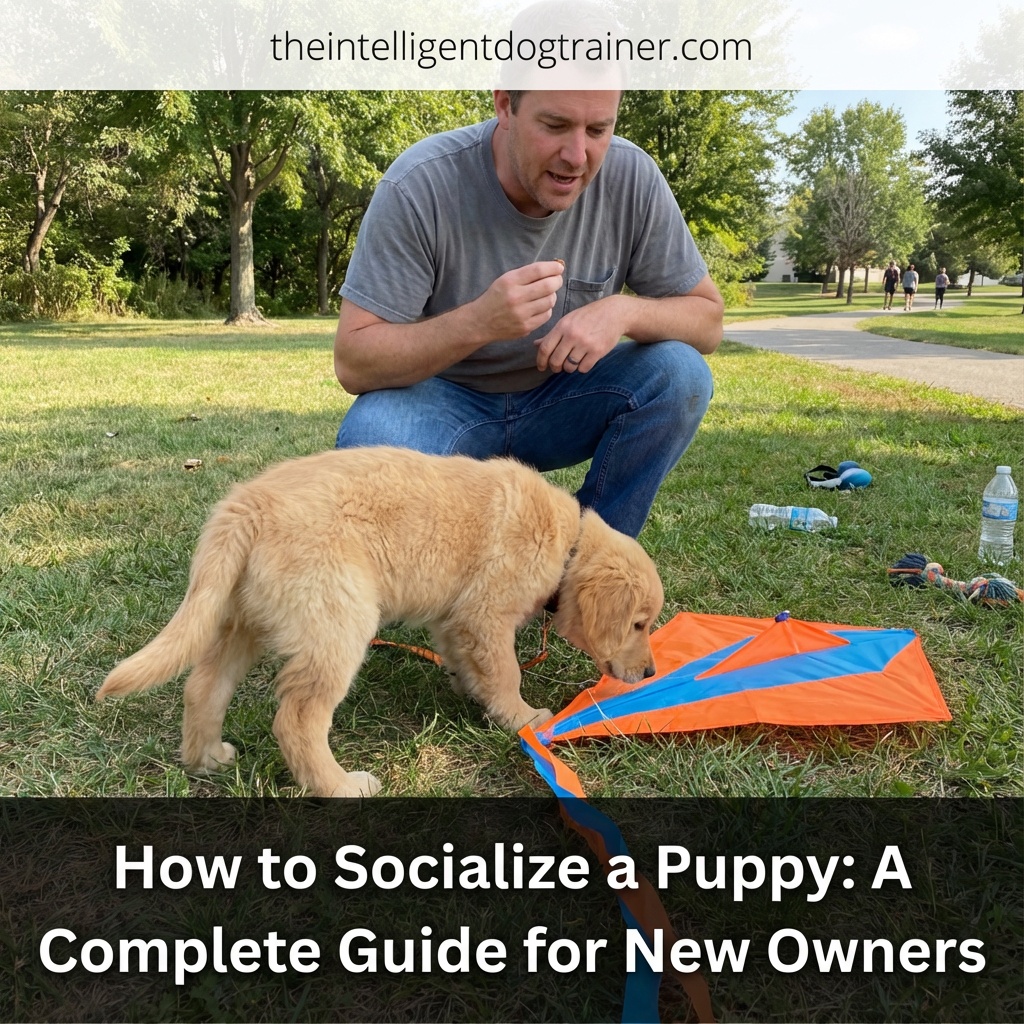
Bringing a new four-legged member into your home is easily one of life’s most joyful milestones, but it comes with a responsibility that goes far deeper than providing full bowls and warm beds: you are effectively the architect of their future personality. If you want to raise a companion who moves through life with confidence and joy, understanding how to socialize a puppy is not just optional—it is essential.
True socialization is about much more than arranging playdates with other dogs; it requires a thoughtful, curated introduction to the sights, sounds, and scents of our chaotic world, all framed within positive experiences. A dog who misses out on these early lessons often matures into an anxious or reactive adult, turning what should be peaceful walks into stressful ordeals.
by committing to a structured and empathetic approach now, you empower your new best friend to navigate complex human environments with ease and assurance later.
Understanding the Critical Puppy Socialization Window
For new guardians navigating a sea of advice, one logistical question usually stands out: When is the best age to start socializing a puppy? The answer is prompt and specific.
Ethologists have pinpointed a prime developmental phase, famously called the puppy socialization window, which generally remains open from three weeks of age until roughly fourteen weeks. During this brief but incredibly potent interval, your puppy’s brain acts like a sponge, absorbing and retaining new experiences with remarkable efficiency. This touches on the golden era for building a foundation of trust before fear has a chance to take root.
Naturally, many owners worry about the timeline, often wondering, “What happens if I miss the puppy socialization window?” While this specific period offers the smoothest path for learning, it is not a door that locks shut forever. missing it simply means that future learning may require more time and a significantly deeper reserve of patience.
Furthermore, if you are bringing a senior animal into your life, you might ask, “Is it too late to socialize an older dog?” You can rest assured that the answer is no. We cannot rewrite their history, but we can absolutely reshape their future through targeted remedial socialization and careful counter-conditioning.
To set your dog up for a lifetime of stability, you should view socialization as a central pillar of their education. Weaving these formative experiences together with comprehensive dog training guides ensures your puppy learns not only to be social but to look to you as a benevolent guide in every scenario.
Socializing a Puppy Before Vaccinations Safely
A major dilemma for owners in 2025 is the tension between behavioral development and medical safety: How can I safely socialize my puppy before they are fully vaccinated? This is a valid fear, considering that illnesses like Canine parvovirus are severe and often life-threatening.
However, keeping a puppy in a sterile bubble until sixteen weeks can have disastrous consequences for their temperament. The solution lies in calculated, low-risk exposure rather than total isolation, meaning you should strictly avoid high-traffic zones frequented by dogs of unknown health status.
A common follow-up question is, Can I take my puppy to the dog park for socialization? The answer here is a hard, unequivocal no until full immunity is established. Dog parks act as petri dishes for viruses and parasites.
A much safer alternative is to invite healthy, vaccinated adult dogs to your home, or to carry your puppy in a sling or backpack through busy environments. This strategy allows them to absorb the auditory and olfactory richness of the world without their paws ever touching potentially contaminated ground.
Management is the cornerstone of this biological balancing act. When you cannot actively supervise these exposure sessions, or when transport to a new location is required, employing effective crate training methods provides a secure sanctuary. This prevents accidental wandering into unsafe territory while still permitting them to observe their surroundings from a place of safety.
Your Essential Puppy Socialization Checklist and Tips
To navigate this process effectively, it is wise to rely on a puppy socialization checklist to ensure no stone is left unturned. You provide the best foundation by systematically introducing your dog to a variety of stimuli.
When you consider What are the most important things to expose my puppy to?, think in clear categories like texture, humanity, and noise. Your itinerary should include walking on diverse surfaces like cool tile, prickly grass, and shifting gravel; meeting a wide spectrum of humans including men, women, children, and people wearing hats or uniforms; and listening to the urban symphony of traffic, vacuum cleaners, and distant thunder.
You should also never overlook the training potential of your own living room. Can I socialize my puppy inside the house? Absolutely, and you should. Indoor socialization is critical for domestic harmony.
Open umbrellas suddenly, run the blender, or drop a heavy book to gauge their response. The objective is to teach them that sudden environmental changes are benign. Always pair these potentially startling moments with high-value treats to forge a positive neural pathway.
However, amidst these sessions, puppies can easily become overstimulated. If your puppy begins nipping at hands or grabbing pant legs during exposure, they aren’t being “naughty”—they are communicating that they are overwhelmed. Recognizing and managing arousal levels is vital, and mastering techniques for preventing puppy biting will help keep these interactions constructive and pain-free for all parties.
Practical Puppy Socialization Exercises for Success
Socialization is an active verb, yet it demands structure. implementing specific puppy socialization exercises systematically builds courage.
A highly effective technique is “The Treat Retreat,” where you toss treats behind the puppy when a trigger, such as a stranger, appears. This clever mechanic encourages the dog to retreat to eat, simultaneously removing social pressure while associating the stranger’s presence with a culinary reward.
Regarding frequency, owners often ask: How often should I work on socialization exercises? Brevity is your friend here; aim for frequent sessions of just five to ten minutes throughout the day.
Your primary job is to remain vigilant regarding their emotional state. What are the signs that my puppy is overwhelmed? Look for subtle displacement behaviors such as lip licking, yawning, tail tucking, or averting their gaze. If these signals appear, stop immediately and create distance from the stimulus.
Physical handling is another pillar of socialization often missed until it is too late. Regularly touch your puppy’s paws, inspect their ears, and handle their mouth to normalize the sensations they will encounter during veterinary exams.
Eventually, these skills must translate to the outside world. proficiency in training a dog to walk on a leash gives you the control necessary to manage outdoor socialization walks, ensuring your puppy remains close and secure while investigating the neighborhood.
Introducing Your Puppy to Older Dogs and New Pets
Integrating a boisterous puppy into a household with resident pets, or introducing them to friends’ dogs, is a delicate diplomatic mission. When introducing puppy to older dogs, neutral territory is your greatest ally. Opt for a parallel walk—moving both dogs in the same direction with a comfortable buffer of distance—rather than a direct face-to-face greeting, which can feel confrontational and rude to a senior canine.
Older dogs frequently find the chaotic energy of a puppy intrusive. It is imperative to respect your senior dog’s boundaries and ensure the puppy does not harass them.
As noted in the field of ethology, dogs are in a constant state of communication via body language; if your older dog growls, they are setting a necessary boundary. Monitor these dialogues closely.
A specific behavior that often derails introductions is the puppy’s tendency to launch themselves at another dog’s face. This lack of etiquette can swiftly trigger a skirmish. Instilling impulse control in your new family member is essential; specifically, knowing the methods for stopping a dog from jumping ensures greetings remain polite, sparing the older dog the need to “correct” the puppy with aggression.
How to Socialize a Fearful Puppy with Patience
Occasionally, due to genetics or unknown past trauma, we find ourselves researching how to socialize a fearful puppy. If your companion is naturally timid, the traditional “sink or swim” immersion will only exacerbate the issue.
How do I socialize a puppy that is scared of strangers? The answer lies in desensitization and counter-conditioning. This involves exposing the dog to the source of their fear—such as a stranger—at a distance where they notice it but remain under threshold, all while feeding them high-value rewards.
Never force a fearful puppy to endure petting or interaction with someone they fear. Such coercion destroys trust and can precipitate defensive aggression. Be their staunchest advocate.
Inform strangers, “He is in training, please ignore him.” Allow the puppy the agency to approach only if and when they feel secure.
If ignored, fear rarely resolves itself; it evolves into reactivity. It is crucial to understand that a growling puppy isn’t being “mean”—they are terrified. Addressing these fears early creates a stable adult, whereas negligence can lead to dangerous behavioral pathologies.
If you are struggling with a puppy that lunges or snaps, consulting resources on training an aggressive dog can provide the advanced strategies needed to transmute that fear into confidence before it calcifies into a permanent issue.
Conclusion
Mastering how to socialize a puppy is an investment that pays dividends for the next decade and a half of your shared life. It is a process demanding patience, consistency, and a keen observational eye for canine body language.
By honoring the critical socialization window, balancing health safety with exposure, and utilizing positive reinforcement, you are molding a dog that feels comfortable in their own skin. Remember that socialization is not merely about meeting other dogs; it is about teaching your puppy that the world is a safe, benevolent place.
Take it slow, keep the experiences positive, and enjoy watching your timid puppy blossom into a confident, steadfast companion.